VortexLattice
- 140
- 0
So, I'm trying this problem and just want to make sure my attack is correct. We have an infinitely long cylindrical hole in an infinitely long cylindrical wire, like in this picture:
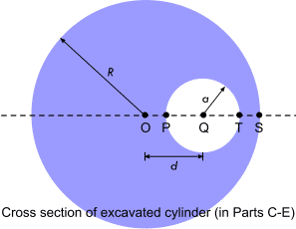
(Here, they call the radius of the hole 'a'. I'm going to call it r.)
There's an electric current I in the wire and the current density is uniform. I want to find the B field anywhere in the cavity. First, I find J, the current density:
[itex]J = \frac{I}{\pi (R^2 - r^2)}[/itex]
So, the step I'm most worried about is this: I want to find the vector potential A in the hole, but it's pretty hard to integrate around a hole. So I'm going to find the vector potential due to the whole cylinder (as if there were no hole), and then the vector potential due to a current of the same density going through the hole, and then subtract the latter from the former (because it's just a superposition, like electric potential, right?).
I'm doing this in polar coordinates, where the z axis goes along the center of the wire. So, typically you have to integrate over a volume to get A, but we don't actually care about the z direction here, so we just integrate it from 0 to z, and it should cancel out at the end:
[itex]\vec{A}(\vec{x}) = Jz \int_0^R r'dr' \int_0^{2\pi} d\phi' \frac{1}{\left|\vec{x} - \vec{x'}\right|}[/itex]
So, I say that our observation point [itex]\vec{x}[/itex] is (x,0,z), and the point [itex]\vec{x'}[/itex] we're integrating at is (x',y',z). Then, in polar coordinates, we have [itex]\vec{x'} = (r'cos(\phi'),r'sin(\phi'),z)[/itex]. Plugging this in, I get:
[itex]\vec{A}(\vec{x}) = Jz \int_0^R r'dr' \int_0^{2\pi} d\phi' \frac{1}{\sqrt{(x - r'cos(\phi'))^2 + (r'sin(\phi'))^2}} = Jz \int_0^R r'dr' \int_0^{2\pi} d\phi' \frac{1}{\sqrt{x^2 -2xr'cos(\phi') + r'^2}}[/itex]
Now, I integrate. I actually first integrate over r'. I do a kind of completing the square thing in the denominator, and then integrate:
[itex]\vec{A}(\vec{x}) = Jz \int_0^R r'dr' \int_0^{2\pi} d\phi' \frac{1}{\sqrt{(r' - cos(\phi'))^2 + x^2sin^2(\phi')}}[/itex]
I integrated this in wolfram, and it simplifies a little. But now I have to integrate over phi, and it gives me an elliptic integral of the first kind. Academia has ruined me so I get afraid when an answer doesn't boil down to three terms or less, so I'm just wondering if this seems right or not.
Also, is my general idea a good one or is there a much easier way?
Thanks!
(Here, they call the radius of the hole 'a'. I'm going to call it r.)
There's an electric current I in the wire and the current density is uniform. I want to find the B field anywhere in the cavity. First, I find J, the current density:
[itex]J = \frac{I}{\pi (R^2 - r^2)}[/itex]
So, the step I'm most worried about is this: I want to find the vector potential A in the hole, but it's pretty hard to integrate around a hole. So I'm going to find the vector potential due to the whole cylinder (as if there were no hole), and then the vector potential due to a current of the same density going through the hole, and then subtract the latter from the former (because it's just a superposition, like electric potential, right?).
I'm doing this in polar coordinates, where the z axis goes along the center of the wire. So, typically you have to integrate over a volume to get A, but we don't actually care about the z direction here, so we just integrate it from 0 to z, and it should cancel out at the end:
[itex]\vec{A}(\vec{x}) = Jz \int_0^R r'dr' \int_0^{2\pi} d\phi' \frac{1}{\left|\vec{x} - \vec{x'}\right|}[/itex]
So, I say that our observation point [itex]\vec{x}[/itex] is (x,0,z), and the point [itex]\vec{x'}[/itex] we're integrating at is (x',y',z). Then, in polar coordinates, we have [itex]\vec{x'} = (r'cos(\phi'),r'sin(\phi'),z)[/itex]. Plugging this in, I get:
[itex]\vec{A}(\vec{x}) = Jz \int_0^R r'dr' \int_0^{2\pi} d\phi' \frac{1}{\sqrt{(x - r'cos(\phi'))^2 + (r'sin(\phi'))^2}} = Jz \int_0^R r'dr' \int_0^{2\pi} d\phi' \frac{1}{\sqrt{x^2 -2xr'cos(\phi') + r'^2}}[/itex]
Now, I integrate. I actually first integrate over r'. I do a kind of completing the square thing in the denominator, and then integrate:
[itex]\vec{A}(\vec{x}) = Jz \int_0^R r'dr' \int_0^{2\pi} d\phi' \frac{1}{\sqrt{(r' - cos(\phi'))^2 + x^2sin^2(\phi')}}[/itex]
I integrated this in wolfram, and it simplifies a little. But now I have to integrate over phi, and it gives me an elliptic integral of the first kind. Academia has ruined me so I get afraid when an answer doesn't boil down to three terms or less, so I'm just wondering if this seems right or not.
Also, is my general idea a good one or is there a much easier way?
Thanks!