Finding the center of an n-gon (circle) based on angle and side-length

  • Context: Undergrad 
  • Thread starter Thread starter STENDEC
  • Start date Start date
  • Tags Tags
    Angle Center Circle
Click For Summary

Discussion Overview

The discussion revolves around finding the center of an n-gon (or circle) based on the angle and side length. Participants explore geometric relationships and trigonometric principles to derive a method for calculating the center's position in a coordinate system.

Discussion Character

  • Exploratory
  • Mathematical reasoning

Main Points Raised

  • One participant expresses difficulty in determining the center of an n-gon, noting that the current setup results in the circle touching the origin (0,0) and the center being offset along the y-axis.
  • Another participant suggests using similar triangles and trigonometry to find the radius along the y-axis, proposing a method involving a perpendicular bisector from the n-gon side intersecting the y-axis.
  • A later reply elaborates on the calculation of the inner angle of the isosceles triangle formed by the n-gon sides, leading to a formula for the distance to the center point using tangent functions.
  • Participants discuss the conversion of angles from degrees to radians as part of the calculations.

Areas of Agreement / Disagreement

There is no explicit consensus on a single method, but participants build upon each other's ideas and calculations, indicating a collaborative exploration of the problem.

Contextual Notes

Participants reference geometric principles and trigonometric functions without resolving all assumptions or potential limitations in their approaches.

STENDEC
Messages
21
Reaction score
0
I hope this is self-evident to someone, I'm struggling.

I have a program that draws circles (n-gons really) of various sizes, but by translating-rotating-translating-rotating-..., not by x=sin/y=cos. That works as intended, but my wish is to offset the circle so that its center is (0,0) in the coordinate system. For that i need its center. Currently the circle itself originates from- and hence touches the (0,0) coordinates, so its center is somewhere above, in the y-axis.
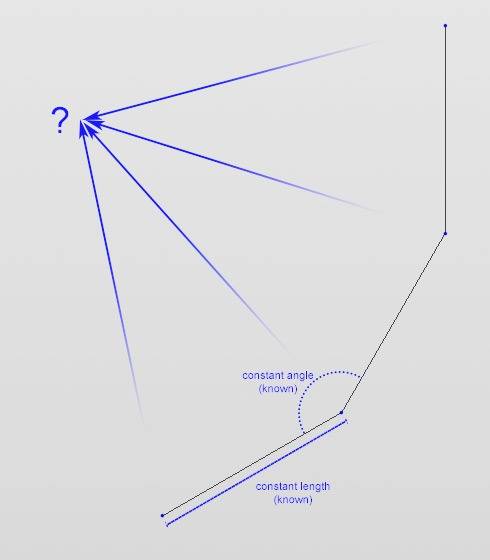
dsrd0.jpg


Position of ? is sought after. A wider angle would result in ? rising for instance.

I found lots of tutorials on how to do it on paper using dividers and i also considered that it's a isosceles triangle, but it seems all textbook examples assume that one of the symmetric sides is already known.
 
Mathematics news on Phys.org
you could use similar triangles and some trig to get the radius along the y-axis.

Notice you can extend a perpendicular bisector from the first n-gon side which intersects the y-axis

so that 1/2 the n-gon side is the short edge the perpendicular creates the right angle and the y-axis is the hypotenuse.

This triangle is similar to the one formed by the n-gon edge and the x-axis.

So I get something like:

radius along y-axis = (1/2 n-gon side) / sin theta
 
Last edited:
jedishrfu said:
you could use similar triangles and some trig to get the radius along the y-axis.
Yes, you're right. After some more reading and pondering i came to this solution:

\alpha = angle in degrees
s = segment length

To get the inner angle between the sides, we subtract from a half-circle. We then divide by two, to get the inner angle of the isosceles triangle:
\beta = (180 - \alpha) \div 2

degrees to radians:
\phi = \beta\times\frac\pi{180}

Distance to center point can then be gotten from s\div 2 * tan(\phi).

Edit: Just saw you extended your reply, oh well :)
 
STENDEC said:
Yes, you're right. After some more reading and pondering i came to this solution:

\alpha = angle in degrees
s = segment length

To get the inner angle between the sides, we subtract from a half-circle. We then divide by two, to get the inner angle of the isosceles triangle:
\beta = (180 - \alpha) \div 2

degrees to radians:
\phi = \beta\times\frac\pi{180}

Distance to center point can then be gotten from s\div 2 * tan(\phi).

Edit: Just saw you extended your reply, oh well :)

Glad you figured it out.
 

Similar threads

  • · Replies 4 ·
Replies
4
Views
2K
  • · Replies 2 ·
Replies
2
Views
2K
  • · Replies 1 ·
Replies
1
Views
2K
  • · Replies 7 ·
Replies
7
Views
8K
Replies
8
Views
3K
  • · Replies 2 ·
Replies
2
Views
4K
  • · Replies 2 ·
Replies
2
Views
2K
  • · Replies 7 ·
Replies
7
Views
3K
  • · Replies 20 ·
Replies
20
Views
4K
  • · Replies 8 ·
Replies
8
Views
3K