Finding the Coefficient of Drag for Partial Parachutes

Click For Summary

Discussion Overview

The discussion revolves around calculating the coefficient of drag for parachutes during various stages of deployment, particularly focusing on the transition phase between partial and full deployment. Participants explore theoretical approaches, empirical methods, and computational fluid dynamics (CFD) as potential solutions to model the drag forces acting on parachutes in a rocket recovery system.

Discussion Character

  • Exploratory
  • Technical explanation
  • Debate/contested
  • Mathematical reasoning
  • Experimental/applied

Main Points Raised

  • David seeks to calculate the force acting on parachutes during the intermediary phase of deployment and asks for equations to determine the drag coefficient without experimental data.
  • Some participants suggest that calculating a drag coefficient is typically empirical and may require experiments or sophisticated CFD, rather than theoretical calculations alone.
  • Concerns are raised about the drag characteristics changing rapidly as the parachute inflates and the implications of tension in the shrouds during deployment.
  • One participant mentions the potential risks of deploying a parachute at high speeds and the need to consider wind conditions and safety factors in calculations.
  • Another participant shares their experience with theoretical aerodynamics and the challenges faced in applying theoretical models to practical scenarios.
  • Specific drag force and effective drag coefficient values are mentioned, but the context of these calculations remains unclear.
  • Historical context is provided regarding the Apollo missions and the considerations for parachute deployment in varying wind conditions.
  • A question is raised about the significance of wind speed on parachute deployment, particularly at high velocities like those experienced during Apollo missions.

Areas of Agreement / Disagreement

Participants express a range of views on the feasibility of calculating drag coefficients theoretically, with some emphasizing the necessity of empirical data and others discussing the complexities involved in the deployment process. There is no consensus on a single method or approach to accurately determine the drag coefficient for parachutes in this context.

Contextual Notes

The discussion highlights limitations in theoretical modeling, the dependence on empirical data, and the unresolved complexities of parachute dynamics during deployment phases. Specific mathematical steps and assumptions are not fully articulated.

Who May Find This Useful

Individuals involved in aerospace engineering, rocket recovery systems, parachute design, and those interested in fluid dynamics and aerodynamics may find this discussion relevant.

David Bloom
Hey Guys,

I'm on a rocket team at my university and we are attempting to figure out the force of opening acting on some of our parachutes. Typically this is done using the following equations, in particular, the one in the top right corner.
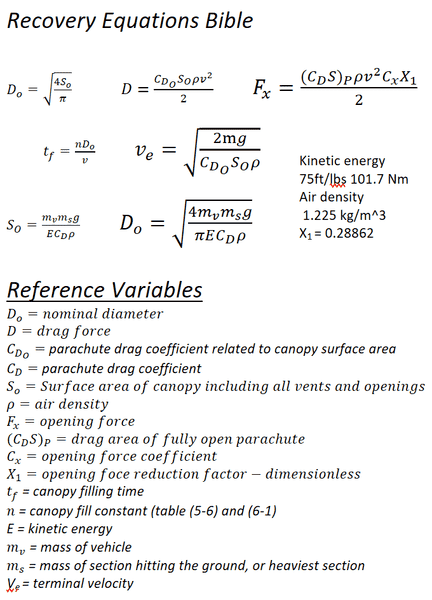
680x944.png.456c63b7df0245d3ab1a56893577579c.png


This is where our trouble begins. In the Recovery Systems Design manual, it describes the force acting on the parachute as a function of time in this graph...

gtGDWG


Obviously, the force at partial deployment is much greater than the force for full deployment as that partial deployment "steals" much of the kinetic energy from the full deployment. So...our issue is this.

We need to calculate the force acting on our parachute/rocket while it is in that intermediary phase between apogee and full deployment. (Ideally there would be a way of modeling the differential equation behind this interaction we could calculate it for ANY stage of deployment.)

Which brings us to the final question: How can we calculate the coefficient of drag of the parachute during those different stages of inflation without doing it experimentally? Are there equations out there for this idea?

Thanks,
David
 
Physics news on Phys.org
In most cases you can't simply calculate a drag coefficient. The drag coefficient is essentially an empirically-derived proportionality constant between the drag force and the area and dynamic pressure. You will either need to do experiments, some fairly sophisticated CFD, or else just guess based on other data.
 
Dear Dr. Strangelove,

What software would you suggest I do that CFD on? I know a lot of rocket teams use CAD's extension, but I've heard it is very inaccurate. I have also considered ANSYS, but I'm not sure if that is too advanced for my needs.

Any suggestions?
 
"CAD" isn't a single program. It is a type of program. Many of them do have some basic fluids ability but it is usually relatively rudimentary. ANSYS has a few products like CFX and Fluent, the latter of which I know is popular and pretty powerful. That said, I am not a CFD expert and won't pretend to be able to tell you about the pros and cons of each.
 
I see a couple of problems.
Firstly; as the parachute begins to open and fill, it will progressively inflate and so wrap itself around a parcel of air. During that filling process it will have minimal drag.

Secondly; once the canopy has filled, tension will appear in the surface, that tension must be transferred between the canopy and the load, through the shrouds. The distinctive sound as a canopy is filled demonstrates that sudden transition. The design will need to consider the elasticity of the shrouds and the speed of sound in the shrouds. Which direction(s) will that tension wave travel?

Will the initial deployed canopy be a full circular outline surface or will it be a skeletal drogue, designed to slow a supersonic load prior to a full canopy opening?

What happens if the parachute is accidentally deployed during a high speed phase of the flight?
 
I agree with Strangelove. The CD will be changing rapidly as the size of the chute changes and it depends on how evenly the chute deploys.

I found old textbooks about sailing with equations on how to calculate lift and drag, the drag equation looked similar to yours but ended up not working out well for me. How old is your recovery systems book?

Without doing testing you're entering the very scary world of theoretical aerodynamics. I don't know if CFD is based on theoretical or experimental data (I'm guessing it's a healthy mix).

I like what you're doing and trying to do. I have an undergraduate research project dealing with aerodynamics on a theoretical level and it's proving to be quite difficult.
 
Maybe I should just change my username to Strangelove.
 
  • Like
Likes   Reactions: SeattleDrew
As an old paratrooper and Jumpmaster, as well as Air Movement Officer in charge of my Airborne Infantry company’s heavy drop toys ( mortars, Jeeps etc..) during many rapid deployment exercise

Your drag calcs are a good learning exercise but not practical if this is only data used.

Say you come up with the drag calculation and implement it. I give you a 20% success rateReason – for a successful airborne operations you got to know wind speed for AGL deployment. That is Above Ground Level.

Your chute can get shredded if you add in another 30 to 60 knot wind speed.

Also, not having a static line to pull out the deployment bag means you have to use an air brake to do this. Air brake being a smaller Drouge chute to pull the deployment bag out of the chute package, extend the shroud lines and provide time for the main chute to properly deploy without twisting the shroud lines and causing a partial malfunction..

Not going to do any good if the drouge chute is shredded due to wind speed. Total Malfunction. StreamerWind speed is never constant and you can measure it before launch but a guarantee you it will change by deployment time.
Also the air density will increase after apogee since you are in free fall. velocity will increase too but am sure you know this.

You have to set maximum limits on the wind speed for deployment, calculate this into the equation as worst case to find shear and add in at least 10% safety factor. Then you can get approximation of deployment drag and deployment time AT Worst Case scenario.
Just more to think about but I like your work so far.
 
Last edited:
post-processor-screenshot 0.4 m 33 m p second turbulent.png


0.4 m skirt diameter .
33 m/s

From results : Drag force = 126 N and effective Cd = 1.6
 
  • #10
Ranger Mike said:
Your chute can get shredded if you add in another 30 to 60 knot wind speed.

This was one consideration when choosing the splash down location to be used for the returning Apollo missions . There was a first choice location but several other locations were always kept available for emergencies . The wind speed and other weather conditions were monitored continuously at each location .
 
  • #11
Was wind that much a factor for parachute deployment, considering Apollo could be traveling at about 0.7 ( high value )Mach for drogue chute deployment., with altitude and air density adjustment, about 460 mph.
 

Similar threads

  • · Replies 26 ·
Replies
26
Views
14K
  • · Replies 17 ·
Replies
17
Views
9K
  • · Replies 1 ·
Replies
1
Views
1K
  • · Replies 1 ·
Replies
1
Views
2K
  • · Replies 5 ·
Replies
5
Views
2K
  • · Replies 2 ·
Replies
2
Views
10K
Replies
3
Views
5K
  • · Replies 3 ·
Replies
3
Views
5K
  • · Replies 17 ·
Replies
17
Views
4K
  • · Replies 4 ·
Replies
4
Views
3K