: Finding the Current and Power across each Resistor in a Complicated Network

Click For Summary
The discussion focuses on solving a circuit problem involving a 12 V battery connected to a complex resistor network. The equivalent resistance is calculated as 6 ohms, leading to a total current of 2 A and total power dissipation of 24 Watts. Participants discuss how to find the current through each individual resistor, emphasizing the importance of understanding series and parallel configurations. The confusion arises regarding the distribution of voltage and current across the resistors, particularly in the top part of the circuit. Overall, a systematic approach of redrawing the circuit and applying Ohm's law is recommended for clarity in solving such problems.
sweetdion
Messages
64
Reaction score
0
URGENT: Finding the Current and Power across each Resistor in a Complicated Network

Homework Statement


For the circuit below, a 12 V batter is connected across the points a and b. Determine the following:

a) the equivalent resistance between points a and b
b) the total current flowing through the resistor network
c) the total power dissipated by the resistor network
d) the current through each individual resistor and the power dissipated by each resistor. Sum up the power dissipation from each and compare that sum to your result from c. Is this what you expect?
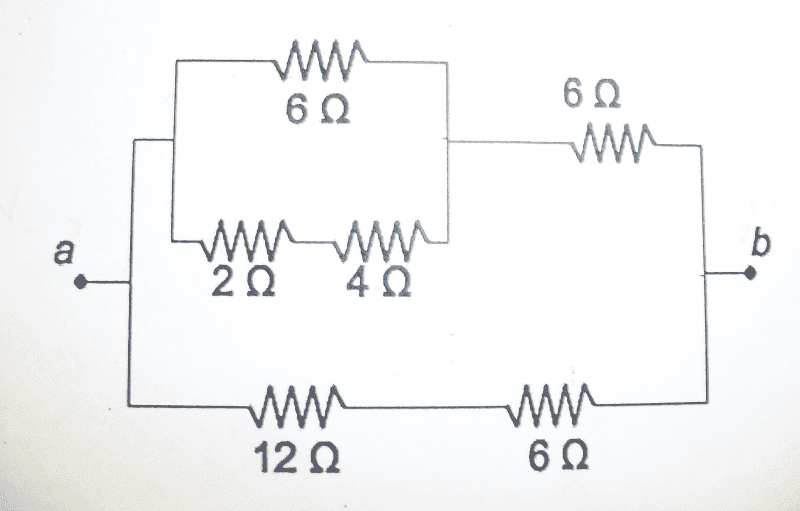
pp2.png


Homework Equations


series: Req=R1+R2+...
parallel: 1/Req=1/R1+1/R2+...
I=V/R
P=I^2R


The Attempt at a Solution


a) I know how to do this part. I get 6 ohms.
b) using I=V/R=12/6=2A
c) P=I^2R=2^2*6=24 Watts
d) I have no idea how to do this part. How does the Voltage split up? Does 6V go into the top part then the 6 splits into 3 for each part within the part? Then combine to form 6 again once it comes out the square in the top part?
 
Physics news on Phys.org


There's 12 across the top part and 12 V across the bottom part as well.
Find the equivalent resistance of the top and the bottom part and then
calculate the currents through both parts.


for top Req=9 ohms
bottom Req=18 ohms

top (using V=IR) I=12/9=4/3 Amps
bottom I=18/9=2 Amps

now how do i find the currents in each resistor?


the best way to do a problem like this is to add up all the resistors and redraw the circuit each time you combined two resistors. This way, once you have the final resistance, you can find the total current, total voltage, total power, etc. then you can work your way backwards by using the circuits you drew.

Remember that current is the same for resistors in series and voltage is the same for resistors in parallel

know your concepts, it will make problems like these 100% easier.


johnnyies said:
the best way to do a problem like this is to add up all the resistors and redraw the circuit each time you combined two resistors. This way, once you have the final resistance, you can find the total current, total voltage, total power, etc. then you can work your way backwards by using the circuits you drew.

Remember that current is the same for resistors in series and voltage is the same for resistors in parallel

know your concepts, it will make problems like these 100% easier.

I did as you suggested. The only part that's confusing me is the box on the top part of the circuit. with the 6, 2, and 4 ohm resistors. Since they are in parallel, the top and bottom both have 12 Volts going through them. So (using V=IR) does that mean there are 2 Amps going through the 6 ohm resistor. And 6 and 3 amps going through the 2 and 4 ohm resistors respectively?
 
The book claims the answer is that all the magnitudes are the same because "the gravitational force on the penguin is the same". I'm having trouble understanding this. I thought the buoyant force was equal to the weight of the fluid displaced. Weight depends on mass which depends on density. Therefore, due to the differing densities the buoyant force will be different in each case? Is this incorrect?

Similar threads

  • · Replies 1 ·
Replies
1
Views
2K
Replies
2
Views
920
  • · Replies 4 ·
Replies
4
Views
2K
Replies
22
Views
4K
  • · Replies 4 ·
Replies
4
Views
2K
  • · Replies 1 ·
Replies
1
Views
2K
  • · Replies 1 ·
Replies
1
Views
1K
  • · Replies 3 ·
Replies
3
Views
1K
  • · Replies 3 ·
Replies
3
Views
2K
  • · Replies 1 ·
Replies
1
Views
1K