Finding the directional derivative

Click For Summary
SUMMARY

The discussion centers on calculating the directional derivative of the function ##V^2##, where ##\vec V = \hat ixy^2 + \hat jzy^2 + \hat kxz^2##, at the point (2,0,3) in the direction of the outward normal to the sphere defined by ##x^2+y^2+z^2=14## at the point (3,4,0). The original poster calculated a directional derivative of 194.4, while the correct answer is 540. Key mistakes identified include using the incorrect point on the sphere and potential typographical errors in the problem statement regarding the sphere's equation.

PREREQUISITES
  • Understanding of directional derivatives and gradients in multivariable calculus.
  • Familiarity with vector notation and operations, particularly in three-dimensional space.
  • Knowledge of spherical coordinates and equations of spheres.
  • Ability to compute the gradient of a scalar function.
NEXT STEPS
  • Review the concept of directional derivatives and their calculation using gradients.
  • Learn about the properties of spheres and how to derive their normal vectors.
  • Study the implications of point locations relative to geometric shapes in multivariable calculus.
  • Explore common pitfalls in problem statements and how to identify typographical errors in mathematical contexts.
USEFUL FOR

Students and educators in multivariable calculus, mathematicians working with vector calculus, and anyone involved in solving complex mathematical problems involving directional derivatives and gradients.
Saptarshi Sarkar
Messages
98
Reaction score
13
Homework Statement
Find the directional derivative of ##V^2## where ##\vec V = \hat ixy^2 + \hat jzy^2 + \hat kxz^2## at the point (2,0,3), in the direction of the outward normal to the sphere ##x^2+y^2+z^2=14## at the point (3,4,0).
Relevant Equations
Directional Derivative = ##\nabla f.\hat n##
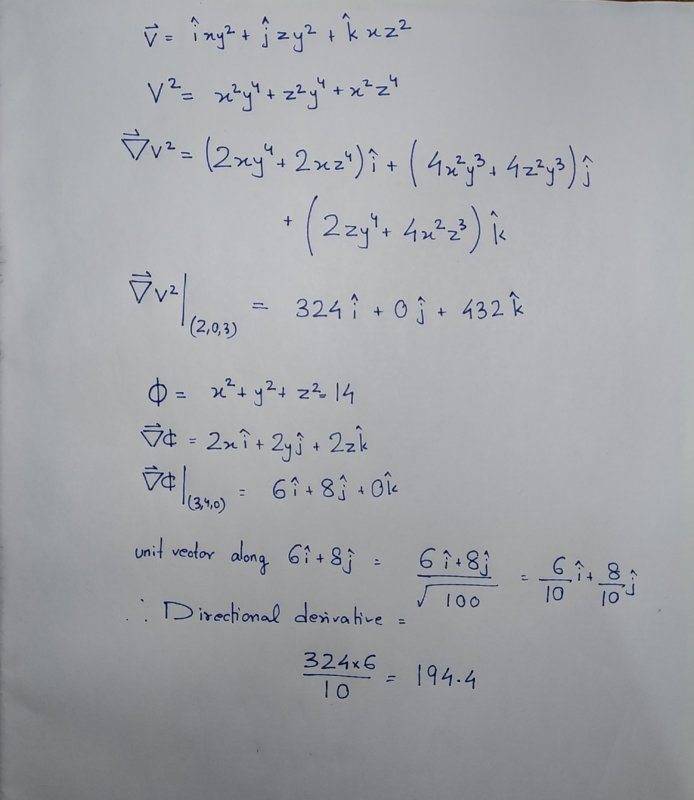
I tried to calculate the directional derivative but the answer that I found was 194.4 but the answer marked in the book was 540. I tried a lot but couldn't understand what my mistake was.
Please let me know what mistake I did.

IMG_20200131_233638.jpg
 
Physics news on Phys.org
Is this the exact problem formulation?
 
Orodruin said:
Is this the exact problem formulation?

Yes

Screenshot_20200201-005036~2.png
 
Saptarshi Sarkar said:
Homework Statement:: Find the directional derivative of ##V^2## where ##\vec V = \hat ixy^2 + \hat jzy^2 + \hat kxz^2## at the point (2,0,3), in the direction of the outward normal to the sphere ##x^2+y^2+z^2=14## at the point (3,4,0).
Relevant Equations:: Directional Derivative = ##\nabla f.\hat n##

I tried to calculate the directional derivative but the answer that I found was 194.4 but the answer marked in the book was 540. I tried a lot but couldn't understand what my mistake was.
Please let me know what mistake I did.

View attachment 256393
Your solution looks good.

Notice what you obtain if you use (3, 0, 4) instead of the point (3, 4, 0) .

People working out answer keys have been known to make mistakes.
 
  • Like
Likes PeroK, jim mcnamara and Saptarshi Sarkar
Saptarshi Sarkar said:

There's a peculiar randomness to this question. Note that the outward normal to a sphere (centred at the origin) is in the direction ##\hat r##. So, you could just write down the normal in this case: ##(\frac 3 5, \frac 4 5, 0)##, or otherwise.
 
  • Informative
Likes Saptarshi Sarkar
I'm a bit puzzled by the problem statement too, because ##(3,4,0)## isn't on the sphere ##x^2+y^2+z^2=14##... Could it be that the author wanted to consider the sphere ##x^2+y^2+z^2=25##?
 
  • Wow
  • Like
Likes SammyS, PeroK and Saptarshi Sarkar
vanhees71 said:
I'm a bit puzzled by the problem statement too, because ##(3,4,0)## isn't on the sphere ##x^2+y^2+z^2=14##... Could it be that the author wanted to consider the sphere ##x^2+y^2+z^2=25##?

It's very much possible. But even if (3,4,0) is not on the sphere, I can draw a normal to that point from the sphere's centre. But, most sphere equations that I see have a squared term on the RHS, so I think it was a typing mistake there.
 
The question is a normal to what? You need a surface to define a unit normal vector (in 3D) (up to a sign of course).
 
  • Like
Likes Saptarshi Sarkar
Another thing to consider:

As O.P. determined, the gradient of V2 at the point (2, 0, 3) is:
##\displaystyle \left. \vec{\nabla} V^2 \right|_{(2,\ 0,\ 3)} = 324 \hat{i} + 0 \hat{j} + 432 \hat{k} ##

Now notice that the magnitude of that is 540 .

Added in Edit:
After reading the next post (#10, from @vanhees71 ) in this thread: I suppose that I should have been more complete in this post.

The thing to notice here is that the magnitude of gradient (the maximum directional derivative) is 540.

I was not trying to find the directional derivative along any normal to any surface.
 
Last edited:
  • #10
Yes, but that's not a normal vector on the surface of the given sphere, because the point ##(2,0,3)## is not located at that sphere!
 
  • #11
vanhees71 said:
Yes, but that's not a normal vector on the surface of the given sphere, because the point ##(2,0,3)## is not located at that sphere!

These questions that the OP finds are often like this. First, there are two mistakes (perhaps typos) in the question: it should be ##25## instead of ##14##; and, the point on the sphere should be ##(3, 0, 4)##.

There's also the peculiar aspect that the normal to a sphere at a given point has nothing to do with the gradient of the given function at another point. It looks like two different questions "cobbled together".
 
  • Like
Likes vanhees71
  • #12
Ok, with the mentioned corrections the problem is well posed, and the solution is (at least conceptually) correct.
 

Similar threads

Replies
9
Views
2K
  • · Replies 6 ·
Replies
6
Views
2K
  • · Replies 4 ·
Replies
4
Views
1K
  • · Replies 3 ·
Replies
3
Views
1K
  • · Replies 7 ·
Replies
7
Views
2K
  • · Replies 8 ·
Replies
8
Views
2K
  • · Replies 4 ·
Replies
4
Views
1K
Replies
7
Views
2K
Replies
10
Views
2K
  • · Replies 8 ·
Replies
8
Views
5K