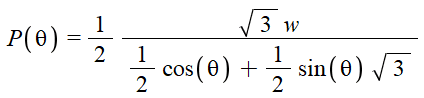
Finding the minimum value of P(θ)

  • Thread starter tracker890 Source h
  • Start date
4 replies · 2K views · last reply
tracker890 Source h
Messages
90
Reaction score
11
No Effort - Member warned that some effort must be shown
Dear Everyone:
Q:Please help me to understand how to solve the P(theta)min is
Fraction with numerator sqrt(3) times w and denominator 2, written as a handwritten-style math expression: √3w over 2.
?

Equation P(θ) = (1/2) · (√3 w) / ((1/2)cos(θ) + (1/2)sin(θ)√3)


Thank you for your time and consideration.
 
You're trying to prove that ##\sqrt{3} w/2## is the smallest value P can take? What have you done so far to try to solve this? We can help identify what the next step is easier if we see what your work is so far.
 
  • Like
Likes   Reactions: mfb
Dear Office_Shredder :
Thank you for reminding, and this problem has been solved.
(ref.https://mathhelpforum.com/threads/please-help-me-to-understand-how-to-solve-the-p-theta-min.286784/#post-958901)

Diagram of a weight W hanging from a rope over a pulley at A on a wall, with the rope pulled at point B by a force P, the rope at B making angle θ with the incline from A.

Problem:
Determine the Pmin for the sys equilibrium.sol/
Free-body diagram of three forces at a point on x and y axes: P pointing up-left at angle θ from the x-axis, T pointing up-right at angle α from the x-axis, and W pointing straight down.

Maple worksheet solving for the minimum of P: alpha set to 30 degrees, equilibrium equations solved for T and P, derivative of P with respect to theta set to zero, giving theta = pi/3 and P = (1/2) w sqrt(3).
 
Attachments
  • Screenshot of a Maple worksheet: eq1 is T sin(α) + P sin(θ) = w and eq2 is T cos(α) = P cos(θ); solve gives P = cos(α)w / (cos(θ)sin(α) + sin(θ)cos(α)) and T = w cos(θ) / (cos(θ)sin(α) + sin(θ)cos(α)); then α is set to 30·(π/180) and the solution is shown as P = (1/2)·√3 w / (½cos(θ) + ½sin(θ)√3) and T = w cos(θ) / (½cos(θ) + ½sin(θ)√3).
    1598422201134.png
    10 KB · Views: 205
Last edited:
tracker890 Source h said:
Dear Everyone:
Q:Please help me to understand how to solve the P(theta)min is View attachment 268338 ?

Thank you for your time and consideration.

I know this has been solved now, but another method to do this (other than differentiation) is to notice that the denominator can be expressed as a double-angle formula. The coefficients [itex]\sqrt 3 /2[/itex] and [itex]1/2[/itex] seem to stand out to me. For example:

[tex]\frac{1}{2} cos\theta + \frac{\sqrt 3}{2} sin \theta = sin(\theta + \frac{\pi}{6})[/tex]
We can now see that we want the minimum of [itex]P[/itex] which occurs when the denominator is a maximum. Max(sin) = 1 and thus we get the answer as required (and we can see that [itex]\theta = \pi / 3[/itex] for the sin() to equal 1)
 
  • Like
Likes   Reactions: tracker890 Source h, etotheipi and PeroK
An even shorter option: If two sine waves are shifted by pi/2 (just like sine and cosine are) then they can be combined to a single sine function by adding the individual amplitudes in quadrature. As formula: ##a\sin(\theta)+b\cos(\theta) = \sqrt{a^2+b^2} \sin(\theta+x)## with some phase x we don't need to care about. This function has a maximum of ##\sqrt{a^2+b^2}##. That means we just need to calculate ##\sqrt{\left(\frac{1}{2}\right)^2+\left(\frac{\sqrt{3}}{2}\right)^2} = \sqrt{\frac 1 4 + \frac 3 4}=1##.
 
  • Like
Likes   Reactions: tracker890 Source h