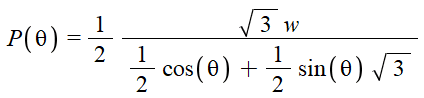
Finding the minimum value of P(θ)

  • Thread starter Thread starter tracker890 Source h
  • Start date Start date
Join the discussion
Registration is free. Ask a follow-up in this thread, or start your own.
4 replies · 1K views
tracker890 Source h
Messages
90
Reaction score
11
No Effort - Member warned that some effort must be shown
Dear Everyone:
Q:Please help me to understand how to solve the P(theta)min is
1598410450990.png
?

1598410474543.png


Thank you for your time and consideration.
 
Physics news on Phys.org
You're trying to prove that ##\sqrt{3} w/2## is the smallest value P can take? What have you done so far to try to solve this? We can help identify what the next step is easier if we see what your work is so far.
 
  • Like
Likes   Reactions: mfb
Dear Office_Shredder
Thank you for reminding, and this problem has been solved.
(ref.https://mathhelpforum.com/threads/please-help-me-to-understand-how-to-solve-the-p-theta-min.286784/#post-958901)

1598422174695.png

Problem:
Determine the Pmin for the sys equilibrium.sol/
1598422214040.png

1598424079846.png
 

Attachments

  • 1598422201134.png
    1598422201134.png
    10 KB · Views: 192
Last edited:
tracker890 Source h said:
Dear Everyone:
Q:Please help me to understand how to solve the P(theta)min is View attachment 268338 ?

Thank you for your time and consideration.

I know this has been solved now, but another method to do this (other than differentiation) is to notice that the denominator can be expressed as a double-angle formula. The coefficients [itex]\sqrt 3 /2[/itex] and [itex]1/2[/itex] seem to stand out to me. For example:

[tex]\frac{1}{2} cos\theta + \frac{\sqrt 3}{2} sin \theta = sin(\theta + \frac{\pi}{6})[/tex]
We can now see that we want the minimum of [itex]P[/itex] which occurs when the denominator is a maximum. Max(sin) = 1 and thus we get the answer as required (and we can see that [itex]\theta = \pi / 3[/itex] for the sin() to equal 1)
 
  • Like
Likes   Reactions: tracker890 Source h, etotheipi and PeroK
An even shorter option: If two sine waves are shifted by pi/2 (just like sine and cosine are) then they can be combined to a single sine function by adding the individual amplitudes in quadrature. As formula: ##a\sin(\theta)+b\cos(\theta) = \sqrt{a^2+b^2} \sin(\theta+x)## with some phase x we don't need to care about. This function has a maximum of ##\sqrt{a^2+b^2}##. That means we just need to calculate ##\sqrt{\left(\frac{1}{2}\right)^2+\left(\frac{\sqrt{3}}{2}\right)^2} = \sqrt{\frac 1 4 + \frac 3 4}=1##.
 
  • Like
Likes   Reactions: tracker890 Source h