Finding the Phase Constant of a Sinusoidal Velocity Graph

  • Thread starter Thread starter bcjochim07
  • Start date Start date
  • Tags Tags
    Constant Phase
Click For Summary
SUMMARY

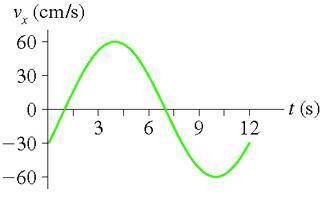
The discussion centers on determining the phase constant of a sinusoidal velocity graph with a period of 12 seconds and a maximum velocity of 60 cm/s. The initial velocity at t=0 is -30 cm/s, leading to the equation -30 cm/s = -(π/6) * 114.6 * sin(phase constant). The user initially calculated the phase constant as 0.5235 rad but faced confusion due to multiple possible angles from the arcsin function. Ultimately, the correct approach involves recognizing that the sine function can yield two angles, but only one corresponds to the graph's behavior as time progresses.

PREREQUISITES
  • Understanding of sinusoidal functions and their properties
  • Familiarity with angular frequency and its calculation (ω = 2π/T)
  • Knowledge of the relationship between velocity, amplitude, and phase constant in harmonic motion
  • Ability to solve trigonometric equations and interpret their results
NEXT STEPS
  • Study the derivation and application of the sine function in harmonic motion
  • Learn how to differentiate between amplitude for displacement and amplitude for velocity
  • Explore the implications of multiple solutions in trigonometric equations
  • Practice solving phase constant problems using different initial conditions and parameters
USEFUL FOR

Students studying physics, particularly those focusing on harmonic motion and wave mechanics, as well as educators looking for insights into common student misconceptions regarding phase constants in sinusoidal graphs.

bcjochim07
Messages
366
Reaction score
0
Phase constant --Please help me!

Homework Statement


What is the phase constant?


aharmonic.jpg

The picture didn't come yet but here's a description:
It is a velocity vs. time graph. It is sinusoidal with a period of 12 s and a max velocity of 60 cm/s. The inital value for velocity at t=0 is -30 cm/s and the value for velocity at t=12 is -30 cm/s

Homework Equations


The Attempt at a Solution


First I found A vmax= 2pi*A/T
60= 2pi*A/12 A=114.6

ok so I tried vo= -omega*A sin(phase constant)
omega= 2pi/T 2 pi/ 12 = pi/6
-30 cm/s = -(pi/6)*114.6 sin(phase constant)

I found phase constant = .5235 rad, but that's not right

I know that there is another angle that has the sine value, but how do I know which one is the phase constant
 
Physics news on Phys.org
I am really having trouble with the phase constant
 
Could someone help me out?
 
Your amplitude, A, corresponds to the maximum velocity, which in this case is 60cm/s. Your period is 12s, so by using T = 2*pi/w, in which w is angular frequency, you could find the value for w. Since you know the amplitude and angular frequency, and you know that the general form for the velocity is v = -A*sin(wt + phase constant), all you have to do is plug in numbers. At t = 0, v = -30cm/s, and since you already know the amplitude and angular frequency, you could solve for the phase constant.
 
Right, I think that's what I did up above, but I got the answer wrong according to mastering physics. I've checked it several times, and I don't know why it's wrong.

-30 cm/s = -(pi/6)*114.6 sin(phase constant)
.49996= sin(phaseconstant)
arc sin (.49996) = .52355 rad or 2.618 rad I don't know which one is right because at both position the particle would be moving to the left ( have a negative velocity initially like in the graph) This is what is confusing me.
 
The amplitude is 60 cm/s.
 
oh, so for the velocity formula, you have to have A in cm/s...ok I see

so .955=sin(phase constant)

phase constant = 1.27 rad ?
 
v=60*sin(wt+phase). At t=0, v=-30. Put that in. -30=60*sin(phase). sin(phase)=(-1/2). Isn't that what you want?
 
My book says the formula is v= -omega* Asin(omega * t + phaseconstant)
 
  • #10
Your book's formula is using the amplitude of the displacement. For this question we are using the amplitude of the quantity in the graph you showed us. That would be the velocity amplitude, 60 cm/s.

Displacement, velocity, and acceleration each have their own amplitude. We need to be clear on which one we are using.
 
  • #11
so if I used that formula in my book, then shouldn't I come up with right answer as long as I use the amplitude from vmax=omega*A, where A is in cm. I chose to use the amplitude for displacement, so shouldn't that yield the same answer? I'm really confused about this.
 
  • #12
Yes, you are confused. If the amplitude for displacement is A, then yes, the amplitude for velocity is omega*A. But omega*A=60 from your graph. Since it's a graph of velocity. So A=60/omega. Hence the amplitude for velocity is omega*A which is omega*(60/omega). Which is 60. Which is where we started. This is making my head hurt. Can you make it stop?
 
  • #13
I'm sorry...
Ok, so I was doing exactly what you are telling me aways up above until I got confused about the amplitude.

I wrote: .49996= sin(phaseconstant)

but the problem I was having was what value of the angle is the phase constant since arcsin .49996 gives two angles, both of which would be moving left like indicated in the graph.
 
  • #14
Ok, but shouldn't sin(phase) be -0.5, not +0.5? And yes, there are two really different values modulo 2pi. But only one increases the velocity as t increases from 0. Look at your diagram. There are two different points where the velocity is -30. But only one fits your diagram.
 
Last edited:

Similar threads

  • · Replies 4 ·
Replies
4
Views
2K
  • · Replies 8 ·
Replies
8
Views
4K
  • · Replies 6 ·
Replies
6
Views
5K
Replies
6
Views
5K
  • · Replies 1 ·
Replies
1
Views
2K
  • · Replies 42 ·
2
Replies
42
Views
3K
  • · Replies 2 ·
Replies
2
Views
2K
Replies
9
Views
2K
  • · Replies 8 ·
Replies
8
Views
3K
  • · Replies 8 ·
Replies
8
Views
3K