Finding the resistance of this shunt resistor

Click For Summary
SUMMARY

The discussion focuses on calculating the resistance of a shunt resistor placed in parallel with an ammeter. The relevant equation used is the electromotive force (emf) equation, E = I(R + r), where E represents the battery voltage. Participants clarify that the current through the ammeter decreases from 0.4 A to 0.3 A, leading to a current of 0.1 A through the shunt resistor. The final calculation yields a shunt resistance (Rs) of 2.4 ohms, derived from the voltage across the shunt and the current flowing through it.

PREREQUISITES
  • Understanding of Ohm's Law (V = IR)
  • Familiarity with parallel circuit analysis
  • Knowledge of electromotive force (emf) and internal resistance concepts
  • Basic algebra for manipulating equations
NEXT STEPS
  • Study the principles of parallel circuits and current division
  • Learn about shunt resistors and their applications in ammeter circuits
  • Explore the concept of internal resistance in batteries and its effects on circuit performance
  • Review advanced circuit analysis techniques, including Thevenin's and Norton's theorems
USEFUL FOR

Electronics students, electrical engineers, and hobbyists interested in circuit design and analysis, particularly those working with ammeters and shunt resistors.

Bolter
Messages
262
Reaction score
31
Homework Statement
Work out the resistance of shunt placed in parallel to ammeter
Relevant Equations
emf, E = I(R+r)
How would I go about this question?

Screenshot 2020-02-06 at 19.30.02.png

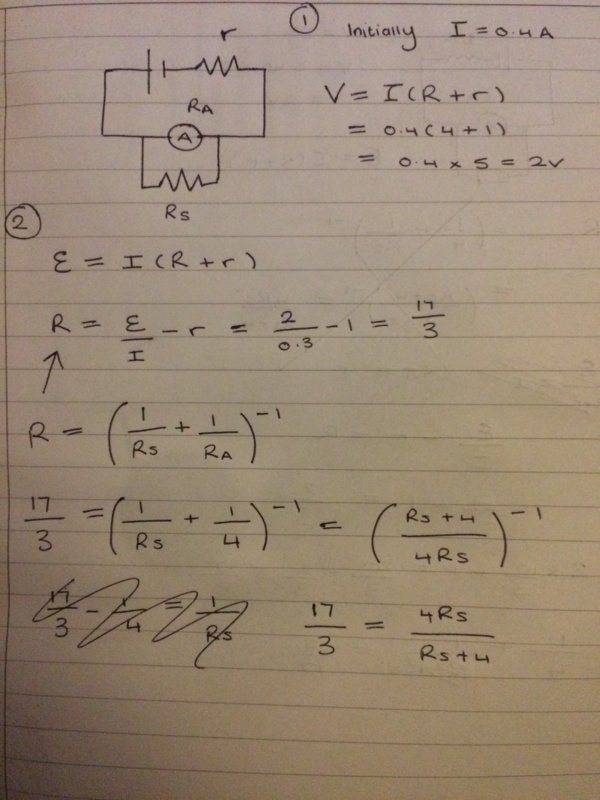
Here is my attempt at it but I haven't really gone anywhere with this :oldconfused:

IMG_3805.JPG


Any help would be really appreciated!
 
Physics news on Phys.org
Bolter said:
Homework Statement:: Work out the resistance of shunt placed in parallel to ammeter
Relevant Equations:: emf, E = I(R+r)

How would I go about this question?

View attachment 256732
Here is my attempt at it but I haven't really gone anywhere with this :oldconfused:

View attachment 256733

Any help would be really appreciated!
From where you got to, you can just multiply out and collect the Rs terms together.
However, the answer it gives is clearly wrong. It is because you took the 0.3A as being the current through the main circuit. Reread the question.
 
Firstly, I don't like your use of R and E without saying what they are. Is E the same as V, the battery voltage?
Both for your sake and ours, be clear what letters/symbols refer to.

1 is fine, at least, if it's to find the battery voltage.

2. What are you doing now? I guess R is the equivalent resistance of the meter with the shunt in place.

But, as Haruspex says, you don't know the current now. You know the current through the meter decreases from 0.4 A to 0.3 A, but some current now flows through the shunt - and you don't know how much.

What you need is a bit more info:
If the current through the meter has reduced and the meter internal resistance is the same, what else must have changed?
 
haruspex said:
From where you got to, you can just multiply out and collect the Rs terms together.
However, the answer it gives is clearly wrong. It is because you took the 0.3A as being the current through the main circuit. Reread the question.

So does the total current still remain as 0.4 A?

And then when total current reaches the 2 branches in parallel with each other, current gets split.
Where 0.3 A flows through the ammeter and 0.1 A flows through the shunt resistor.

I know that voltage is the same across each branch in a parallel combination. So the ammeter has resistance 4 ohms and current 3 A, therefore V = IR = 0.3 * 4 = 1.2 V

Hence Rs * 0.1 = 1.2 V so Rs = 12 ohms (Rs = resistance of shunt resistor)
 
Merlin3189 said:
Firstly, I don't like your use of R and E without saying what they are. Is E the same as V, the battery voltage?
Both for your sake and ours, be clear what letters/symbols refer to.

1 is fine, at least, if it's to find the battery voltage.

2. What are you doing now? I guess R is the equivalent resistance of the meter with the shunt in place.

But, as Haruspex says, you don't know the current now. You know the current through the meter decreases from 0.4 A to 0.3 A, but some current now flows through the shunt - and you don't know how much.

What you need is a bit more info:
If the current through the meter has reduced and the meter internal resistance is the same, what else must have changed?

The voltage drop across the ammeter?
 
Right. Sorry I didn't see your previous post.

If the voltage across the ammeter has dropped, then the current won't still be 0.4 A
 
Merlin3189 said:
Right. Sorry I didn't see your previous post.

If the voltage across the ammeter has dropped, then the current won't still be 0.4 A

Is it safe to say that 0.1 A will flow across the shunt and 0.3 A across the ammeter?
 
No.
If the voltage across the ammeter and shunt has dropped, then if 0.4 A still flowed, there would not be enough voltage drop across the battery internal resistance.
 
Work out what the voltage was originally across the meter, then what will the new voltage across the meter be?
 
  • #10
Merlin3189 said:
Work out what the voltage was originally across the meter, then what will the new voltage across the meter be?

Voltage originally across the meter is 1.6 V as the emf was 2V, lost volts came out to be 0.4 V therefore the terminal pd across the meter has to be 1.6 V

New voltage across the meter can be found by simply using ohm's law, so V = IR = 0.3 * 4 = 1.2 V
 
  • #11
Now you can get the new current through the battery
 
  • #12
Merlin3189 said:
Now you can get the new current through the battery

Wait so if I know that battery emf is 2V and that 1.2V is across the shunt and ammeter? Then lost volts through the internal resistance of the batter is 0.8V

I = v/r = 0.8/1 = 0.8 A so new current has increased?
 
  • #13
Yes. Because you have reduced the overall resistance of the circuit.
 
  • #14
Merlin3189 said:
Yes. Because you have reduced the overall resistance of the circuit.

I see, but how does this new battery current help us find the shunt resistance?

So now I'm I correct to say that if the main current happens to be 0.8 A, then 0.3 A passes the meter and 0.5 A passes the shunt, where the 2 individual currents across each branch must sum to the total current 0.8 A

So using ohm's law again. 1.2V = 0.5A * Rs

Giving Rs = 2.4 ohms?
 
  • #15
That's what I got.
 
  • #16
You actually beat me, because I did a bit more work to get the 1.2 V, instead of just Ohm's law.

It is a slightly unusual question, because you usually want to calculate what shunt you need to make the ammeter read 0.4 when the current is say 2 A or something like that.
 
  • Like
Likes   Reactions: Bolter
  • #17
Merlin3189 said:
You actually beat me, because I did a bit more work to get the 1.2 V, instead of just Ohm's law.

It is a slightly unusual question, because you usually want to calculate what shunt you need to make the ammeter read 0.4 when the current is say 2 A or something like that.

Yes I remember I have answered questions like these before in the past so this one threw me off quite a bit instead

But thank you so much for your help :)
 

Similar threads

Replies
7
Views
2K
  • · Replies 3 ·
Replies
3
Views
3K
  • · Replies 4 ·
Replies
4
Views
1K
Replies
13
Views
3K
  • · Replies 4 ·
Replies
4
Views
2K
Replies
5
Views
5K
  • · Replies 1 ·
Replies
1
Views
1K
  • · Replies 31 ·
2
Replies
31
Views
4K
Replies
2
Views
752
  • · Replies 1 ·
Replies
1
Views
1K