Finding the resistance of this shunt resistor

Click For Summary

Homework Help Overview

The discussion revolves around calculating the resistance of a shunt resistor placed in parallel with an ammeter. Participants are exploring the implications of current changes in the circuit and the relationship between voltage and resistance.

Discussion Character

  • Mixed

Approaches and Questions Raised

  • Participants discuss the initial attempts to apply relevant equations and clarify the meanings of symbols used in the problem. Questions arise regarding the current distribution between the ammeter and the shunt, as well as the impact of voltage changes on these currents.

Discussion Status

There is an ongoing exploration of the relationships between current, voltage, and resistance. Some participants have provided insights into the calculations and reasoning, while others are questioning assumptions and seeking further clarification on the implications of their findings.

Contextual Notes

Participants note the importance of understanding the definitions of variables and the need for additional information regarding the circuit's behavior as the current changes. The discussion reflects uncertainty about the correct interpretation of the problem setup.

Bolter
Messages
262
Reaction score
31
Homework Statement
Work out the resistance of shunt placed in parallel to ammeter
Relevant Equations
emf, E = I(R+r)
How would I go about this question?

Screenshot 2020-02-06 at 19.30.02.png

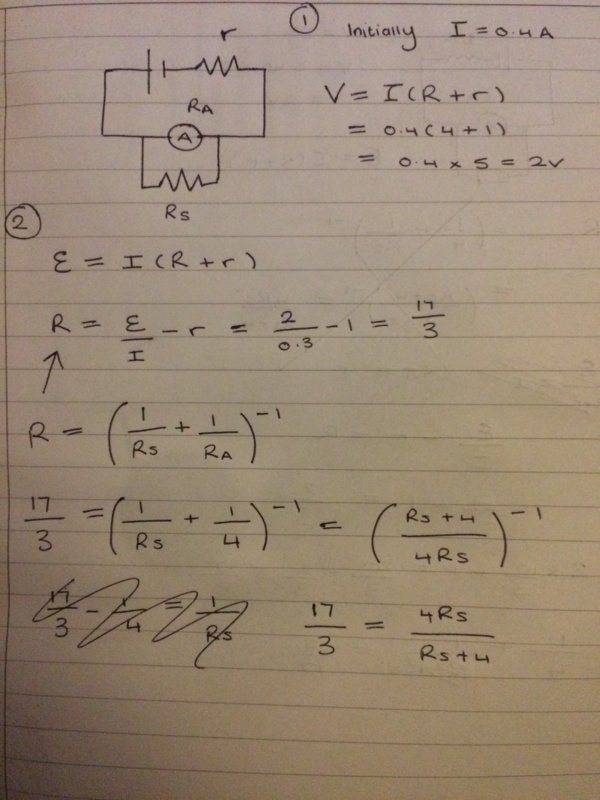
Here is my attempt at it but I haven't really gone anywhere with this :oldconfused:
IMG_3805.JPG


Any help would be really appreciated!
 
Physics news on Phys.org
Bolter said:
Homework Statement:: Work out the resistance of shunt placed in parallel to ammeter
Relevant Equations:: emf, E = I(R+r)

How would I go about this question?

View attachment 256732
Here is my attempt at it but I haven't really gone anywhere with this :oldconfused:

View attachment 256733

Any help would be really appreciated!
From where you got to, you can just multiply out and collect the Rs terms together.
However, the answer it gives is clearly wrong. It is because you took the 0.3A as being the current through the main circuit. Reread the question.
 
Firstly, I don't like your use of R and E without saying what they are. Is E the same as V, the battery voltage?
Both for your sake and ours, be clear what letters/symbols refer to.

1 is fine, at least, if it's to find the battery voltage.

2. What are you doing now? I guess R is the equivalent resistance of the meter with the shunt in place.

But, as Haruspex says, you don't know the current now. You know the current through the meter decreases from 0.4 A to 0.3 A, but some current now flows through the shunt - and you don't know how much.

What you need is a bit more info:
If the current through the meter has reduced and the meter internal resistance is the same, what else must have changed?
 
haruspex said:
From where you got to, you can just multiply out and collect the Rs terms together.
However, the answer it gives is clearly wrong. It is because you took the 0.3A as being the current through the main circuit. Reread the question.

So does the total current still remain as 0.4 A?

And then when total current reaches the 2 branches in parallel with each other, current gets split.
Where 0.3 A flows through the ammeter and 0.1 A flows through the shunt resistor.

I know that voltage is the same across each branch in a parallel combination. So the ammeter has resistance 4 ohms and current 3 A, therefore V = IR = 0.3 * 4 = 1.2 V

Hence Rs * 0.1 = 1.2 V so Rs = 12 ohms (Rs = resistance of shunt resistor)
 
Merlin3189 said:
Firstly, I don't like your use of R and E without saying what they are. Is E the same as V, the battery voltage?
Both for your sake and ours, be clear what letters/symbols refer to.

1 is fine, at least, if it's to find the battery voltage.

2. What are you doing now? I guess R is the equivalent resistance of the meter with the shunt in place.

But, as Haruspex says, you don't know the current now. You know the current through the meter decreases from 0.4 A to 0.3 A, but some current now flows through the shunt - and you don't know how much.

What you need is a bit more info:
If the current through the meter has reduced and the meter internal resistance is the same, what else must have changed?

The voltage drop across the ammeter?
 
Right. Sorry I didn't see your previous post.

If the voltage across the ammeter has dropped, then the current won't still be 0.4 A
 
Merlin3189 said:
Right. Sorry I didn't see your previous post.

If the voltage across the ammeter has dropped, then the current won't still be 0.4 A

Is it safe to say that 0.1 A will flow across the shunt and 0.3 A across the ammeter?
 
No.
If the voltage across the ammeter and shunt has dropped, then if 0.4 A still flowed, there would not be enough voltage drop across the battery internal resistance.
 
Work out what the voltage was originally across the meter, then what will the new voltage across the meter be?
 
  • #10
Merlin3189 said:
Work out what the voltage was originally across the meter, then what will the new voltage across the meter be?

Voltage originally across the meter is 1.6 V as the emf was 2V, lost volts came out to be 0.4 V therefore the terminal pd across the meter has to be 1.6 V

New voltage across the meter can be found by simply using ohm's law, so V = IR = 0.3 * 4 = 1.2 V
 
  • #11
Now you can get the new current through the battery
 
  • #12
Merlin3189 said:
Now you can get the new current through the battery

Wait so if I know that battery emf is 2V and that 1.2V is across the shunt and ammeter? Then lost volts through the internal resistance of the batter is 0.8V

I = v/r = 0.8/1 = 0.8 A so new current has increased?
 
  • #13
Yes. Because you have reduced the overall resistance of the circuit.
 
  • #14
Merlin3189 said:
Yes. Because you have reduced the overall resistance of the circuit.

I see, but how does this new battery current help us find the shunt resistance?

So now I'm I correct to say that if the main current happens to be 0.8 A, then 0.3 A passes the meter and 0.5 A passes the shunt, where the 2 individual currents across each branch must sum to the total current 0.8 A

So using ohm's law again. 1.2V = 0.5A * Rs

Giving Rs = 2.4 ohms?
 
  • #15
That's what I got.
 
  • #16
You actually beat me, because I did a bit more work to get the 1.2 V, instead of just Ohm's law.

It is a slightly unusual question, because you usually want to calculate what shunt you need to make the ammeter read 0.4 when the current is say 2 A or something like that.
 
  • Like
Likes   Reactions: Bolter
  • #17
Merlin3189 said:
You actually beat me, because I did a bit more work to get the 1.2 V, instead of just Ohm's law.

It is a slightly unusual question, because you usually want to calculate what shunt you need to make the ammeter read 0.4 when the current is say 2 A or something like that.

Yes I remember I have answered questions like these before in the past so this one threw me off quite a bit instead

But thank you so much for your help :)
 

Similar threads

Replies
7
Views
2K
  • · Replies 3 ·
Replies
3
Views
3K
  • · Replies 4 ·
Replies
4
Views
2K
Replies
13
Views
3K
  • · Replies 4 ·
Replies
4
Views
2K
Replies
5
Views
6K
  • · Replies 1 ·
Replies
1
Views
2K
  • · Replies 31 ·
2
Replies
31
Views
5K
Replies
2
Views
872
  • · Replies 1 ·
Replies
1
Views
1K