mmmboh
- 401
- 0
Hi, this isn't homework but a practice problem.
A particle is simultaneously subjected to three simple harmonic motions, all of the same frequency and in the x direction. The amplitudes are 0.25, 0.20, 0.15, and the face difference between the first and second is 450 and between the second and third is 300. Find the amplitude of the resultant displacement and its phase relative to the first component.
I made a diagram
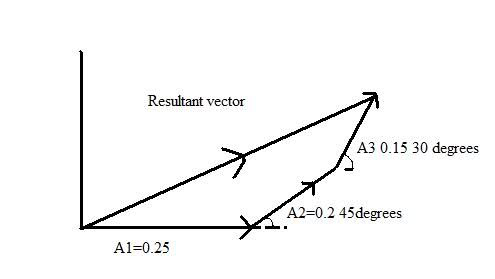
The 0.25, 0.20, and 0.15 components are represented by Z1=A1ejwt, Z2=A2ej(wt+a), and Z3=A3ej(wt+b), adding them all together to give me the resultant component, and simplifying gives me: Z=ejwt[A1+A2eja+A3ejb]...so what I would think I am suppose to do is find the x component of the resultant vector and the y component, and use Pythagorean to find the resultant vector and then do arctan(y/x) to get the phase angle. The answers are 0.52 and 33.50.
I can get 0.52 for the amplitude, but that is only by taking the x component of the resultant vector and ignoring the rest, if I do it with Pythagorean I get [0.522 +0.2162]1/2=0.56, and the angle is arctan (0.216/0.52)=22.5...so apparently I am wrong, can someone help please?
A particle is simultaneously subjected to three simple harmonic motions, all of the same frequency and in the x direction. The amplitudes are 0.25, 0.20, 0.15, and the face difference between the first and second is 450 and between the second and third is 300. Find the amplitude of the resultant displacement and its phase relative to the first component.
I made a diagram
The 0.25, 0.20, and 0.15 components are represented by Z1=A1ejwt, Z2=A2ej(wt+a), and Z3=A3ej(wt+b), adding them all together to give me the resultant component, and simplifying gives me: Z=ejwt[A1+A2eja+A3ejb]...so what I would think I am suppose to do is find the x component of the resultant vector and the y component, and use Pythagorean to find the resultant vector and then do arctan(y/x) to get the phase angle. The answers are 0.52 and 33.50.
I can get 0.52 for the amplitude, but that is only by taking the x component of the resultant vector and ignoring the rest, if I do it with Pythagorean I get [0.522 +0.2162]1/2=0.56, and the angle is arctan (0.216/0.52)=22.5...so apparently I am wrong, can someone help please?