Finding the value of lambda so that two lines are parallel

Click For Summary

Homework Help Overview

The discussion revolves around finding the value of lambda that ensures two vectors, represented by the lines PR and RS, are parallel. The subject area involves vector analysis and properties of parallel lines in three-dimensional space.

Discussion Character

  • Exploratory, Conceptual clarification, Mathematical reasoning, Assumption checking

Approaches and Questions Raised

  • Participants explore different methods to determine the conditions for parallel vectors, including normalization and scalar multiples. Questions arise regarding the validity of squaring both sides of an equation and the implications of creating unit vectors.

Discussion Status

There is an ongoing exploration of the reasoning behind the original poster's method and why it led to a trivial result. Some participants suggest alternative approaches, such as comparing coefficients directly or using the concept of scalar multiples, indicating a productive discussion without a clear consensus.

Contextual Notes

Participants note that the original method involved unnecessary steps, such as normalizing vectors, which may have complicated the solution process. There is also mention of the importance of recognizing the relationship between vector components for establishing parallelism.

member 731016
Homework Statement
I am try to understand how they the solution got their answer as my method is not giving the correct answer.
Relevant Equations
##\textbf {PR} = -3\hat i + 6\hat j - 2\hat k##

##\textbf {RS} = 2\hat i - 4\hat j + \lambda \hat k##
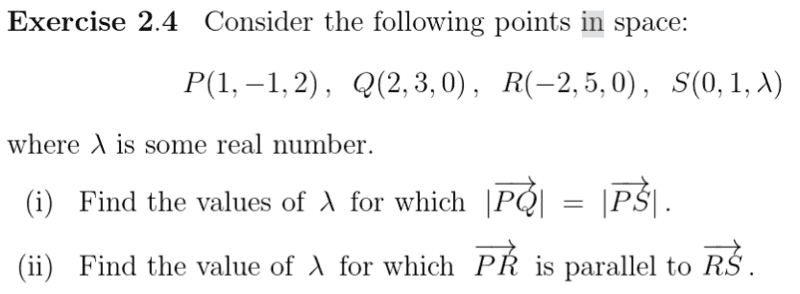
For this (ii),
1681245369416.png


The solution is ##\lambda = \frac{4}{3}##, however when I tried solving the problem I did not get their answer. Dose somebody please guide me to their solution and tell me what I did wrong with my method below:

##\textbf {PR} = -3\hat i + 6\hat j - 2\hat k##
##\textbf {RS} = 2\hat i - 4\hat j + \lambda \hat k##
##\hat {PR} = \frac{\textbf {PR}}{|PR|} = \hat {RS} = \frac{\textbf {RS}}{|RS|}##
##\hat {PR} = \frac{-3\hat i + 6\hat j - 2\hat k}{\sqrt{49}} = \frac{2\hat i - 4\hat j + \lambda \hat k}{\sqrt{20 + \lambda^2}}##

Then square both sides (which I think we then use the scalar product) giving:
##\frac{9 + 36 + 4}{49} = \frac{4 + 16 + \lambda^2}{20 + \lambda^2}##
##\frac{49}{49} = \frac{20 + \lambda^2}{20 + \lambda^2}##
##1 = 1##

Many thanks!

[Moderator's note: moved from a technical forum.]
 
Last edited by a moderator:
Physics news on Phys.org
You found that the length of a unit vector is 1 (twice).
How do you show that two vectors are parallel?
 
  • Like
Likes   Reactions: member 731016
Frabjous said:
You found that the length of a unit vector is 1 (twice).
How do you show that two vectors are parallel?
Thank you for your reply @Frabjous!

The two vectors should be parallel if they are multiples of each other by some constant.

Many thanks!
 
ChiralSuperfields said:
The two vectors should be parallel if they are multiples of each other by some constant.
Don’t normalize the vectors. Find the constant for each component. They should all be equal.
 
  • Like
Likes   Reactions: member 731016
Frabjous said:
Don’t normalize the vectors. Find the constant for each component. They should all be equal.
Thank you for your reply @Frabjous!

I have gotten the correct solution :) However, I am wondering why my first method did not work. Is it because there is no other way of solving for lambda without squaring both sides which makes the numerator equal to the denominator for each unit vector.

Many thanks!
 
ChiralSuperfields said:
I have gotten the correct solution :) However, I am wondering why my first method did not work. Is it because there is no other way of solving for lambda without squaring both sides which makes the numerator equal to the denominator for each unit vector.
As already noted, you absolutely don't need to generate unit vectors. You did a lot of work for no noticeable gain.

ChiralSuperfields said:
##\textbf {PR} = -3\hat i + 6\hat j - 2\hat k##
##\textbf {RS} = 2\hat i - 4\hat j + \lambda \hat k##
Another point that was already noted is that for two vectors to be parallel (or antiparallel -- pointing in opposite directions), each one must be a nonzero scalar multiple of the other.
For the vectors above one can determine by nothing more than inspection that the scalar multiple must be -3/2. So ##-2 = -3/2 \times \lambda##, or ##\lambda = (-2)(-2/3) = 4/3##.
ChiralSuperfields said:
The solution is
##\lambda = \frac{4}{3}##, however when I tried solving the problem I did not get their answer. Dose somebody please guide me to their solution and tell me what I did wrong with my method below:

##\textbf {PR} = -3\hat i + 6\hat j - 2\hat k##
##\textbf {RS} = 2\hat i - 4\hat j + \lambda \hat k##
You don't need to do any of the stuff below.
ChiralSuperfields said:
##\hat {PR} = \frac{\textbf {PR}}{|PR|} = \hat {RS} = \frac{\textbf {RS}}{|RS|}##
##\hat {PR} = \frac{-3\hat i + 6\hat j - 2\hat k}{\sqrt{49}} = \frac{2\hat i - 4\hat j + \lambda \hat k}{\sqrt{20 + \lambda^2}}##

Then square both sides (which I think we then use the scalar product) giving:
##\frac{9 + 36 + 4}{49} = \frac{4 + 16 + \lambda^2}{20 + \lambda^2}##
##\frac{49}{49} = \frac{20 + \lambda^2}{20 + \lambda^2}##
##1 = 1##
Aside from the fact that the above work is not useful, it's even less useful to end up with an equation that is trivially true; i.e., that 1 is equal to itself.
 
Last edited:
  • Like
Likes   Reactions: member 731016
ChiralSuperfields said:
Is it because there is no other way of solving for lambda without squaring both sides which makes the numerator equal to the denominator for each unit vector.
It was (almost) fine up to here:
ChiralSuperfields said:
##\hat {PR} = \frac{-3\hat i + 6\hat j - 2\hat k}{\sqrt{49}} = \frac{2\hat i - 4\hat j + \lambda \hat k}{\sqrt{20 + \lambda^2}}##
What went wrong after that is that squaring both sides is equivalent to insisting that both vectors have the same length - but you'd already made them unit vectors, so that was true independent of ##\lambda##.

You could have compared the coefficients of ##\hat i##, which would hopefully have flagged to you why I wrote "almost", which is that ##\hat{PR}=-\hat{RS}## because they point in opposite directions. Or you could have required that ##\hat{PR}\cdot\hat{RS}=\pm 1##. Either is more work than the method already mentioned of noting that for parallel vectors the coefficients of the basis vectors need to be in the same ratio, so ##\frac{-3}2=\frac 6{-4}=\frac{-2}\lambda##.
 
  • Like
Likes   Reactions: member 731016

Similar threads

  • · Replies 14 ·
Replies
14
Views
3K
  • · Replies 20 ·
Replies
20
Views
4K
  • · Replies 6 ·
Replies
6
Views
3K
Replies
18
Views
2K
  • · Replies 21 ·
Replies
21
Views
1K
  • · Replies 13 ·
Replies
13
Views
3K
  • · Replies 2 ·
Replies
2
Views
2K
  • · Replies 25 ·
Replies
25
Views
2K
  • · Replies 18 ·
Replies
18
Views
1K
  • · Replies 3 ·
Replies
3
Views
2K