Finding Value of ##N_A## and P in a Frame

  • Thread starter Thread starter YehiaMedhat
  • Start date Start date
  • Tags Tags
    Frame Value
Click For Summary

Homework Help Overview

The discussion revolves around determining the value of the reaction force ##N_A## and the minimum load ##P## required to maintain equilibrium in a frame structure. The problem involves analyzing forces and moments acting on the frame, particularly around points A and B.

Discussion Character

  • Exploratory, Assumption checking, Problem interpretation

Approaches and Questions Raised

  • Participants discuss the calculation of ##N_A## using moment equations and question the relevance of this value when determining the minimum ##P##. There are inquiries about the diagram's clarity and the definitions of forces and moments involved. Some participants express confusion regarding the relationship between the calculated values and the problem requirements.

Discussion Status

The conversation is ongoing, with participants exploring different interpretations of the problem. Some have offered insights into the calculations and the implications of reducing ##P## on the value of ##N_A##. There is no explicit consensus, but several lines of reasoning are being examined.

Contextual Notes

Participants note potential ambiguities in the problem statement and the diagram, including the placement of points A, B, and C, as well as the reference point for the moment. There is mention of a model answer that may have influenced participants' understanding of the problem.

YehiaMedhat
Messages
21
Reaction score
3
Homework Statement
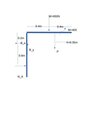
The rigid body ABC is in equilibrium in the position shown. If ##W=650N, P=450N, M=400N.m, and x=0.35m##, then: (Neglect the the thickness of the frame):
The samllest force P for equilibrium in the position shown is (N):
Relevant Equations
$$\sum_{}^{} F_y =0$$
$$\sum_{}^{} F_x =0$$
$$\sum_{}^{} Moments =0$$
The first thing I did is to get the value of ##N_A## by the equaiton of ##\sum{}^{} M_B=0 \rightarrow 650*0.4+450*0.45+400=N_A*0.6 \rightarrow N_A = 104.2N## This is the first.
The magnitude of the reaction at B: ##\sum{}^{} F_y=0 \rightarrow B_y=450+650,\sum{}^{} F_x=0 \rightarrow B_x=N_A=104.2N##
This was until I came to the question whose required is to get the minimum value of P to keep the body in equilibrium, my question is: will I use the value of N_A nevertheless that I just got from the previous P value?? isn't this weird? so, what should I do?
Below is the FBD of the frame in the problem.
 

Attachments

  • Mechanics FBD.jpg
    Mechanics FBD.jpg
    8.3 KB · Views: 140
Physics news on Phys.org
Hi,

Can you explain the diagram ? Or do I have to sleuth to find out where A, B and C are located ?

And can you explain why it says ##P = 450 ## N when the problem statement asks for a value of ##p## ?

Finally, what is the reference point for this ## M = 400 ## N.m ?

##\ ##
 
The picture for the problem its self
Screenshot_20230112-141024_Xodo Docs.jpg

And I did refrence the forces by the arrows and the name of the points like##N_A##
 
  • Informative
Likes   Reactions: BvU
Okay, that explains the given ##P##.
Seen this one before, will need a moment ( :wink: ) to refresh ... my coffee
 
YehiaMedhat said:
so, what should I do?
At the minimum ##P## the contraption will almost start to rotate anti-clockwise around B. So what ##N_A## is associated with that minimum ?

##\ ##
 
Zero, isn't it?
Maybe I'm asking because the model answer for this problem used the ##N_A## we got earlier in the calculations, so that made me feel that there's sth wrong.
 
YehiaMedhat said:
Zero, isn't it?
Maybe I'm asking because the model answer for this problem used the ##N_A## we got earlier in the calculations, so that made me feel that there's sth wrong.
The part of the diagram where ##N_A## makes contact has been drawn on, so it is hard to see the details. But yes, I would have interpreted it as just a buffer, so as P is reduced it should go to zero.
 
haruspex said:
The part of the diagram where ##N_A## makes contact has been drawn on, so it is hard to see the details. But yes, I would have interpreted it as just a buffer, so as P is reduced it should go to zero.
Ok, that makes sense now, so it'll be##\sum{}^{} M_B=0 \rightarrow 0.45P=400-650*0.4 \rightarrow P=311N##
 
YehiaMedhat said:
Ok, that makes sense now, so it'll be##\sum{}^{} M_B=0 \rightarrow 0.45P=400-650*0.4 \rightarrow P=311N##
Yes.
 

Similar threads

  • · Replies 1 ·
Replies
1
Views
2K
  • · Replies 5 ·
Replies
5
Views
2K
  • · Replies 3 ·
Replies
3
Views
2K
  • · Replies 29 ·
Replies
29
Views
4K
  • · Replies 1 ·
Replies
1
Views
9K
Replies
1
Views
2K
  • · Replies 13 ·
Replies
13
Views
14K
  • · Replies 6 ·
Replies
6
Views
2K
  • · Replies 2 ·
Replies
2
Views
2K
  • · Replies 4 ·
Replies
4
Views
2K