Fixing Dented Capacitors on a RC Helicopter Receiver Board

  • Thread starter Thread starter karabiner98k
  • Start date Start date
  • Tags Tags
    Capacitors
Click For Summary
SUMMARY

The forum discussion centers on the repair of dented electrolytic capacitors on an RC helicopter receiver board. Users confirm that while the board continues to function without visible flight issues, it is advisable to replace the damaged capacitors to prevent future failures, especially in high-vibration environments. The recommended specifications for replacement capacitors are 16V and 100 microF, with caution advised regarding polarity during installation. Users also discuss the importance of soldering skills and suggest seeking professional help if necessary.

PREREQUISITES
  • Understanding of electrolytic capacitors and their specifications (e.g., voltage and capacitance)
  • Basic soldering skills or knowledge of soldering techniques
  • Familiarity with RC helicopter components and their functions
  • Knowledge of circuit board repair and maintenance
NEXT STEPS
  • Research proper soldering techniques for circuit board repairs
  • Learn about capacitor specifications and how to select appropriate replacements
  • Explore resources on diagnosing and repairing RC helicopter electronics
  • Investigate local electronics repair services for professional assistance
USEFUL FOR

RC helicopter enthusiasts, hobbyists involved in electronics repair, and individuals seeking to understand capacitor functionality and replacement in electronic devices.

karabiner98k
Messages
90
Reaction score
12
Hello everyone,

I have a RC helicopter that crashed recently and its receiver board was damaged.

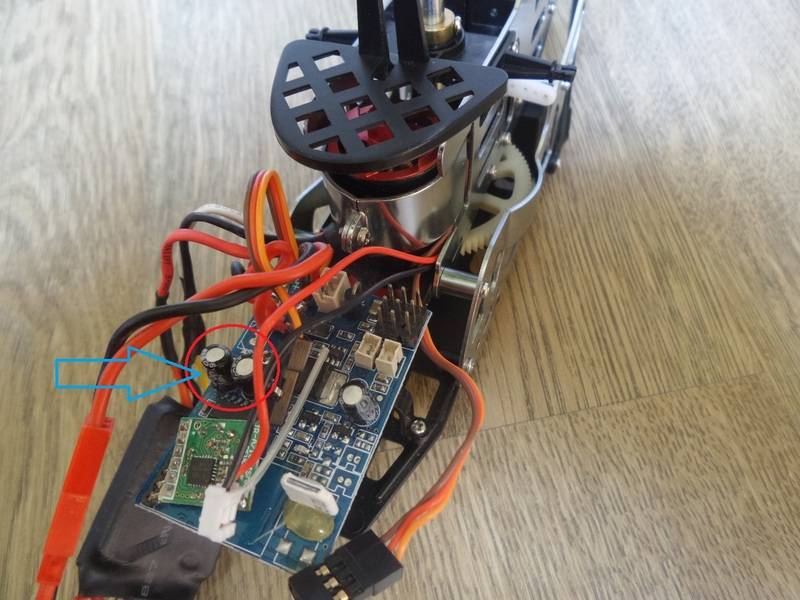
Two capacitors were dented (as you can see in the picture) and the antenna base moved a bit.

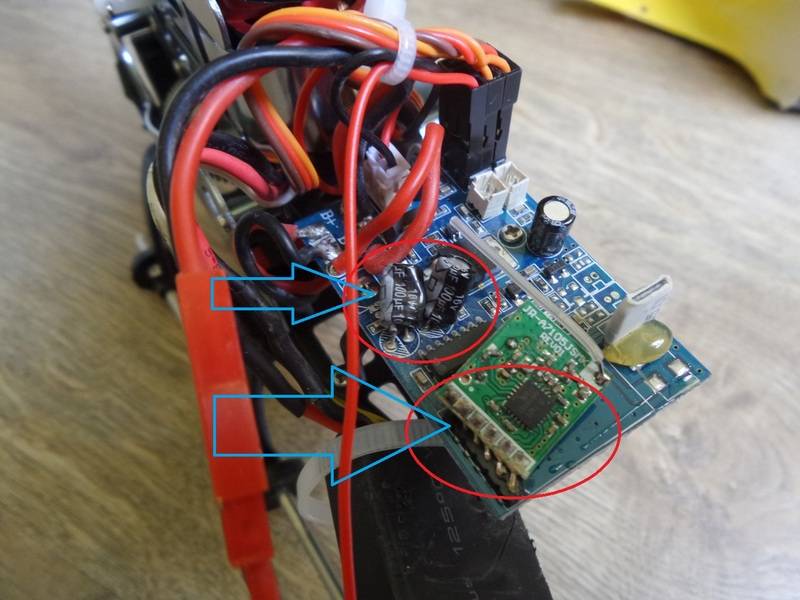
I straightened the capacitors which can be seen in the second picture.

After crash:
1.jpg

After my adjustments:
2.jpg

Despite the damages, the board works perfectly fine and there is no visible change in helicopter flight behavior.
It flies without any problems.

But the question I want to ask is that:

Is it OK to continue flying with this board and those capacitors?
I'm not an electronic expert, that's why I need your help.

Thanks in advance.
 

Attachments

  • 1.jpg
    1.jpg
    58.9 KB · Views: 2,136
  • 2.jpg
    2.jpg
    66.8 KB · Views: 1,977
Engineering news on Phys.org
It is hard to say how much damage the dents did to the value of capacitance.

karabiner98k said:
Despite the damages, the board works perfectly fine and there is no visible change in helicopter flight behavior. It flies without any problems.

Based on that, the answer to "is it OK" seems to be yes. I don't understand your question. If there is not visible change in flight behavior, what other factors would make it not OK?
 
Those are electrolytic capacitors. Probably have thin sheets of foil separated by thin paper or membrane and rolled up in the tube. If the foils are not contacting, then it may still work, BUT I would worry that it might be more likely to fail in future. Particularly in a high vibration application.

I think back to watching a friend trying out his (expensive) new quadcopter last year. When it was at about 50' it suddenly flipped and plummeted to the ground. I was amazed how much was not damaged, but still a big repair. Potentially much more expensive depending on where it crashed.

I'd prefer to replace them myself.
 
  • Like
Likes   Reactions: rrogers, Asymptotic, davenn and 1 other person
Electrolytic capacitors can tolerate some beating, but not this much. Once the lead is moved, they are most likely down. What keeps that thing moving is the usual engineering approach (at least 50% reserve), the usual parallel ceramic cap and the fact that it works from battery.
It's fine to use it like this for some time, but it would be better to replace it.
 
  • Like
Likes   Reactions: Asymptotic and davenn
So, you think I should replace the board?

What happens if the capacitors fail during flight?

I don't understand your question. If there is not visible change in flight behavior, what other factors would make it not OK?

My question is obvious. I want to know if a capacitor is dented but still works without any problem, should I continue using the device or I must replace them?
 
karabiner98k said:
So, you think I should replace the board?
Only the caps (if you are not familiar with soldering, then find somebody who can do it properly).
Not urgent, you can still use the thing for some time, but don't forget it.

Ps.: check if the temperature of the caps are OK after a flight. If anyone of them is hot, then you might have to remove that one.
 
  • Like
Likes   Reactions: Asymptotic
I would replace the capacitors: they're cheap enough and I have the soldering gear. The bent connector, I wouldn't worry about if the tracks are still good and the joints ok.
I don't know if you'd be able to source a replacement board and I think that's not necessary.

This is a helicopter, so probably flown in a field, well away from high risk targets - unlike drones which get flown in high risk areas. So maybe take your chances.
I also think helicopters crash less harmfully - just broken totors.
 
Is it just right to replace them with new capacitors that have the same voltage and farad? The brands may be different.
I'm worried about replacing them because new ones may not work well!

I don't have soldering skill either.
 
Also might mention electrolytic have a polarity. Be careful if you replace them to get them soldered in correctly. They will smoke if in backwards.
 
  • #10
karabiner98k said:
Is it just right to replace them with new capacitors that have the same voltage and farad? The brands may be different.
I'm worried about replacing them because new ones may not work well!

I don't have soldering skill either.
The cost of good quality components like those is not high - even including postage costs - and consider the cost of the helicopter if it fell out of the sky from a great height. The idea of paying someone else to do that sort of soldering job worries me but, in this case, it really should be done by someone 'professional'. If you go to your local Computer repair shop and show them the problem, I'd bet they could help you for a sensible cost and much less than sending it away to a model helicopter specialist.
Computer repairers have nerves of steel and the right tools for the job.
 
  • #11
karabiner98k said:
Is it just right to replace them with new capacitors that have the same voltage and farad? The brands may be different.
It depends on how they are being used in the circuit. For some applications, the ESR (equivalent series resistance) and Ripple Current specifications are important. For other applications, just matching the value (microFarad number) and Voltage is enough. Can you post what you can read on the capacitor? Is there a brand and part number or series name? I don't suppose you have the schematic?
 
  • #12
@berkeman concern of how they are used is a valid point. I would think the function of those capacitors would be somewhat easy to determine by making a quick schematic. Keep on mind you only need to draw a schematic as far as needed to figure out what the capacitors do and not the whole board. Someone with a bit of experience will need to help with that.
 
  • Like
Likes   Reactions: berkeman
  • #13
Can you post what you can read on the capacitor? Is there a brand and part number or series name?
I read 16V 100 microF on them. I don't have their schematic but I can provide you with more pictures:

1.jpg

2.jpg


I found an electronics store which offers capacitors much like those on my helicopter with the same voltage and capacitance number.
 

Attachments

  • 1.jpg
    1.jpg
    39.1 KB · Views: 976
  • 2.jpg
    2.jpg
    28.3 KB · Views: 951
  • #14
karabiner98k said:
I read 16V 100 microF on them. I don't have their schematic but I can provide you with more pictures:
No coils there, so most likely the common types of the same capacity and voltage will do.
However, size matters. I mean, diameter, height and distance of legs...
 
  • #15
If you feel like daring to do it yourself you should have a small but powerful soldering iron PLUS a solder sucker (like a small bicycle pump with a ptfe nozzle and a spring plunger. It will clear all the solder from around the hole on the old capacitors and leave room in the holes for there replacements. Do the extraction deed as quickly as you can and the printed pads will not lift off the board.
 
  • Like
Likes   Reactions: Asymptotic
  • #16
How can I make sure about the size of the capacitors I want to order? Should I inspect them closely?
 
  • #18
Tom.G said:
for USD$13
Way cheaper than buying a new soldering iron and accessories! :smile:
 
  • Like
Likes   Reactions: dlgoff
  • #19
Tom.G said:
This site has the complete board, populated with all the options, for USD$13:
He can't go wrong buying one. With no soldering experience, chances of lifting a pad is high, as most consumer boards like this have a low copper weight.
 
  • Like
Likes   Reactions: berkeman and Asymptotic
  • #20
This site has the complete board, populated with all the options, for USD$13:
Thanks for your help but this is not the board for my helicopter because my helicopter has a brushless motor and the above board belongs to brushed version.

I knew that I could buy a whole new board for my helicopter even cheaper than USD$13. This site offers my complete board for USD$10.79!

https://www.banggood.com/WLtoys-Bru...rts-Receiver-Board-p-941282.html?rmmds=search

But the problem is that I can't buy items from these sites because of sanctions imposed upon some countries by Trump Administration. I don't have access to a reasonably priced US currency to pay for the board and if I try other ways, it will be too expensive to me! :frown:

That's why my only solution is to replace the capacitors.
 
  • #21
karabiner98k said:
How can I make sure about the size of the capacitors I want to order? Should I inspect them closely?
Measure the dimensions. For instance, a Nichicon part # UBT1C101MPD radial 100 uF/16V capacitor is 8 mm diameter, and 11.5 mm high with 3.5 mm spacing between the leads. Lead spacing is usually the most critical dimension, but those two caps are mounted close to one another so diameter will also matter.
 
  • Like
Likes   Reactions: karabiner98k
  • #22
karabiner98k said:
How can I make sure about the size of the capacitors I want to order? Should I inspect them closely?
Should be there somewhere on the site you wants to order from: worst case you should look up from the datasheet of the component.
Example, about a random capacitor:
 
  • Like
Likes   Reactions: karabiner98k
  • #23
sophiecentaur said:
If you feel like daring to do it yourself you should have a small but powerful soldering iron PLUS a solder sucker (like a small bicycle pump with a ptfe nozzle and a spring plunger. It will clear all the solder from around the hole on the old capacitors and leave room in the holes for there replacements. Do the extraction deed as quickly as you can and the printed pads will not lift off the board.
If possible, dig up a circuit board from a trashed piece of electronic equipment, and practice unsoldering components from it to develop your technique.
 
  • Like
Likes   Reactions: berkeman, sophiecentaur, karabiner98k and 1 other person
  • #24
I tried to solder it but it seems that the temperature of my soldering iron is not enough to melt the legs of broken capacitors.
Failure! :frown:

I bought two capacitors with the same specifications. (FUJI brand)
 
  • #25
karabiner98k said:
it seems that the heat from my soldering iron is not enough to melt the legs
Fortunately:woot::biggrin:

I think you really should look for some help at this point and not pick your toys as subject for your very first soldering experiments:smile:
 
  • Like
Likes   Reactions: sophiecentaur
  • #26
karabiner98k said:
I tried to solder it but it seems that the temperature of my soldering iron is not enough to melt the legs of broken capacitors.
Failure! :frown:(FUJI brand)
That is a worrying statement. A soldering iron doesn't melt wires! IF the iron will not melt the solder on the pads, it is probably dirty and not making good thermal contact. It should be shiny with the tip covered with a thin layer os newly applied fresh solder. That will transfer the heat properly. Look at some of the many YouTube movies about how to solder. They make it look very easy so be careful - it isn't.
I bought two capacitors with the same specifications.

It is also important to use the right sort of solder for delicate circuit boards. AVOID!
 
  • Like
Likes   Reactions: karabiner98k and Asymptotic
  • #27
sophiecentaur said:
That is a worrying statement.
I think it's more like a funny misunderstanding:smile:

However, boards which are hard to replace are not good for beginners to practice on.
 
  • Like
Likes   Reactions: karabiner98k and sophiecentaur
  • #28
In fact, I didn't do it myself! My brother has developed a skill for soldering in the past and told me that his soldering device is not powerful enough to melt the solders around the legs (not the legs themselves!).
The tip of his device is clean and shiny and he tested it on another board and it melted the solder quickly. But apparently my helicopter's board needs higher temperature.
 
  • Like
Likes   Reactions: sophiecentaur
  • #29
New boards are often made with lead-free solder which has higher melting point.
If you have help, and you have some old style solder wire (with lead) then you can try to mix up the solder on the board. Just melt some solder from the wire on the tip and put it on the solderpad of the capacitor. When it start mixing it'll lower the melting point.

But maybe it's still better to find somebody with the right equipment.
 
  • Like
Likes   Reactions: Merlin3189, karabiner98k and Asymptotic
  • #30
karabiner98k said:
My brother has developed a skill for soldering in the past and told me that his soldering device is not powerful enough to melt the solders around the legs ...
On thing that could help make it easier to melt the solder is to clip the capacitor leads on the circuit side of the board and remove them. That way the solder iron doesn't have so much mass the heat. Only try this if you have enough clearance to get a cutting tool under the capacitor.
 
  • Like
Likes   Reactions: jim hardy

Similar threads

  • · Replies 9 ·
Replies
9
Views
5K
Replies
26
Views
3K
  • · Replies 10 ·
Replies
10
Views
6K
  • · Replies 5 ·
Replies
5
Views
2K
  • · Replies 12 ·
Replies
12
Views
4K
  • · Replies 1 ·
Replies
1
Views
3K
  • · Replies 25 ·
Replies
25
Views
5K
  • · Replies 16 ·
Replies
16
Views
5K
  • · Replies 6 ·
Replies
6
Views
2K
  • · Replies 18 ·
Replies
18
Views
2K