Flourescent light ballast wiring

  • Context: Electrical 
  • Thread starter Thread starter gpsimms
  • Start date Start date
  • Tags Tags
    Light Wiring
Click For Summary

Discussion Overview

The discussion revolves around the wiring of fluorescent light ballasts and the potential transition to LED lighting. Participants explore issues related to ballast replacement, wiring configurations, and the implications of switching to LED tubes, including concerns about buzzing sounds and compatibility with existing electrical setups.

Discussion Character

  • Technical explanation
  • Debate/contested
  • Exploratory

Main Points Raised

  • One participant describes a problem with a fluorescent light that occasionally fails to work and seeks advice on wiring a new ballast.
  • Another participant suggests that it is acceptable to wire only one end of the prongs, but notes that the original ballast heated filaments for better performance in low temperatures.
  • Some participants propose replacing fluorescent tubes with LED alternatives, mentioning that some LED tubes do not require a ballast.
  • Concerns are raised about the buzzing sound from the LED lights, with one participant noting that the installation instructions recommend contacting an electrician if buzzing occurs.
  • Clarification is sought regarding the bypassing of the ballast and the specifics of the wiring connections made for the LED tubes.
  • One participant questions whether the buzzing could be related to a dimmer switch on a different light on the same circuit, while another suggests testing the LED on a different circuit.
  • There is mention of the importance of understanding the type of sockets used with LED tubes and how they relate to the ballast type.

Areas of Agreement / Disagreement

Participants express a range of views on the best approach to wiring and the implications of switching to LED lighting. There is no consensus on the cause of the buzzing sound or the best practices for wiring configurations, indicating ongoing uncertainty and debate.

Contextual Notes

Participants highlight various assumptions about wiring safety, compatibility of components, and the potential for previous DIY work affecting current installations. There are also references to specific technical details regarding ballast types and LED compatibility that remain unresolved.

gpsimms
Messages
30
Reaction score
1
Ok very much amateur here, appreciate any advice.

So, the guy at home depot suggested the ballast was the reason my flourescent kitchen light goes out occasionally. The light worked well for the first 3 years of ownership. Now, it doesn't buzz or flicker, it just occasionally doesn't work.

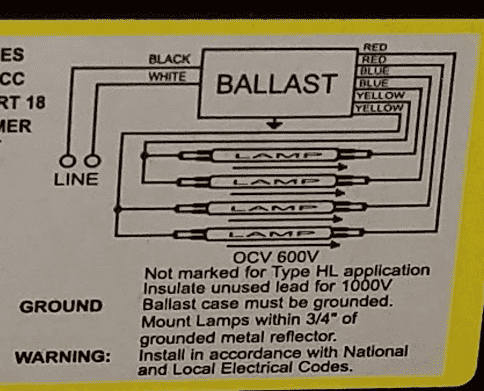
After some time, it will work fine again. Anyway, home depot says change the ballast, here's what you need. Seems simple enough, I remove the old ballast and then realize that the wiring diagrams are different.

Here is the old:
upload_2018-12-28_22-36-50.png


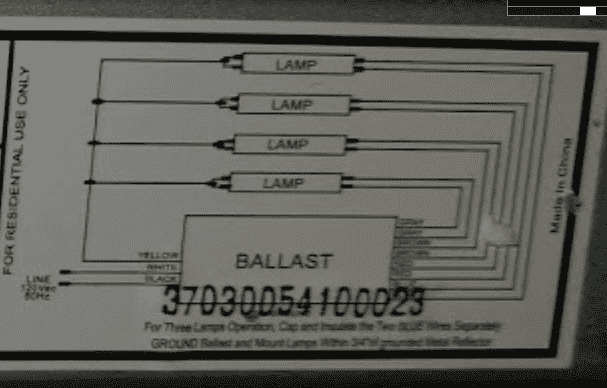
And here is the new:

upload_2018-12-28_22-39-44.png


So basically, on the yellow end of the bulbs, I need to put two bulbs in parallel (instead of all 4). And on red/blue ends, one wire goes to each bulb, and then the two prongs are in parallel instead of a separate wire going to each individual lead.

Here is my question:

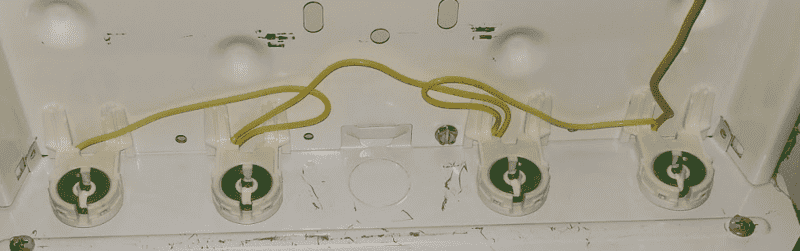
The old yellow end is wired like this:
upload_2018-12-28_22-42-40.png


I'm just wondering if it's ok to wire up one end of the prongs only, as is done here, or if it was previously wired incorrectly, and instead the yellow wires should go to each prong as is shown in the wiring diagram.

Thanks in advance for the patience regarding my dumb question.
 

Attachments

  • upload_2018-12-28_22-35-51.png
    upload_2018-12-28_22-35-51.png
    123 bytes · Views: 475
  • upload_2018-12-28_22-36-50.png
    upload_2018-12-28_22-36-50.png
    36.3 KB · Views: 983
  • upload_2018-12-28_22-39-44.png
    upload_2018-12-28_22-39-44.png
    46.9 KB · Views: 1,053
  • upload_2018-12-28_22-42-40.png
    upload_2018-12-28_22-42-40.png
    48 KB · Views: 886
Physics news on Phys.org
gpsimms said:
I'm just wondering if it's ok to wire up one end of the prongs only, as is done here,
That should be fine.
However, the original ballast heated the filaments in the lamps, allowing them to start at lower ambient temperatures, and operate longer into their end-of-life. If they need to operate at low temperature (50°F ?), get an exect replacement ballast, one that has two leads to at least one end of all the lamps.

If you need the heated filaments, it might be easier to find two ballasts, each operating two lamps.

Cheers,
Tom
 
  • Like
Likes   Reactions: gpsimms
You might take this opportunity to replace the tubes with LED. They sell LEDs in the same size, form factor, and voltage as fluorescent tubes.

If I understand their sales literature, no ballast is needed with the LED replacements.
 
  • Like
Likes   Reactions: gpsimms, NTL2009 and scottdave
Check with the instructions on the ballast (if any). I would have probably gone to an electrical supply for something like this, rather than Home Depot. When it comes to electric wiring (especially when dealing with high voltage), if you're not sure, then don't do it. Find somebody who can help you.
 
  • Like
Likes   Reactions: gpsimms
Like @anorlunda said, this is a good opportunity to switch to LED. Some LED replacement tubes can work either with a ballast or with it bypassed. Others require you to bypass the ballast (you are wiring the 110 directly to the tube connections)
 
  • Like
Likes   Reactions: gpsimms
Thanks everyone for the advice. I had already purchased the ballast, so gave it a go, and the lights worked fine.

But...

The old ballast housing did not fit over the new ballast, and I got frustrated and decided to try the LED suggestion. Wiring up the LEDs to bypass the ballast entirely was easy and seemed like a good idea.

But...

The lights worked fine and looked good, but there was a very faint humming/buzzing sound. After googling, this issue seems to mostly be related to lights that are on a dimmer. However, mine are not on a dimmer. On the installation instructions that came with the LEDS, it says very specifically "if there is any buzzing, contact an electrician."

I do not think that the wiring in our house is very old, but there are some other indications around the house (shoddy plumbing, etc.), that the previous owner was a bit of a DIYer, and maybe not great at it.

What do you all think? Thanks again for all the advice.
 
When you say you bypassed the ballast, did you actually disconnect the power side?
 
Yeah. I removed the ballast from the fixture entirely. I bought "bypass" led bulbs. The pins on one end are labelled "L" and "N" and the pins on the other end are not labelled. I connected the black wire from the ceiling in parallel to the 4 line pins and the white wire in parallel to the 4 neutral pins. The pins without labels are not wired to anything.
 
OK, ballast removed, good ("bypassed" is a little vague, could mean several things, and in troubleshooting at a distance, clear, unambiguous phrasing is important) .

LED lights contain a switching circuit to convert the source AC voltage to the Direct current that an LED needs to provide light w/o flicker. Those switching circuits typically run at higher frequencies, so would not be expected to cause an audible hum.

So I'm kinda stumped. I've installed a couple of these in my home to replace florescent tubes with no problems (I also completely removed the ballast). They probably draw less than the tubes they replace, so I wouldn't think wiring problems would be to blame.

Is it at all possible that some other dimmer is on that circuit? Unlikely, but if the wiring has been messed with, just about anything is possible. Anyone else have ideas?
 
  • #10
NTL2009 said:
OK, ballast removed, good ("bypassed" is a little vague, could mean several things, and in troubleshooting at a distance, clear, unambiguous phrasing is important) .

LED lights contain a switching circuit to convert the source AC voltage to the Direct current that an LED needs to provide light w/o flicker. Those switching circuits typically run at higher frequencies, so would not be expected to cause an audible hum.

So I'm kinda stumped. I've installed a couple of these in my home to replace florescent tubes with no problems (I also completely removed the ballast). They probably draw less than the tubes they replace, so I wouldn't think wiring problems would be to blame.

Is it at all possible that some other dimmer is on that circuit? Unlikely, but if the wiring has been messed with, just about anything is possible. Anyone else have ideas?

Ah, yes, actually. There is a dimmer on a different light on the same breaker switch. Is it possible that could be the problem?
 
  • #11
Unlikely. I was thinking more if the dimmer was actually wired into the LED, like cross-wired from another circuit or something. At any rate, if the dimmer is set to full ON or full OFF, it shouldn't create any hum anyway. It is either out of the circuit, or bypassed when ON/OFF.

You could try connecting the LED to another circuit I guess.
 
  • #12
Not sure i understand everything in this article

https://www.1000bulbs.com/land/when-to-use-shunted-vs-nonshunted-lampholders-with-your-t8s

Upgrading to LED Tubes
If you’ve decided to upgrade your fluorescent fixtures to LED, the type of ballast and sockets your fixture has may impact which LED tubes you pick. If you have an instant start ballast, plug-and-play T8 tubes will be the easiest solution to start. This type of LED tube simply installs straight into the fixture without needing to rewire or change your fixture. Keep in mind, because of the average lifespans of fluorescent ballasts and LEDs, the ballast will fail long before your bulbs do.

For installing direct wire LED bulbs, the ballast will be removed entirely and line voltage will be wired directly to the non-shunted sockets on one side of the fixture with the sockets on the other side just helping to hold the lamp in place. If bypassing an instant start ballast, the shunted sockets will need to be replaced with non-shunted ones. Recently, there have been direct wire LED tubes manufactured that are compatible with both shunted and non-shunted tombstones. These T8 bulbs are primarily designed for applications with hard to reach sockets.

if they lit you're probably okay

more here

https://insights.regencylighting.com/shunted-vs.-non-shunted-sockets-tombstones-lampholders

NTL2009 said:
LED lights contain a switching circuit to convert the source AC voltage to the Direct current that an LED needs to provide light w/o flicker. Those switching circuits typically run at higher frequencies, so would not be expected to cause an audible hum.
Quite so.
But the current they draw from he 120 volt line is taken in 'gulps' near the voltage peaks.
Being shorter duration and higher amplitude than you'd expect, the connecting wires will have a modest pulsating magnetic field at 120 hz, which is in the range of mechanical vibrations in sheet metal .

i think i'd look for one of the wires making gentle contact with sheet metal letting the magnetic field cause slight vibration, exciting the fixture like a musical instrument... think of a drum skin.
Bending the wire away from the metal or securing it with "Handyman's Secret Weapon" (duct tape) ought to quiet that effect.

old jim
 
Last edited:
  • #13
jim hardy said:
...
Quite so.
But the current they draw from he 120 volt line is taken in 'gulps' near the voltage peaks.
Being shorter duration and higher amplitude than you'd expect, the connecting wires will have a modest pulsating magnetic field at 120 hz, which is in the range of mechanical vibrations in sheet metal ...

old jim

Ahhh, good point, I hadn't thought of that.

Makes me think of another question I have regarding switching power supplies and harmonics, but if I'm motivated I'll start a separate thread on that.
 
  • Like
Likes   Reactions: jim hardy

Similar threads

  • · Replies 5 ·
Replies
5
Views
7K
  • · Replies 18 ·
Replies
18
Views
2K
Replies
24
Views
3K
  • · Replies 4 ·
Replies
4
Views
2K
  • · Replies 7 ·
Replies
7
Views
5K
  • · Replies 10 ·
Replies
10
Views
2K
  • · Replies 1 ·
Replies
1
Views
9K
  • · Replies 4 ·
Replies
4
Views
2K
  • · Replies 1 ·
Replies
1
Views
4K
Replies
14
Views
786