Flow Mapping Theorem and Obstacles

Click For Summary

Homework Help Overview

The discussion revolves around flow problems in fluid dynamics, particularly focusing on the Flow Mapping Theorem and its application in scenarios involving obstacles. Participants express challenges in understanding the concepts and applying relevant mathematical rules.

Discussion Character

  • Exploratory, Assumption checking, Problem interpretation

Approaches and Questions Raised

  • The original poster seeks assistance with flow problems, indicating difficulty with fluid flows. Another participant mentions progress on parts of the problem but struggles with a specific part, suggesting the use of the Inverse Function Rule. Questions arise regarding the definitions and functions referenced in the problem, indicating potential gaps in the provided information.

Discussion Status

Participants are actively engaging with the problem, with some offering partial solutions and others questioning the completeness of the information. There is a collaborative effort to clarify definitions and explore the mathematical relationships involved, though no consensus or complete resolution has been reached.

Contextual Notes

There appears to be missing information regarding the definition of the function Jα, which is critical for understanding the problem. Participants are navigating through the constraints of the problem setup and the implications of the mathematical rules mentioned.

fr33d0m
Messages
4
Reaction score
0
Hi All

I have one final question that's related to flow problems with obstacles.

Any help would be greatly appreciated as I am finding fluid flows extremely difficult.
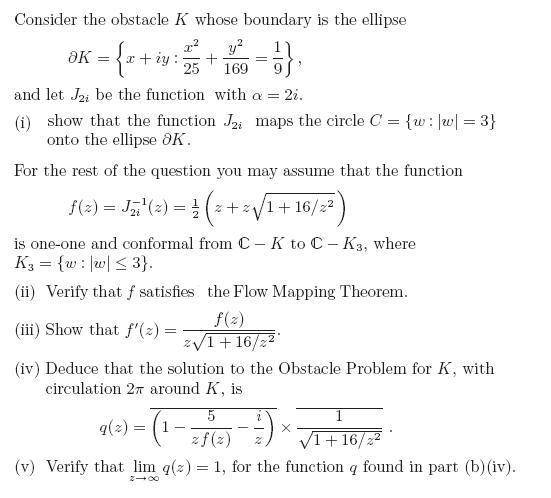
q2cb.JPG


"Examinations are formidable even to the best prepared, for
the greatest fool may ask more than the wisest man can answer".
Charles Caleb Colton, 1825
 
Physics news on Phys.org
Hi All

Think I've cracked part (i) and (ii). However, I'm stuch on part (iii). I think I need to use the Inverse Function Rule somehow to get the function stated but when I do, it doesn't give the answer. Can someone please help? The inverse function rule states that f (z)'=1/1-1/(f(z))^2.

Dont know if it will help but for part (ii) I got z+(4/z)-(16/z^3)...

Please please help...
 
There is something missing! You say "let J_{2i} be the function with \alpha= 2i". I presume that somewhere earlier they defined another function J_{\alpha} but you don't include that information.
 
The function you specift is given by the following formula:


Jalpha=w+(alpha)^2/w.

Hence j2i=3+4/3 and j2i = 3-4/3. Substituting this into the standard equation of an ellipse for a^2 and b^2 and rearranging gives the required formula. Does this help?
 

Similar threads

  • · Replies 3 ·
Replies
3
Views
2K
  • · Replies 13 ·
Replies
13
Views
4K
  • · Replies 19 ·
Replies
19
Views
5K
Replies
29
Views
6K
  • · Replies 1 ·
Replies
1
Views
3K
  • · Replies 12 ·
Replies
12
Views
7K
  • · Replies 1 ·
Replies
1
Views
4K
  • · Replies 14 ·
Replies
14
Views
6K
  • · Replies 5 ·
Replies
5
Views
12K
Replies
9
Views
14K