Fluid Dynamics Question -- Water flowing through a pipe into two cylinders

Click For Summary

Discussion Overview

The discussion revolves around fluid dynamics, specifically the performance of two cylindrical designs intended to assist in the movement of a tool string through a pipe. Participants explore the implications of design choices on fluid flow and effectiveness in achieving desired movement with minimal water usage.

Discussion Character

  • Exploratory
  • Technical explanation
  • Debate/contested

Main Points Raised

  • One participant describes a scenario involving a 4" I.D. steel tube with water flowing at ~12mph and two cylinder designs, questioning whether they will perform identically or if one will be more effective in "grabbing" water.
  • Another participant requests clarification on the terms "perform" and "more effective," seeking to understand the purpose of the cylinders and the assembly.
  • A participant explains that "more effective" means using less water to achieve the same speed, implying that Cylinder B may not provide any advantage over Cylinder A.
  • There is a discussion about the use of a rubber part versus a metal design, with concerns about wear and effectiveness in assisting the movement of a heavy tool string.
  • Participants explore the implications of the design of Cylinder B, including its shape and how it interacts with fluid flow, with one participant suggesting that a conical design may slow down the fluid and reduce force.
  • Another participant raises concerns about pressure acting on the interior walls of Cylinder B and the front end of the cylinder, suggesting that these factors could negate any potential advantages of the design.
  • One participant acknowledges a lack of awareness regarding certain forces at play, indicating a learning moment in the discussion.

Areas of Agreement / Disagreement

Participants express differing views on the effectiveness of the two cylinder designs, with no consensus reached on whether Cylinder B provides any advantages over Cylinder A. The discussion remains unresolved regarding the optimal design for the intended application.

Contextual Notes

Participants note the complexity of fluid dynamics and the need for additional information, such as sketches, to fully understand the scenarios being discussed. There are also references to assumptions about fluid behavior and pressure interactions that remain unaddressed.

nrobidoux
Messages
24
Reaction score
0
TL;DR
Being ambitious at work I had an idea that would help us but lack engineering knowledge. Fluid dynamics: does cross sectional area differ between these two objects?
Because my little work project involves fluids I thought this the best topic to post under.

I took the route of biological sciences and computer science. This area is out of my league at the moment I'm not sure the amount of time that would be required to get the material applicable to this.

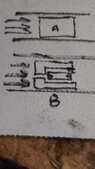
The question is pretty simple. There's a 4" I.D. steel tube with water flowing through at ~12mph. There is a choice between two cylinders. Both diameters are 3.8"; both appear similar externally except the top/bottom of #2. One is solid. The other has a 0.5" inlet on top which leads to another cylindrical solid. The outlet has more cross sectional area than the inlet.

Will each perform identically or will the latter be more effective? ("Grab more" water)

Ascii art not the easiest on the phone, my thinking got me here mathematically:

Cylinder A X- sectional area = 1.9^2 * pi
Cylinder B's =

(1.9^2 * pi - 0.25^2 * pi) + (1^2 * pi)
i.e. 3.8" top with 0.5" inlet to 2" Cylinder beneath

Have no idea if B is correct... or leaning towards the correct idea. (2nd term effectively multiplied by coefficient < 1 but result > the cross sectional area of inlet)
 
Last edited:
Engineering news on Phys.org
We need more information to help you. Without a sketch, I have no clue as to what you are trying to do. So please add a sketch.

nrobidoux said:
Will each perform identically or will the latter be more effective? ("Grab more" water)
What do you mean by "perform" and "more effective"? What is the purpose of the two cylinders? What is the purpose of this assembly?
 
jrmichler said:
What do you mean by "perform" and "more effective"? What is the purpose of the two cylinders? What is the purpose of this assembly?
Provide greater surface area to push the tool string downhole. "More effective" means using less water to achieve the same speed. So "perform identically" means the ideas for Cylinder B do nothing.
 

Attachments

  • 20221002_094441.jpg
    20221002_094441.jpg
    23.6 KB · Views: 139
Nice use of a paper towel there. So this thing is used as a shuttle. It carries that thing inside to some other location in the system?
 
  • Like
Likes   Reactions: russ_watters
erobz said:
Nice use of a paper towel there. So this thing is used as a shuttle. It carries that thing inside to some other location in the system?
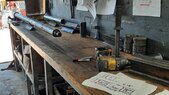
It's not a picture of the system but of the idea being explored. The reality is currently this part is made of rubber and can be used to assist the movement of the tool string. That is not its primary purpose... and rubber wears down fast. Also the rubber part is not designed to minimize wear.

Our tool string is essentially a 3.125" Cylinder that's about 60' in length and weighs close to 700 lbs. The part to assist us getting down hole is optional but helpful. Meaning that much weight (wet steel on steel) is pushed about 2 miles horizontally by water traveling at 12-15 mph (laminar flow) in a 4" ID steel tube.

Both my initial design and the rubber part are approximately the same height. If anything 1" is thicker than the rubber part.

There is a 2" "neck" about halfway in the string. Either part would slide over it and be locked in place.

I'm curious if Cylinder B provides more effective surface area to push against than Cylinder A. I have all these ideas to complicate the part, this is one of them.

However if complicating makes it work better (more speed for less water)... 👍
 
erobz said:
Nice use of a paper towel there.
Have to work with that is available. :)

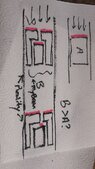
The question is depicted in the new attachment below. What is more representative of reality for the posing area for Cylinder B?
 

Attachments

  • 20221002_122016.jpg
    20221002_122016.jpg
    42.1 KB · Views: 144
  • 20221002_122030.jpg
    20221002_122030.jpg
    77.5 KB · Views: 151
You are slipping a "cup" over the cylinder to make it closer to the pipe diameter so the flow can apply more force?

You are talking about rubber cup or metal cup. You are saying its metal on metal friction, lubricated by water...where is that coming from?
 
Last edited:
erobz said:
You are slipping a "cup" over the cylinder to make it closer to the pipe diameter so the flow can apply more force?
Essentially.

Just take what's on the bench in the above picture of the work area and add on similar diameter items until 60' is reached.

In the other picture above... what is most true for B? Where pink is the pushing area. That's really what I'm trying to figure out.

"Because it's fluids" my brain leaned initially towards the left B. After drawing it my brain is at 50/50 only because it's holding out hope for the left side.

Even if I made the hole conical with the wide end at the "internal" cylinder the fluid must slow down as it enters a wider space... slower = less force. So ultimately is B equivalent to A? ( A = Right B)
 
With the scenario B on the left there is also pressure acting on the opposite interior wall of the cup that you have not highlighted. If that extra area of the cylinder face is where you think any advantage could lie, there isn't.

1664748373569.png


Furthermore,( for the same reason as above) you must consider the pressure acting on the front of cylinder. It is acting to counter the force that is pushing the cylinder. Flow must bypass to lubricate cylinder on its journey. At the front end the cylinder pressure form that fluid is pushing back. The pressure is lower, but it is the net force on an object which is important, so it needs to be considered.

1664748295310.png


$$ \sum F = F_1 - F_2 - F_{fr} = M a$$
 
Last edited:
  • Like
Likes   Reactions: Lnewqban
  • #10
I was aware of friction... but not of force 2. Thank you.
 

Similar threads

Replies
0
Views
2K
  • · Replies 45 ·
2
Replies
45
Views
6K
  • · Replies 14 ·
Replies
14
Views
2K
  • · Replies 31 ·
2
Replies
31
Views
5K
  • · Replies 2 ·
Replies
2
Views
2K
  • · Replies 9 ·
Replies
9
Views
3K
  • · Replies 20 ·
Replies
20
Views
11K
  • · Replies 1 ·
Replies
1
Views
2K
  • · Replies 29 ·
Replies
29
Views
7K
  • · Replies 6 ·
Replies
6
Views
14K