Force at the end of a Rod at rest on an inclined surface

Click For Summary
SUMMARY

The discussion focuses on calculating the force acting at point B of a uniform rod resting on an inclined surface. The rod, with a length of 1.5 meters and a weight of 30N, is positioned against a smooth surface inclined at 70°, while the other end rests on rough ground at 50°. Participants emphasize the importance of using the moment equation, moment = F x d, and suggest taking moments about point A to simplify the problem by eliminating unnecessary forces. The required force at B, denoted as R_{B2}, is determined to be perpendicular to the inclined surface.

PREREQUISITES
  • Understanding of static equilibrium in physics
  • Familiarity with moment equations and lever arms
  • Knowledge of trigonometric functions related to angles
  • Ability to interpret free-body diagrams
NEXT STEPS
  • Study the principles of static equilibrium in physics
  • Learn how to apply moment equations in various scenarios
  • Explore trigonometric relationships in inclined planes
  • Practice drawing and analyzing free-body diagrams for complex systems
USEFUL FOR

Students studying physics, particularly those focusing on mechanics, as well as educators looking for practical examples of static equilibrium and force analysis in inclined systems.

so_gr_lo
Messages
69
Reaction score
10
Homework Statement
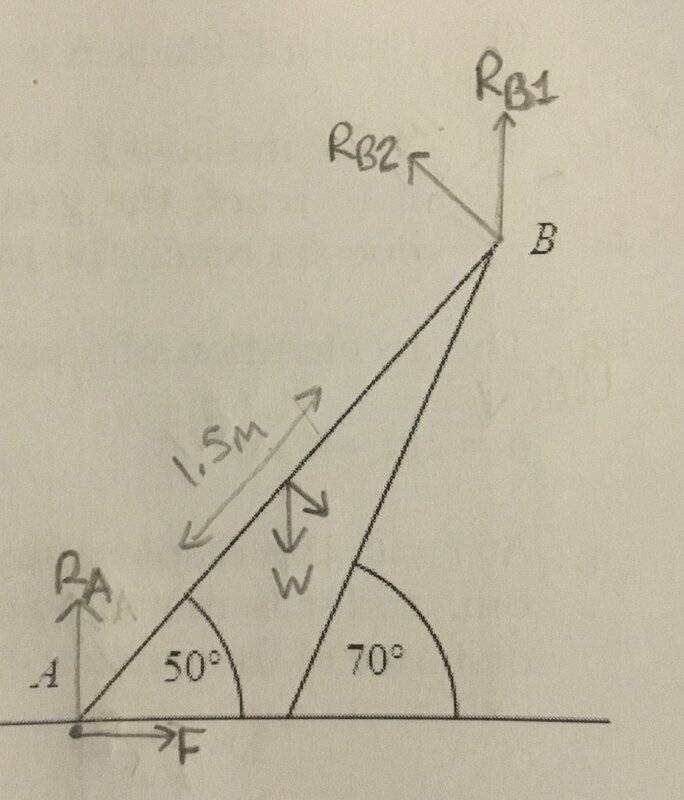
End B of uniform rod of length 1.5 weight 30N rests against smooth surface inclined at 70°. Other end, A, of rod rests on rough ground at 50°. Find the magnitude of the force acting at B.
Relevant Equations
moment = F x d
Question diagram, attempt at solution below
F00D8116-E4B5-457D-B304-1B9F8608B51D.jpeg

0F9F02A6-4850-4D38-AC73-252BD070713A.jpeg


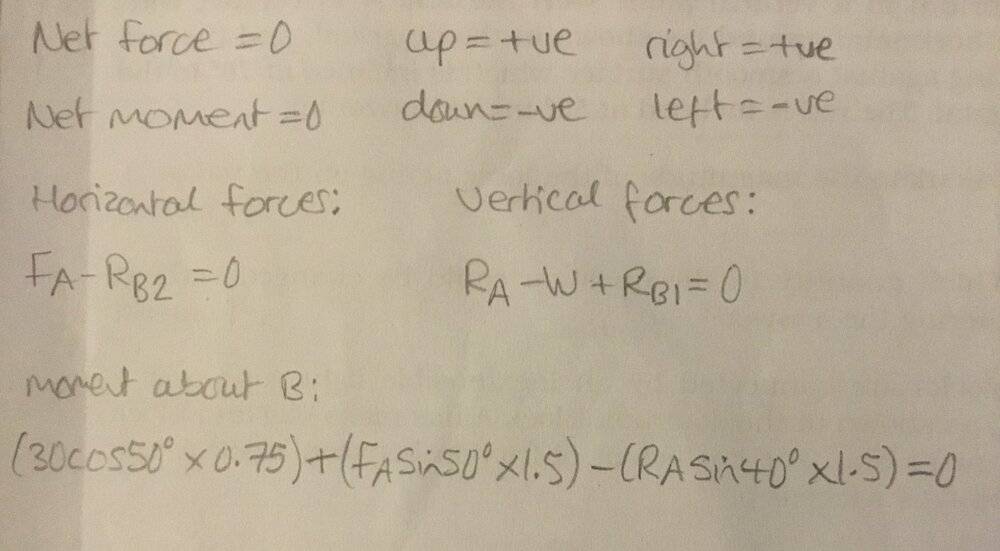
I need to cancel some of the terms in the moment equation but a not sure which ones to start with. I don’t know μ so can not calculate FA, so should probably substitute FA = RB2.
 
Physics news on Phys.org
I find your diagram and equations a bit confusing. Realize that at B, the force exerted by the surface on the rod must be perpendicular to the surface (because the surface is smooth).
 
so_gr_lo said:
Homework Statement:: End B of uniform rod of length 1.5 weight 30N rests against smooth surface inclined at 70°. Other end, A, of rod rests on rough ground at 50°. Find the magnitude of the force acting at B.
Relevant Equations:: moment = F x d

Question diagram, attempt at solution below
View attachment 274416
View attachment 274417
moment = F x d is only true if F and d are perpendicular, i.e. if d is the length of the 'lever-arm' as shown here: https://slideplayer.com/slide/14635...Scalar+Analysis+Mo+=+F+d+Mo+=+F+(r+sin+θ).jpg

One arrow from the rod's middle is the weight (W). No idea what the other arrow is.

You have marked the length incorrectly. The arrow heads should be level with the ends of the rod.

No idea what ##R_{B1}## is. But ##R_{B2}## is perpendicular to the (tilted) wall and there is no friction at B. So ##R_{B2}## is the required force.

There is no need consider horizontal/vertical forces. Take moments about point A. The clockwise moment produced by W equals the anticlockwise moment produced by ##R_{B2}##. That gives you a single equation from which to work out ##R_{B2}##.

You just need to use some simple trig’ to work out the lever -arm distances (d) for W and for ##R_{B2}##.
 
  • Like
Likes   Reactions: Delta2 and Chestermiller
Steve4Physics said:
moment = F x d is only true if F and d are perpendicular, i.e. if d is the length of the 'lever-arm' as shown here: https://slideplayer.com/slide/14635159/90/images/9/Calculating+moment+Scalar+Analysis+Mo+=+F+d+Mo+=+F+(r+sin+θ).jpg

One arrow from the rod's middle is the weight (W). No idea what the other arrow is.

You have marked the length incorrectly. The arrow heads should be level with the ends of the rod.

No idea what ##R_{B1}## is. But ##R_{B2}## is perpendicular to the (tilted) wall and there is no friction at B. So ##R_{B2}## is the required force.

There is no need consider horizontal/vertical forces. Take moments about point A. The clockwise moment produced by W equals the anticlockwise moment produced by ##R_{B2}##. That gives you a single equation from which to work out ##R_{B2}##.

You just need to use some simple trig’ to work out the lever -arm distances (d) for W and for ##R_{B2}##.
Apart from the way RB2 is drawn (seems it it supposed to be horizontal), everything looks correct so far. Also, it would be clearer if the surface were drawn to extend beyond the rod.
But there are only three equations and four unknowns. As @Doc Al posted, the unused fact is that the angled surface is smooth.

@so_gr_lo, a useful trick with such problems is to look for forces that you neither know nor need to know. By carefully choosing the axis to take moments about you can often eliminate these and get straight to the key equation.
 
My initial attempt at the solution was based on a tutorial for a similar question, however this question had a rough wall, so I included unnecessary forces.

if I take moments about A I can ignore RA and F. Below is my second attempt, but I am not sure if the line I have drawn is the correct perpendicular distance from R to A.

C6A6F0CB-0927-4B91-A0D0-791EE2EB554B.jpeg
 
so_gr_lo said:
My initial attempt at the solution was based on a tutorial for a similar question, however this question had a rough wall, so I included unnecessary forces.

if I take moments about A I can ignore RA and F. Below is my second attempt, but I am not sure if the line I have drawn is the correct perpendicular distance from R to A.

View attachment 274465
You know R is perpendicular to the surface, and you want to draw a line perpendicular to R, so...
 
So the length of the surface is the perpendicular distance between R and A?
 
so_gr_lo said:
So the length of the surface is the perpendicular distance between R and A?
No, I wanted you to think about the direction of that perpendicular distance in relation to the plane of the surface.
 
The perpendicular distance is parallel to the surface
 
  • #10
so_gr_lo said:
The perpendicular distance is parallel to the surface
Right. So if that distance meets the line of action of R at C, what is angle CAB?
 
  • Like
Likes   Reactions: Steve4Physics
  • #11
20°
 
  • Like
Likes   Reactions: Steve4Physics
  • #12
so_gr_lo said:
20°
Can I add that if the bottom of the wall is P, then ∠PBC = 90° and the lever arm (AC) is parallel to PB. Also ∠PBA = 20°. An accurate diagram can often make it much easier to see what's going on.
 
  • #13
So for R I get

13CD212D-8CD0-4959-ADAD-95DEB9911945.jpeg
 
  • Like
Likes   Reactions: Lnewqban
  • #15
Finally. Thanks for the help.
 

Similar threads

  • · Replies 36 ·
2
Replies
36
Views
6K
  • · Replies 9 ·
Replies
9
Views
14K
Replies
11
Views
2K
Replies
3
Views
2K
Replies
2
Views
1K
  • · Replies 19 ·
Replies
19
Views
3K
  • · Replies 2 ·
Replies
2
Views
2K
  • · Replies 17 ·
Replies
17
Views
2K
  • · Replies 9 ·
Replies
9
Views
5K