Force components of hanging pith balls

Click For Summary

Discussion Overview

The discussion revolves around the forces acting on hanging pith balls that are charged and have mass. Participants explore the force distribution, tension, and electrostatic interactions between the balls, with a focus on understanding the equilibrium conditions and free body diagrams. The scope includes conceptual clarification and mathematical reasoning related to the forces involved.

Discussion Character

  • Exploratory
  • Technical explanation
  • Conceptual clarification
  • Debate/contested
  • Mathematical reasoning

Main Points Raised

  • One participant expresses confusion about the force distribution and the use of tension in the context of the pith balls, questioning why tension cannot be resolved as T = g cos θ.
  • Another participant corrects the initial force diagram, emphasizing the need to include the horizontal electrostatic force exerted by the charged balls, which affects the tension calculation.
  • A participant acknowledges a mistake in their understanding of the forces, specifically regarding the equilibrium condition and the role of tension and gravitational forces.
  • Discussion includes the assertion that the electrostatic force must be considered to achieve equilibrium, leading to the conclusion that T sin θ = F and T cos θ = mg.
  • Some participants propose that resolving forces along the direction of the string leads to a clearer understanding of the relationships between tension, gravitational force, and electrostatic force.
  • There is a mention of the importance of using algebraic symbols for mass and charge to maintain clarity in calculations.

Areas of Agreement / Disagreement

Participants do not reach a consensus on the correct approach to resolving the forces acting on the pith balls. There are multiple competing views regarding the role of tension and the electrostatic force, and the discussion remains unresolved with differing interpretations of the free body diagram.

Contextual Notes

Some participants note limitations in the initial diagrams and calculations, particularly regarding the omission of the electrostatic force and the implications for equilibrium. There is also a reference to potential confusion arising from the textbook's presentation of mass without units.

Hijaz Aslam
Messages
66
Reaction score
1
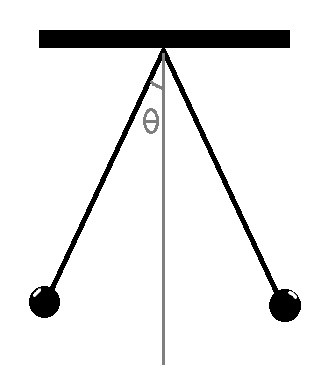
Consider the pith balls in the diagram:
WDUtRtl.png


Both of them has mass 'm' and charge 'q'. The question asks for the charge on both the pith balls.

The concept is a bit straightforward. But I am confused at the force distribution experienced by the pith balls.
My text tackles the problem with reference to the following diagram.

ag7zwvT.png


And taking ##Tcos\theta=g## and then using ##T=\frac{g}{cos\theta}## and then proceeding to find the charge.

The part I am confused with is that, if we consider the following image

VCuS9NF.png


why can't we resolve the vectors as shown in the image and use ##T=gcos\theta## and proceed?

Is it because the tension has a component perpendicular to that of 'g' ?
I am confused with the Free Body Diagram of forces. Is there any good article available on web?
 
Physics news on Phys.org
Corrections to the forces you have shown on the left hand ball. (1) The downward force is mg. (2) You have omitted the horizontal force to the left exerted by the right hand ball due to the charges on the balls. If you include this force it's easy to see why T=(m)gcosθ is wrong. Say if you don't see this.
 
Philip Wood said:
Corrections to the forces you have shown on the left hand ball. (1) The downward force is mg. (2) You have omitted the horizontal force to the left exerted by the right hand ball due to the charges on the balls. If you include this force it's easy to see why T=(m)gcosθ is wrong. Say if you don't see this.

Am sorry. My text gave the value of m=1. I missed out the 'm'.

I understand that there are two forces acting on both the balls due to each other. But are those forces a concern upon my doubt? Can you please explain?
 
The right hand ball exerts a force equal to \frac{Q^2}{4 \pi \epsilon_0 r^2} to the left on the left hand ball. This is the force you haven't shown. If you include it on your diagram things should become clearer. If they don't, do say. [The left hand ball exerts a force of the same magnitude, but to the right, on the right hand ball.]
 
Mr.Philip Wood, as I've commented above, I quite understand the role of the electrostatic force in play. I think I've got a satisfactory answer from my father. If we consider the image below. The mistake I made is that, I stated that the force ##mgcos\theta## is countered by the tension 'T'. But if we take the component of Tension along the y-axis we have ##Tcos\theta=mgcos^2\theta < mg##. This implies that there's a net acceleration in the negative y-direction, which violates the condition of equilibrium.

YyOqQJD.png


If this explanation is wrong, please point it out.
 
As Philip pointed out, a third force acts on the left-hand ball, namely the repulsive electrical force exerted by the charge on the right-hand ball. This force is exactly such that the vector sum of all three forces on the left-hand ball is zero.
 
Clearly the two forces you have shown acting on the left hand ball can't be in equilibrium, as the tension has an unbalanced horizontal component. I'm surprised that you don't seem to want to include the third (electrostatic) force, which enables equilibrium to be achieved. This force (whose magnitude I'll call F) acts to the left so it is clear that
T sin \theta = F and T cos \theta = mg.
It's as simple as this. If you divide one equation by the other you can eliminate T.
The reason why T ≠mg cos \theta is simply that F (not just mg) has a (negative) component in the direction of T. That's why I kept urging you to show F on your diagram!
 
  • Like
Likes   Reactions: Hijaz Aslam
So, resolving along the direction of the string: T = mg cos \theta + F sin \theta.
I've written this equation because it shows you why T = mg cos \theta is wrong. I'm not recommending that you use this equation, as it's far easier to use the equations obtained by resolving horizontally and vertically, as given in my previous post. In fact it's easier still to draw a vector triangle showing the three forces adding to zero. Then it's immediately clear that F = mg \ tan \theta.
 
Oh yes. Mr.Philip Wood I am sorry about my ignorance. I misunderstood your solution. I get it now. Thanks
 
  • #10
I'm so pleased that you now understand.

Just an aside: I'm a little worried about your textbook. I hope it didn't really say m = 1, with no units. In any case it's better to work with algebraic symbols where possible, and put in values only near the end. This makes it easy to check for consistency of units (or dimensions) as you go, and usually saves time.
 
  • #11
Philip Wood said:
Just an aside: I'm a little worried about your textbook. I hope it didn't really say m = 1, with no units. In any case it's better to work with algebraic symbols where possible, and put in values only near the end. This makes it easy to check for consistency of units (or dimensions) as you go, and usually saves time.

It's not the fault with my textbook, I've made a mistake. I completely forgot the 'm' in the diagram. I am referring to The Fundamentals of Physics - Halliday/Resnick/Walker, but an edited version of it.
 

Similar threads

  • · Replies 10 ·
Replies
10
Views
5K
  • · Replies 2 ·
Replies
2
Views
2K
  • · Replies 2 ·
Replies
2
Views
2K
  • · Replies 8 ·
Replies
8
Views
3K
  • · Replies 22 ·
Replies
22
Views
7K
  • · Replies 17 ·
Replies
17
Views
3K
  • · Replies 2 ·
Replies
2
Views
4K
  • · Replies 4 ·
Replies
4
Views
3K
  • · Replies 6 ·
Replies
6
Views
4K
  • · Replies 6 ·
Replies
6
Views
3K