Forces on a string applied perpendicular / tangent direction

Click For Summary
SUMMARY

The discussion centers on the mechanics of forces applied to a nylon suture in a tissue context. When a 500-gram weight is applied to both ends of the suture, the tension in the thread is calculated to be 250 grams per thread. Regardless of whether the force is applied perpendicularly or tangentially, the total force remains 500 grams, but the distribution of tension varies based on the angle and points of application. The tension in the thread can be further analyzed using the principles of static equilibrium and force distribution.

PREREQUISITES
  • Understanding of static equilibrium in physics
  • Basic knowledge of tensile strength and material properties
  • Familiarity with force distribution concepts
  • Knowledge of suture mechanics in biological applications
NEXT STEPS
  • Study the principles of static equilibrium in mechanical systems
  • Research tensile strength and failure modes of nylon sutures
  • Explore force distribution calculations in multi-point load systems
  • Investigate the effects of angle on tension in surgical sutures
USEFUL FOR

This discussion is beneficial for biomedical engineers, surgeons, and materials scientists involved in surgical procedures and suture design, as well as anyone interested in the mechanics of force application in biological tissues.

dislect
Messages
163
Reaction score
0
Hello guys,

I've had the following discussion at work:

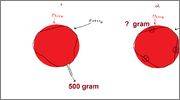
We are currently using a suture with a nylon thread on a tissue, when the thread of the suture is tightened in a force equal to if we've put a 500 gram weight on both ends of the suture line (meaning both end are tied together to the weight).
The assumption is that in this mode, the tissue will fail with a load higher than that.

We were wondering, if the force was applied perpendicularly (direction of the screen) would the max wight change from 500 gram to another value?

Would love a direction to some equations to rationalize my first instinct of saying "No!" :-)

Thanks!
123.jpg
 
Physics news on Phys.org
It does not matter which direction the force is applied - a 500g-force is a 500g-force.
The effect this has on the suture/tissue may be different at different angles.

Note: two ends tied and attached to 500g - each thread has to support 250g + whatever lateral forces are produced by pulling on the tissue. That's something like 250g tension in the thread.

Your diagram has a total of 500g-force applied at three places on the thread ... So each attachment point is supporting 500/3 g-force ... and each is basically the same as two ends, so the tension in the thread is 500/6 g-force.

S the answer kinda depends on the specifics of the question you want to ask.
 
Hi, thanks.
Yes I recon it depends on things like the length of the suture, its width, angles and so on.
But assuming both are identical for the two cases, the tension of the suture would still be 500/6 even if we apply it in at the direction of the screen instead of "pulling it" like in pic 1 (?)
 
In one pic the weight is applied to only one location in the loop - in the other pic the force is applied to three locations at the same time - if I read that right. That's what makes the biggest difference since it's the same total force.
 

Similar threads

  • · Replies 1 ·
Replies
1
Views
1K
  • · Replies 7 ·
Replies
7
Views
2K
  • · Replies 4 ·
Replies
4
Views
24K
Replies
4
Views
4K
  • · Replies 4 ·
Replies
4
Views
4K
  • · Replies 19 ·
Replies
19
Views
2K
  • · Replies 1 ·
Replies
1
Views
2K
  • · Replies 8 ·
Replies
8
Views
3K
  • · Replies 1 ·
Replies
1
Views
2K
  • · Replies 5 ·
Replies
5
Views
2K