Formula/calculation of the magnetic field & inductance in a AC cable

Click For Summary
SUMMARY

The discussion focuses on calculating the magnetic field density and inductance of high voltage AC cables, specifically those carrying 16 kV at 50 Hz. The magnetic field density can be calculated using the formula B = μI/2πR, where μ is the magnetic permeability of air, I is the current, and R is the distance from the cable. Inductance, a property of the conductor, is not dependent on distance and requires knowledge of the cable's physical characteristics. The complexity of the magnetic field is further influenced by the interaction of multiple conductors, such as the rails and overhead wires in railway systems.

PREREQUISITES
  • Understanding of electromagnetic principles, specifically magnetic field calculations.
  • Familiarity with the formula B = μI/2πR for magnetic field density.
  • Knowledge of inductance as a scalar quantity related to conductor properties.
  • Basic understanding of AC and DC current behavior in electrical systems.
NEXT STEPS
  • Research the effects of alternating current on magnetic fields in conductors.
  • Study the relationship between current, voltage, and magnetic field strength in AC systems.
  • Explore the concept of mutual inductance in systems with multiple conductors.
  • Learn about the practical applications of magnetic field calculations in railway systems.
USEFUL FOR

Electrical engineers, railway maintenance professionals, and anyone involved in high voltage AC cable design or analysis will benefit from this discussion.

Gliese123
Messages
143
Reaction score
0
Hello dear PF-members! :shy:

I'm looking for some appropriate formula which could be utilized to calculate the magnetic field density in a straight high voltage AC mere cable. If you're more into the details of why I may ask this - I'm working with the railway maintenance and got interested in how a high voltage cable relates in a physical perspective besides of what I already know - that it carries 16 kV of fatal power.

Besides the magnetic field density, I'd like to know if the inductance can be calculated and if the formula differs especially much if it's DC instead of AC? Also how far out the magnetic field (inductance) stretches out from the cable?
I know some math so understanding such thing wouldn't be awfully hard I hope :biggrin: ..

What I know is this
16 000 V
50 Hz
(The length of the cable could be considered to be of optional length since it's railway cables)

I found this formula but it seems to only be for the magnetic field density (Tesla)

B=μ*(NI/l)

Thank you for your help! :smile:
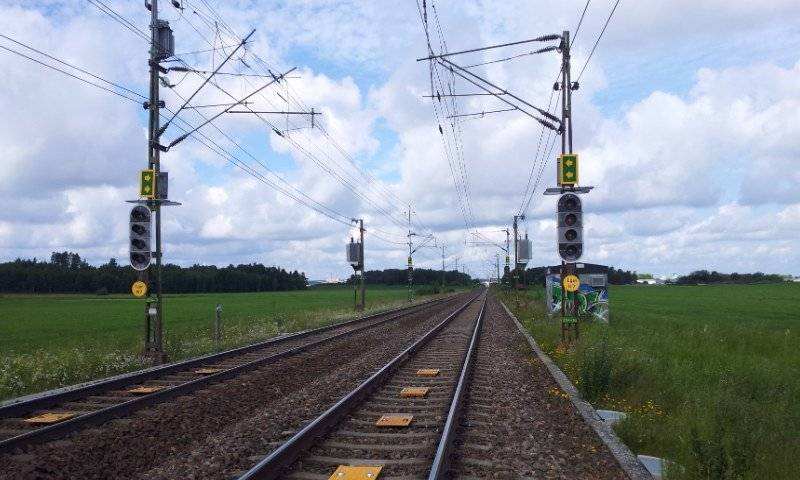
20130624_090308_zps1b7d95bd.jpg
 
Last edited:
Physics news on Phys.org
Come on... Anyone?
 
I think you are misusing the terms slightly.
Inductance is a property of a conductor (we call it L when talking about inductors in circuit classes) and, as far as I know, it is a scalar quantity (unless in certain problems it needs to be defined otherwise perhaps?), meaning that it has nothing to do with space, ie inductance does not "stretch far out". It depends upon the physical and geometrical characteristics of the cable and unless you know those it'd be hard to calculate it. however it seems this is not what you are asking.

The magnetic fiend generated by a cable is depended by the current passing through it, and not voltage, which means you'd need an estimate of the currents in such a cable in order to find B.
In this case the cables we could assume that the cables are very long, ie infinite for the purpose of calculations, and the following formula can be used B =μI/2πR, where μ is the magnetic permeability of air, R the distance from the cable and I the current flowing inside. I believe the formula is the same for AC or DC currents (AC current will create an alternating field and DC a constant one).
have a look at this http://www.phys.uri.edu/~gerhard/PHY204/tsl216.pdf
 
spyrustheviru said:
I think you are misusing the terms slightly.
Inductance is a property of a conductor (we call it L when talking about inductors in circuit classes) and, as far as I know, it is a scalar quantity (unless in certain problems it needs to be defined otherwise perhaps?), meaning that it has nothing to do with space, ie inductance does not "stretch far out". It depends upon the physical and geometrical characteristics of the cable and unless you know those it'd be hard to calculate it. however it seems this is not what you are asking.

The magnetic fiend generated by a cable is depended by the current passing through it, and not voltage, which means you'd need an estimate of the currents in such a cable in order to find B.
In this case the cables we could assume that the cables are very long, ie infinite for the purpose of calculations, and the following formula can be used B =μI/2πR, where μ is the magnetic permeability of air, R the distance from the cable and I the current flowing inside. I believe the formula is the same for AC or DC currents (AC current will create an alternating field and DC a constant one).
have a look at this http://www.phys.uri.edu/~gerhard/PHY204/tsl216.pdf
Thank you very much! Yes, I suppose inductance wasn't what I asked for. Yes, AC creates and alternating current which I have seen because in certain high voltage cables there is around 16 Hz. And an app on my phone was able to (for fun) see how the magnetic field alternated. Common 60 Hz is too fast for the app to see and is thus registrated as it it was DC.
Anyway, now On topic - the formula looks good. The values can be looked up (the resistance etc). I am on the phone now but I'll come back later for any results :p
 
Okey. By using the formula above with various values (5,5 meters and 0,1 meters) of the radius I got:

(B =μI/2πR)
B = μ*600/2π*5,5 = 2,18×10⁻⁵ T
B = μ*600/2π*0,1 = 7,53910-3 T

Is this much? Especially the latter value of 0,1 m? O.o
Thx
 
Seems to me that there are two distinct conductors involved. The Rails below form one while the wire suspended above (contacted by the pantograph on the train) forms the other. The instantaneous current flowing through the train will flow in opposite directions in those conductors. The rails and catenary wires therefore form a virtual two conductor transmission line. The distant magnetic field due to the opposed currents in the two wire transmission line will tend to cancel while the magnetic field at the midpoint between will be twice the field due to the current in either conductor.

Now the complexity. The two rails are parallel conductors so you should model half the train current in each. The overhead wire is usually a pair of wires, the one above hanging in a catenary while the one below (contacted by the pantograph) is suspended from the catenary wire by different length straps so that it is close to level. The train current will be flowing in both those overhead “parallel” wires so you will need to apportion the current between them and calculate the field due to each since the radii from your point of interest will be different.

So to calculate the field at any particular point you must sum four fields due to the four currents at the four different radii. Polarity is important. That field will only be present between the pantograph of the traction unit and the local supply connection to the line. There will be very little field beyond the train. Where power is fed from both directions the train current will be shared from ahead and behind which will effectively halve the current and the resultant field.
 
  • Like
Likes   Reactions: 1 person
Thank you. I didn't really grasp all of what you wrote there but I'm pretty much sure you meant that the magnetic field from the suspended wires have some sort of interaction which alter the magnetic field depending of wherever one stands to measure. I also think I understood the concept with the increased/decreased current from whenever a train pass by. So, if I was to calculate this with consideration of that there are several wires hanging including other cables, I suspect another formula is to be needed. I have a physics book from school which tells that if two wires are present and those wires generates an magnetic field, the formula would look like this:
F = k (l1×l2)/r (Where k is a constant; 2 × 10⁻⁷)
Observe that this only gives me the force between these cables and does not give any magnetic field.
I guess this is a bit too advanced for me :redface:
Thx
 

Similar threads

  • · Replies 27 ·
Replies
27
Views
3K
  • · Replies 8 ·
Replies
8
Views
2K
  • · Replies 15 ·
Replies
15
Views
3K
  • · Replies 6 ·
Replies
6
Views
2K
Replies
5
Views
2K
  • · Replies 4 ·
Replies
4
Views
2K
  • · Replies 16 ·
Replies
16
Views
4K
  • · Replies 15 ·
Replies
15
Views
3K
  • · Replies 42 ·
2
Replies
42
Views
3K
  • · Replies 198 ·
7
Replies
198
Views
15K