Formula for calculating the wavelength of sound in interference

Join the discussion
Ask a follow-up here, or get your own question answered by working scientists, mathematicians and engineers — people, not an autocomplete.
Real named experts · corrections over time · the nuance an AI answer skips
10 replies · 3K views
HelpMeWithPhysics
Messages
6
Reaction score
0
Homework Statement
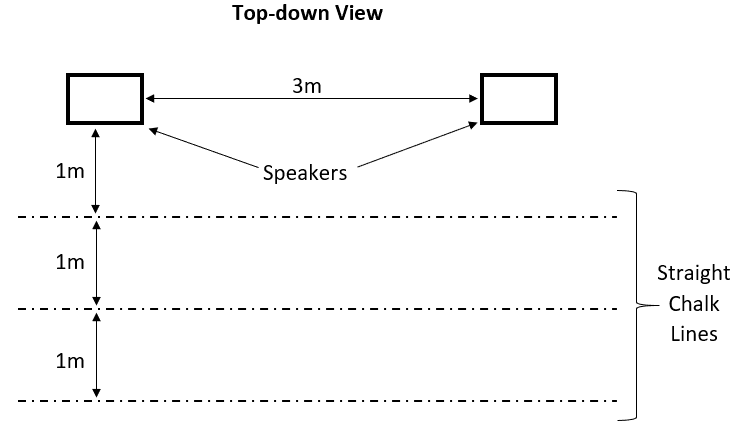
We performed an experiment where 2 speakers were set up with 3 chalk lines spaced 1 metre apart from each other in front of the speakers. A 500 hz and then a 1000 hz sound was played through both speakers. We were to walk along the lines and mark the position of where the sound was the quietest (node) for both frequencies. After that we had to measure the distance between these nodes and calculate the wavelength.
Relevant Equations
For theoretical wavelength: lambda=340m/s divided by frequency
For experimental wavelength I used: lambda=2*distance between nodes
The values calculated was nowhere near the theoretical values, though I guessed they won't be as the results recorded was incredibly inaccurate. My teacher acknowledged the fact the final values won't be close to the theoretical ones but also said that my formula was wrong, that it works to find wavelength of the first line and not the other 2. I need help finding what formula to use, I have searched everyone but I don't really know what I'm looking for and our teacher said that it's not in the textbook that we use.
Here is a diagram of experiment:
vkwpv-f1zrorclu9cd4ridisonsy2mtxxxntrpwdz8hy35-png.png

Here is the results:

Average distance between nodes (cm)
Frequency (hz)Line 1Line 2Line 3
500253176105
1000333438None
My analysis:
ƛ/2=D
∴ƛ=2D where ƛ=wavelength (cm)
D=distance between nodes/antinodes (the average,cm)

500hz:
Line 1: 506cm
2: 356cm
3: 210

100hz:
Line 1: 666cm
2: 876cm
3: none

As seen above the wavelengths are not same for the different lines, that's because I used the same formula. My guess is that there should be a third value in the equation, eg 'n' where n might equal number of lines/harmonics or whatever. But I'm not sure.

Any help would be appreciated relating to the formula. I need the formula of lambda when the waves are in the same direction.
 
on Phys.org
haruspex said:
That's not what D means in the formula you quote. For interference, what is the relevant distance?
Is the relevant distance between the two speakers?
 
haruspex said:
No.
Why does interference occur?
Due to sound waves overlapping. You will get constructive and destructive interference.
 
I'm going to need some more help, I'm in yr10 and am struggling with finding the correct formula. Also what is a static node? And what do you mean by phase? Thanks
 
HelpMeWithPhysics said:
what is a static node?
A node that is at a constant location.
HelpMeWithPhysics said:
what do you mean by phase?
If you draw a graph y=sin(x) then shift it sideways a bit you are changing its phase. E.g. it becomes y=sin(x+φ), φ being the phase shift.
If the distance from a source to a listener is not a whole number of wavelengths then, at a given instant, the listener is receiving the signal at a different phase from that at which it is being emitted.
If a signal from one source can take two paths to a listener, and the difference in the path lengths is not a whole number of wavelengths then the listener receives the signal at two different phases. This will cause the signal to be partly or wholly cancelled. That is interference. If mostly canceled then destructive interference; if in phase or nearly so then constructive interference.

In the present case you have two loudspeakers, but you can assume they emit in phase, so effectively a single source, but with different path lengths to the listener.

But really this is all stuff you should have been taught if you are being posed this question.
 
Last edited:
But really this is all stuff you should have been taught if you are being posed this question.

I agree with you, i should have been taught this by our physics teacher before hand. The problem is when my physics teacher doesn't go over anything. This whole class is confused and she refuses to help. So I have to use other methods of finding out what do to. Hence y I'm on this page. U have been more useful then 7 weeks of my physics teacher.

I'll go over what u said before and let u know if I need anymore help. Thanks
 
haruspex said:
A node that is at a constant location.

If you draw a graph y=sin(x) then shift it sideways a bit you are changing its phase. E.g. it becomes y=sin(x+φ), φ being the phase shift.
If the distance from a source to a listener is not a whole number of wavelengths then, at a given instant, the listener is receiving the signal at a different phase from that at which it is being emitted.
If a signal from one source can take two paths to a listener, and the difference in the path lengths is not a whole number of wavelengths then the listener receives the signal at two different phases. This will cause the signal to be partly or wholly cancelled. That is interference. If mostly canceled then destructive interference; if in phase or nearly so then constructive interference.

In the present case you have two loudspeakers, but you can assume they emit in phase, so effectively a single source, but with different path lengths to the listener.

But really this is all stuff you should have been taught if you are being posed this question.
is this it
Length = (Velocity ÷ Frequency) ÷ 2
Wavelength = 2 x length
 
HelpMeWithPhysics said:
is this it
Length = (Velocity ÷ Frequency) ÷ 2
Wavelength = 2 x length
No.
Suppose that at some instant the waves generated from one source have displacement (pressure, say) A sin(kx) at any point which is distance x from that source. You can visualise this as waves forming concentric rings around the source, yes?
If the wavelength is λ then points at distances x and x+λ have the same phase at any given instant. (They won't have quite the same displacement since the waves get a bit smaller as we get further from the source.)
So sin(kx)=sin(k(x+λ)), whence kx+2π=k(x+λ), 2π=kλ, k=2π/λ. So we have displacement A sin(2πx/λ) at the point.

Now consider the same point in relation to the other source. If its distance from that source is x', what is the displacement of the wave from this second source at the point? What do the two displacements add up to?