Fourier coefficients - dirichlet problem for annulus

Click For Summary
SUMMARY

The discussion focuses on solving the Dirichlet problem for an annulus defined by the Laplace equation \( u_{xx} + u_{yy} = 0 \) within the region \( 0 < a^2 < x^2 + y^2 < b^2 \). The user is attempting to find the Fourier coefficients \( C_0 \) and \( D_0 \) but encounters discrepancies when comparing their results to the expected solution, which includes a factor of \( \frac{1}{\pi} \) in the integrals of boundary functions \( g(\theta) \) and \( h(\theta) \). The user is advised to evaluate the integral \( \int_0^{2\pi} u(a, \theta) \, d\theta \) to clarify the relationship between the coefficients and the boundary conditions.

PREREQUISITES
  • Understanding of Laplace's equation and its applications in potential theory.
  • Familiarity with Fourier series and their coefficients.
  • Knowledge of boundary value problems, specifically the Dirichlet problem.
  • Proficiency in performing integrals over periodic functions.
NEXT STEPS
  • Review the derivation of Fourier coefficients for boundary value problems in annular regions.
  • Study the application of the factor \( \frac{1}{\pi} \) in Fourier series expansions.
  • Explore the properties of harmonic functions and their representation in polar coordinates.
  • Practice solving similar Dirichlet problems using different boundary conditions.
USEFUL FOR

Mathematics students, particularly those studying partial differential equations, applied mathematicians, and anyone interested in the theory of Fourier series and boundary value problems.

Dassinia
Messages
141
Reaction score
0
Hello

1. Homework Statement

Find the Fourier coefficients in the annulus problem of the text.
uxx+uyy=0 in 0<a²<x²+y²<b²
u=g(θ) for x²+y²=a²
u=h(θ) for x²+y²=b²

Homework Equations


The solution is
upload_2016-4-21_17-42-38.png


The Attempt at a Solution


I have the solutions but when I solved it for Co and Do I didn't get the same thing, but or all the other coefficients I got the right thing.

Here is the problem
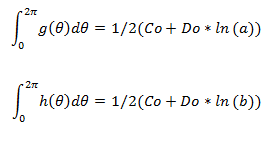
To get Co and Do I did the integral on both sides from 0 to 2π to get rid of the sum.
So I ended up with
upload_2016-4-21_17-47-2.png


But the solution give a factor 1/π Before the integral of h and g , why ?
Thank you !
 
Try $$\int_0^{2\pi}u(a,\theta) \, d \theta$$ and see what you get. You'll have two sides, one is ##g## and the other is the long series you've posted.
 

Similar threads

  • · Replies 6 ·
Replies
6
Views
2K
  • · Replies 3 ·
Replies
3
Views
2K
  • · Replies 1 ·
Replies
1
Views
1K
  • · Replies 7 ·
Replies
7
Views
2K
  • · Replies 5 ·
Replies
5
Views
2K
  • · Replies 2 ·
Replies
2
Views
2K
  • · Replies 16 ·
Replies
16
Views
2K
  • · Replies 4 ·
Replies
4
Views
1K
Replies
3
Views
2K
  • · Replies 1 ·
Replies
1
Views
2K
