Unicorn.
- 39
- 0
Hello,
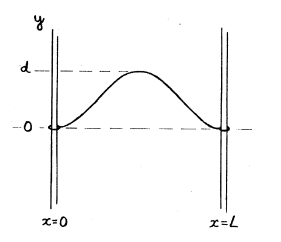
A rope of mass M and length L is tend with tension T between two rings free to oscillate along a rod parallel to the y axis. Initially the rings are maintained at y=0 while we give to the rope a y(x,0)=dsin²(pix/L).
Give the complete expression of motion of the rope in term of its Fourier components.
y(x)=Ʃ Ancos(npix/L)
An=2/L∫y(x)cos(npix/L) dx from 0 to L
The spatial period si P=L and it has to be symetric around points x=0 and x=L, so all the Bn=0.
So I tried to calculate An.
An=2/L∫dsin²(pix/L)*cos(npix/L) dx from 0 to L
I used the identities:
sina*cosb=1/2[sin(a+b)+sin(a-b)] to make the integral easier then I had
An=d/L∫sin(pix/L)sin(a+b)+sin(pix/L)sin(a-b) dx
The problem is that when I calculated everything I found that An=0 ...?
I'm supposed to find that
y(x)=[d/2-d/2*cos(2*pi*x/L)]*cos(wnt)
I arrived to
An=(-d/2)[sin(2π+nπ)/(2π+nπ)+sin(2π-nπ)/(2π-nπ)]
Then I used sin(a + b) = sin a. cos b + sin b. cosa and as n= 1,2,3... we found An=0
I also did it using sin²(x)=1/2cos(2x).. same result
Thanks
Homework Statement
A rope of mass M and length L is tend with tension T between two rings free to oscillate along a rod parallel to the y axis. Initially the rings are maintained at y=0 while we give to the rope a y(x,0)=dsin²(pix/L).
Give the complete expression of motion of the rope in term of its Fourier components.
Homework Equations
y(x)=Ʃ Ancos(npix/L)
An=2/L∫y(x)cos(npix/L) dx from 0 to L
The Attempt at a Solution
The spatial period si P=L and it has to be symetric around points x=0 and x=L, so all the Bn=0.
So I tried to calculate An.
An=2/L∫dsin²(pix/L)*cos(npix/L) dx from 0 to L
I used the identities:
sina*cosb=1/2[sin(a+b)+sin(a-b)] to make the integral easier then I had
An=d/L∫sin(pix/L)sin(a+b)+sin(pix/L)sin(a-b) dx
The problem is that when I calculated everything I found that An=0 ...?
I'm supposed to find that
y(x)=[d/2-d/2*cos(2*pi*x/L)]*cos(wnt)
I arrived to
An=(-d/2)[sin(2π+nπ)/(2π+nπ)+sin(2π-nπ)/(2π-nπ)]
Then I used sin(a + b) = sin a. cos b + sin b. cosa and as n= 1,2,3... we found An=0
I also did it using sin²(x)=1/2cos(2x).. same result
Thanks
Last edited: