Frequency of TV signal from EM waves

Click For Summary
SUMMARY

The discussion centers on the frequency of TV signals as they relate to electromagnetic (EM) waves. Participants explain that the signal variation occurs as the student moves between nodes (points of minimum displacement) and antinodes (points of maximum displacement), leading to the conclusion that option C is correct. Additionally, a reference to an EngineerGuy video demonstrates a similar experiment using a microwave oven, illustrating the principles of wave behavior in a practical context.

PREREQUISITES
  • Understanding of electromagnetic waves and their properties
  • Familiarity with wave phenomena such as nodes and antinodes
  • Basic knowledge of signal transmission in television technology
  • Experience with practical experiments involving microwaves
NEXT STEPS
  • Research the principles of wave interference and its effects on signal strength
  • Explore the concept of nodes and antinodes in wave mechanics
  • Watch the EngineerGuy video on microwave experiments for practical insights
  • Investigate the relationship between frequency and wavelength in EM waves
USEFUL FOR

This discussion is beneficial for physics students, educators, and anyone interested in understanding the behavior of electromagnetic waves and their applications in technology.

Bolter
Messages
262
Reaction score
31
Homework Statement
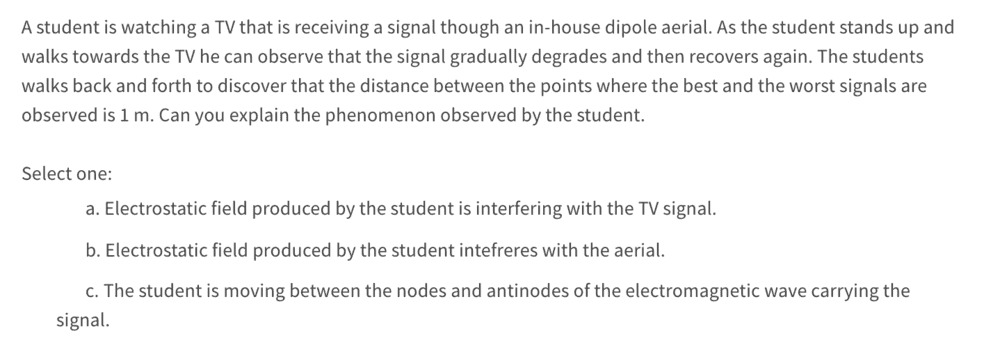
See image attached below
Relevant Equations
V = freq x wavelength
Having some trouble with this question
Screenshot 2020-03-06 at 16.18.26.png


I believe phenomenon behind this one is that the student is passing between nodes (minimum displacement) to antinodes (maximum displacement) which explains why the signal weakens and strengthens continuously. Hence the ans to this is option C?

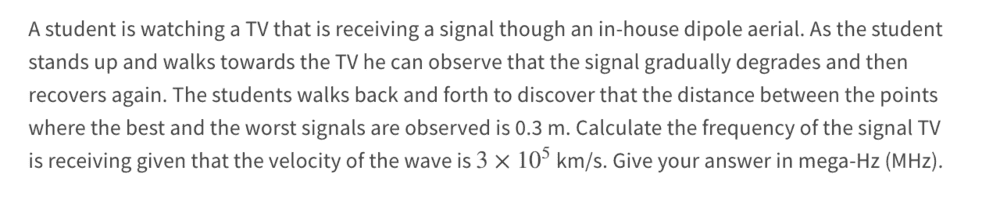
For the 2nd part, I have this:
Screenshot 2020-03-06 at 16.21.24.png

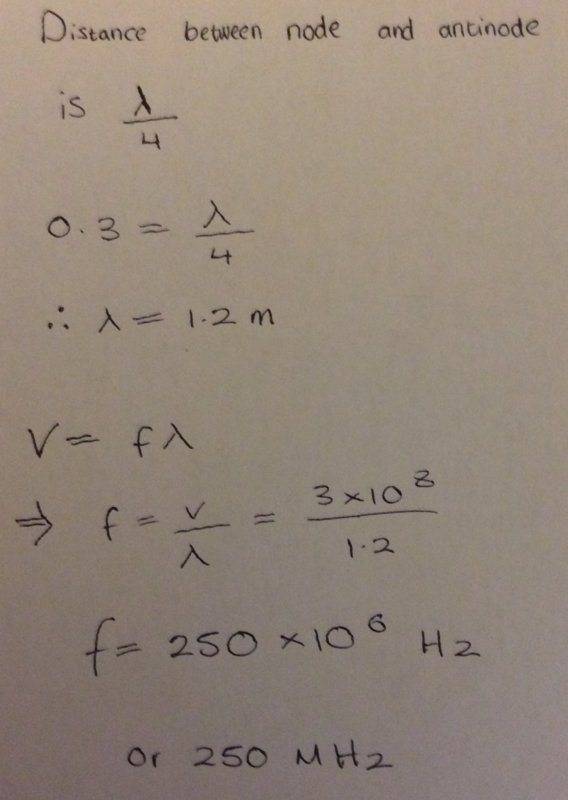
From what I have figured out earlier, I had done the following:
IMG_0783.JPG


Does this seem reasonable?

Thanks for any help!
 
Physics news on Phys.org
It looks like you know what you're doing. Check out this EngineerGuy video where he does a similar type experiment with a microwave oven and some melting cheese (about 2 minutes into the video).

 
  • Like
Likes   Reactions: Bolter
scottdave said:
It looks like you know what you're doing. Check out this EngineerGuy video where he does a similar type experiment with a microwave oven and some melting cheese (about 2 minutes into the video).


Thank you for sharing this video, found it pretty fascinating o0)
 

Similar threads

  • · Replies 15 ·
Replies
15
Views
3K
  • · Replies 5 ·
Replies
5
Views
6K
  • · Replies 6 ·
Replies
6
Views
2K
  • · Replies 10 ·
Replies
10
Views
3K
  • · Replies 21 ·
Replies
21
Views
2K
  • · Replies 1 ·
Replies
1
Views
3K
  • · Replies 7 ·
Replies
7
Views
3K
  • · Replies 1 ·
Replies
1
Views
3K
  • · Replies 4 ·
Replies
4
Views
3K
  • · Replies 15 ·
Replies
15
Views
3K