Frequency Response of a Damped Car-Suspension System

Click For Summary
SUMMARY

The discussion centers on analyzing the frequency response of a quarter car suspension system when both tires encounter a pothole simultaneously. Participants clarify that the scenario is better represented by a half-car model and emphasize the importance of using a step response rather than a frequency response to analyze the system's behavior. Key techniques mentioned include solving differential equations using MATLAB's ODE45 function and applying Laplace transforms to derive the system's response. The moment of inertia of the wheels is noted as negligible for this analysis.

PREREQUISITES
  • Understanding of quarter car and half-car suspension models
  • Familiarity with differential equations and their solutions
  • Knowledge of Laplace transforms
  • Experience using MATLAB, specifically the ODE45 function
NEXT STEPS
  • Research the application of ODE45 in MATLAB for solving ordinary differential equations
  • Study the differences between frequency response and step response in mechanical systems
  • Learn about modal analysis and how to calculate modal weights
  • Explore the impact of rigid body dynamics on suspension systems
USEFUL FOR

Mechanical engineers, automotive suspension designers, and students studying dynamics and control systems will benefit from this discussion.

Engineer47
Messages
2
Reaction score
0
Homework Statement
How can I solve for the frequency response of a damped system when I have the full matrices for M, C, and K when a car suspension hits a pot-hole of a certain height?
Relevant Equations
The equation I have now to work with it M(U(double dot)) which is a 4x4 matrix, times a 4x1 matrix, -[K]*[U] -[C][U(dot)] where M is the mass matrix, k is the spring matrix, and c is the damper matrix, all of the same dimensions as the M and U(double dot) matrix above. I am trying to solve using eigenvalues or vectors I believe with modal superposition on Matlab!
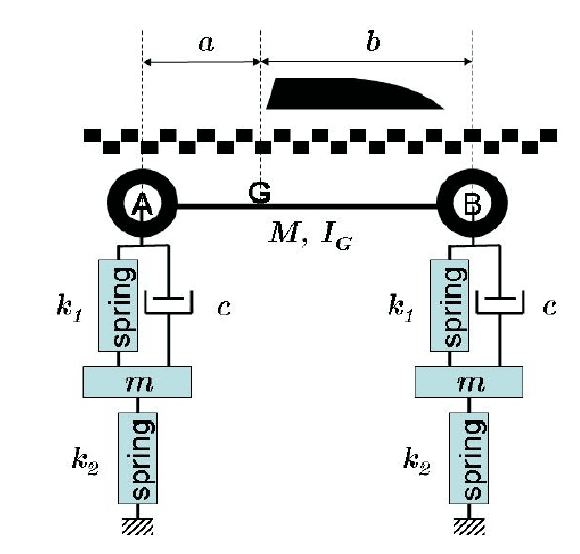
The quarter car system is represented by the above picture and I currently have all of the equations of motion and constants for each spring, mass, damper, distance, and moment of inertia. How can I find the frequency response with this information and knowing both tires hit a pothole of height h at the same time? Thanks!
243021
 
Physics news on Phys.org
Helllo engineer, :welcome: !

Looks more like a half-car representation to me :smile:
Even so, your wheels (front and back) won't hit the pothole simultaneously -- or is that outside the scope of your exercise ? And you draw an ##a## and a ##b## -- but do you have the moment of inertia around a wheel as a given ?

Anyway: what happens at a pothole is not described with a frequency response, but with a step response (or a pulse ersponse, but both: in the time domain, not the frequency domain.

Did you learn about Laplace transforms already ? If not, you have to solve the differential equation as is.
 
BvU said:
Helllo engineer, :welcome: !

Looks more like a half-car representation to me :smile:
Even so, your wheels (front and back) won't hit the pothole simultaneously -- or is that outside the scope of your exercise ? And you draw an ##a## and a ##b## -- but do you have the moment of inertia around a wheel as a given ?

Anyway: what happens at a pothole is not described with a frequency response, but with a step response (or a pulse ersponse, but both: in the time domain, not the frequency domain.

Did you learn about Laplace transforms already ? If not, you have to solve the differential equation as is.
Hi! It technically is a half-car representation, and is to be treated as a rigid body. Furthermore, the moment of inertia of the wheels aren't given and can be neglected. I already have the equations of motion of each mass as well, I am just unsure on how to take those and see how a pothole affects them. And although it makes sense that the front and back wheels wouldn't hit the hole at the same time, I am to assume it is. And although I have learned about Laplace Transforms already, I think the problem requires some use of ODE45 in MATLAB and solve for undamped modes, finding the modal weights, and then summing to find the frequency response to all of the modes!
 

Similar threads

  • · Replies 0 ·
Replies
0
Views
2K
  • · Replies 2 ·
Replies
2
Views
1K
Replies
3
Views
861
Replies
4
Views
2K
  • · Replies 4 ·
Replies
4
Views
4K
  • · Replies 1 ·
Replies
1
Views
5K
Replies
3
Views
3K
  • · Replies 1 ·
Replies
1
Views
1K
  • · Replies 1 ·
Replies
1
Views
2K
  • · Replies 2 ·
Replies
2
Views
3K
