SUMMARY
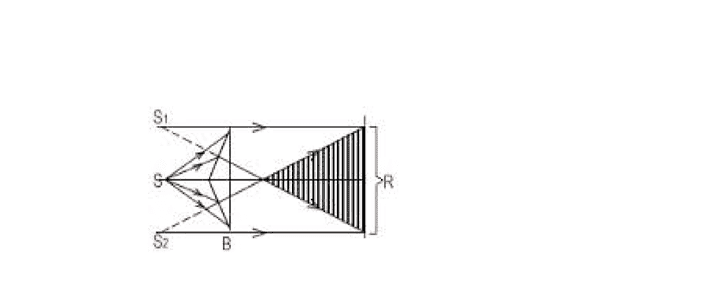
Fresnel's biprism experiment utilizes virtual sources S1 and S2, formed by the refraction of light rays R1 through R4, to demonstrate interference patterns. The rays from an actual point source S are bent by the biprism, creating two virtual sources from which the refracted rays appear to emanate. The experiment confirms that interference occurs when wave fronts are parallel, necessitating the biprism's edge to align with the slit. This discussion clarifies the optical principles behind the experiment and addresses common misconceptions regarding the nature of the biprism.
PREREQUISITES
- Understanding of optical principles, specifically light refraction
- Familiarity with the concept of virtual sources in optics
- Knowledge of interference patterns and their formation
- Basic comprehension of prism geometry and types, particularly acute-angled prisms
NEXT STEPS
- Study the principles of light refraction using Fresnel's equations
- Explore the mathematical foundations of interference patterns in optics
- Learn about the construction and application of common-path interferometers
- Investigate the differences between diffraction and interference in wave optics
USEFUL FOR
Students and educators in physics, optical engineers, and researchers interested in wave optics and interference phenomena will benefit from this discussion.