Gamma radiation decay intensity (IAEA nuclide chart)

Click For Summary

Discussion Overview

The discussion revolves around the interpretation of gamma radiation decay intensity data from the IAEA nuclide chart, focusing on the absolute intensity values and their relation to decay processes. Participants explore concepts related to gamma emission, internal conversion, and the implications of these processes on the reported intensities.

Discussion Character

  • Exploratory
  • Technical explanation
  • Debate/contested

Main Points Raised

  • Some participants express confusion regarding why the absolute intensity values do not sum to 100%, contrasting this with beta decay intensities that do.
  • It is noted that the 0.662 KeV state of Ba-137 decays 85% of the time by gamma emission, with the remainder involving internal conversion processes.
  • Participants discuss that some nuclides, like Co-60, decay by emitting multiple gamma rays, which may complicate the understanding of intensity percentages.
  • There is a query about the significance of the 15% of decays for Cs-137 that do not result in gamma emission, prompting further exploration of decay pathways.
  • Clarification is provided regarding the meaning of 'CE' as conversion electron, distinguishing it from Auger electrons.
  • One participant suggests that the percentages represent the radiation per decay, indicating that not all decays lead to additional radiation emissions.
  • Another participant raises concerns about the uncertainties in beta branching ratios and their impact on the calculations of decay probabilities.
  • A later contribution explains that the relative intensity values do not need to sum to 100% as they are comparisons to the most intense gamma emission from a given level.

Areas of Agreement / Disagreement

Participants express varying levels of understanding regarding the interpretation of intensity values and the decay processes involved. There is no consensus on the reasons behind the discrepancies in the percentages, and multiple viewpoints on the interpretation of the data remain present.

Contextual Notes

Participants mention uncertainties related to beta branching ratios and how these might affect the calculations and interpretations of decay probabilities. The discussion also highlights the complexity of decay processes and the need for careful consideration of the data presented.

eneacasucci
Messages
69
Reaction score
18
TL;DR
Gamma radiation decay intensity in IAEA website, what does it represent.
I was looking at the gamma radiation data from IAEA's website:

(https://www-nds.iaea.org/relnsd/vcharthtml/VChartHTML.html)

and was confused by the absolute intensity listed in the page. I Googled it and it seems to be the probability of emission but why it doesn't add up to 100%?

For example Cs-137 https://www-nds.iaea.org/relnsd/vcharthtml/VChartHTML.html
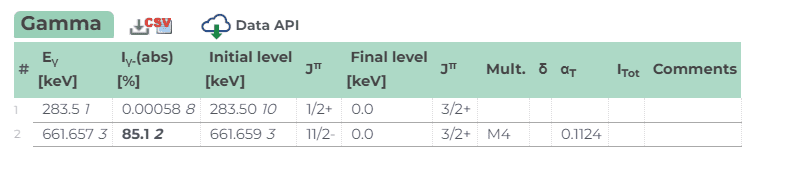
1676837141354.png

I don't understand why, because for example the sum of the beta intensities is 100%:
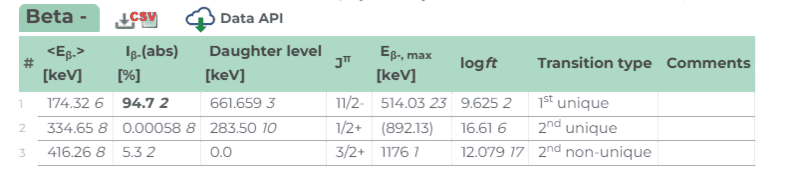
1676837187940.png
I know about gamma intensity related to the attenuation in matter but this is another topic

Thank you so much for your help
 
Last edited:
Physics news on Phys.org
The 0.662 KeV state of Ba137 decays 85% of the time only by gamma emission and decays by the internal conversion process the rest of the time.
 
  • Like
Likes   Reactions: eneacasucci
Some nucleai, like Co-60 decay by more than one gamma.
 
gleem said:
The 0.662 KeV state of Ba137 decays 85% of the time only by gamma emission and decays by the internal conversion process the rest of the time.
This would make sense and clarify the %, but how do you know it? I don't see this info in the website
 
Vanadium 50 said:
Some nucleai, like Co-60 decay by more than one gamma.
Thank you for your answer. I know that there could be more than one gamma, but for Co-60 the main two gammas (1332 keV and 1173 keV) are related to different initial level. For Cs-137, considering the level 662 keV, if only 85% of times the nucleus decays to ground level emitting the related gamma, what happens the 15% of times (still starting from that level)?
 
eneacasucci said:
I don't see this info in the website
Look under the heading "Electrons".
 
  • Like
Likes   Reactions: eneacasucci
eneacasucci said:
I know that there could be more than one gamma, but for Co-60 the main two gammas (1332 keV and 1173 keV) are related to different initial level
Huh?

They come from the Co-60 ground state, and you get two, not one or the other.
 
gleem said:
Look under the heading "Electrons".
My fault, I wasn't considering the column of electrons and now I see them. My last question is: shouldn't these [%] (highlighted in yellow) make 100% (because it doesn't)?
1676884213363.png


(Excuse my ignorance, but what does the initials 'CE' mean (before the electron's shell)?
 
  • #10
eneacasucci said:
My fault, I wasn't considering the column of electrons and now I see them. My last question is: shouldn't these [%] (highlighted in yellow) make 100% (because it doesn't)?
Keep in mind the percentages are the percentages of the radiation per decay. Cesium decays 5% of the time to the ground state of Ba which has no additional radiation processes. So only about 95% of the decays of Cs result in additional radiation so expect a gamma or an internal conversion electron 95% of the decays.
 
  • Like
Likes   Reactions: eneacasucci
  • #11
I think I got it now.
The percentages match as it should be right?
1676912083021.png
1676912097973.png
 
Last edited:
  • #12
I've tried to make the same reasoning applied to Co-60.
I considered level 1332. You can reach it with the beta decay
1676935015323.png
, and with gamma decays
1676935642138.png
. Also without considering the conversion electrons the tot probability to reach final level 1332 (99,9776%) is lower than the probability of decaying from that level (99,9826%)

I've also tried to download the excel file with the whole data but there is still this incongruency... so I'm doubting I didn't understand the concept
 
  • #13
Did you take into account the uncertainties in the data especially the beta branching ratios?
 
  • #14
gleem said:
Did you take into account the uncertainties in the data especially the beta branching ratios?
No I didn't, I don't know exactly how to deal with them. I just wanted to be sure that "my reasoning" (which would be the application of what you explained to me in the previous messages) was correct, and that the non-coincidence of numbers was due to something else
 
  • #15
Play with the data and see how it affects your results. Increase the 1.332 Beta ratio 0.12 ±.03 to a value within the uncertainty for example.
 
  • #16
I had the same question and found some information in this site:
https://www-nds.iaea.org/relnsd/vcharthtml/guide.html.
There it says:
Iγ(rel) Relative Intensity 100 is assigned to the most intense gamma from a given initial level, and other gammas relative intensities are referred to that.
So, my humble opinion in this case is, they do not have to add up to 100%, because the percentage here is just for comparison between any given intensity and the intensity of the “most intense” gamma, it would mean just how much smaller are those other gammas relative to the 100% highest intensity gamma. It would make more sense to relate them with a relative ratio than with percentage, which in most cases gives a balance of species out of a total.
 

Similar threads

  • · Replies 4 ·
Replies
4
Views
2K
  • · Replies 20 ·
Replies
20
Views
3K
  • · Replies 2 ·
Replies
2
Views
1K
  • · Replies 6 ·
Replies
6
Views
3K
  • · Replies 1 ·
Replies
1
Views
2K
  • · Replies 18 ·
Replies
18
Views
4K
  • · Replies 4 ·
Replies
4
Views
5K
Replies
3
Views
2K
  • · Replies 8 ·
Replies
8
Views
2K
  • · Replies 4 ·
Replies
4
Views
2K