Gauge Invariance (QED): How Does the Statement Hold?

Join the discussion
Ask a follow-up here, or get your own question answered by working scientists, mathematicians and engineers — people, not an autocomplete.
Real named experts · corrections over time · the nuance an AI answer skips
8 replies · 2K views
PhyAmateur
Messages
103
Reaction score
2
My book says that in this case $$e^+e^- \rightarrow \gamma \gamma $$ gauge invariance requires that $$k_{1\nu}(A^{\mu\nu} + \tilde{A}^{\mu\nu})=0=k_{2\mu}(A^{\mu\nu} + \tilde{A}^{\mu\nu})$$ Please see attachment. My question is how does this statement hold?
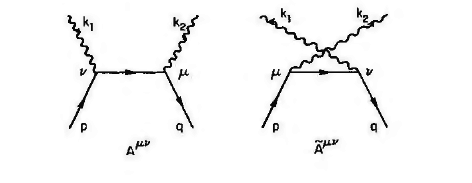
Capture.PNG
Capture.PNG
 
Last edited:
Physics news on Phys.org
But the author insisted that these conditions are met although the quantities in the equations k1ν(Aμν+A~μν)=0=k2μ(Aμν+A~μν) each separately are all different from zero. Why would he say that if it is already a consequence of ward identity? @vanhees71
 
  • Like
Likes   Reactions: loopylisa
How does this have to do with my question? I can't relate.
 
  • Like
Likes   Reactions: loopylisa
If you write out the expressions for ##A^{\mu\nu}## and ##\tilde{A}^{\mu\nu}## that you get from computing these diagrams, you will find that ##k_{1\nu}(A^{\mu\nu} + \tilde{A}^{\mu\nu})=0## and ##k_{2\mu}(A^{\mu\nu} + \tilde{A}^{\mu\nu})=0##. So, while this can be predicted from gauge invariance, it is also the result of doing the explicit calculation.
 
  • Like
Likes   Reactions: PhyAmateur
Are you telling me that Ward Takashi holds for the amplitude and not necessarily for each of the Feynman diagrams whose sum is the amplitude? @vanhees71
 
Yes, that's it. The same is true for other symmetries, like charge conjugation symmetry, which implies that n-photon vertices with an odd number of photons must vanish. This also holds true only for the sum at a given loop order. Take, e.g., the one-loop triangle diagrams. You need to add both contibutions (which are different only by the orientation of the electron-positron loop making up the triangle).