Gauss' Law: Understand How to Calculate Flux

Click For Summary
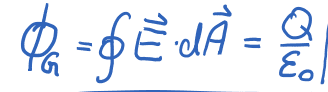
Gauss' Law is essential for calculating electric flux, with two main formulas: integration of the electric field over an area and the equation Q/ε0. The choice of formula depends on the information available; if the electric field is known, use the integral method. Conversely, if the charge enclosed by the surface is known, apply the Q/ε0 formula. Understanding when to use each approach is crucial for accurate calculations. Mastering these concepts is key to effectively applying Gauss' Law in physics problems.
sayuri2009
Messages
13
Reaction score
2
Homework Statement
Gauss Law for flux
Relevant Equations
flux = Integration E ds = Q / e0
Hello everybody

To calculate the flux for the electric field I need the gauss law. There are two formula one with the integration over some area and the other is Q/e0. When do I have to use which one?
1609694547736.png
 
Physics news on Phys.org
sayuri2009 said:
Homework Statement:: Gauss Law for flux
Relevant Equations:: flux = Integration E ds = Q / e0

Hello everybody

To calculate the flux for the electric field I need the gauss law. There are two formula one with the integration over some area and the other is Q/e0. When do I have to use which one?
View attachment 275550
I depends on what is given to you. If you know the electric field, you do the integral to find the flux. If you know the charge enclosed by the surface, you divide that charge by ε0 and you have the flux through the surface.
 
  • Like
Likes sayuri2009
Thread 'Correct statement about size of wire to produce larger extension'
The answer is (B) but I don't really understand why. Based on formula of Young Modulus: $$x=\frac{FL}{AE}$$ The second wire made of the same material so it means they have same Young Modulus. Larger extension means larger value of ##x## so to get larger value of ##x## we can increase ##F## and ##L## and decrease ##A## I am not sure whether there is change in ##F## for first and second wire so I will just assume ##F## does not change. It leaves (B) and (C) as possible options so why is (C)...

Similar threads

  • · Replies 22 ·
Replies
22
Views
3K
  • · Replies 12 ·
Replies
12
Views
1K
  • · Replies 5 ·
Replies
5
Views
2K
  • · Replies 2 ·
Replies
2
Views
2K
Replies
3
Views
1K
  • · Replies 8 ·
Replies
8
Views
3K
Replies
10
Views
4K
  • · Replies 26 ·
Replies
26
Views
3K
Replies
9
Views
616