Calculating Gear RPM: Understanding Tire and Shaft Rotation | 60 Tooth Gear

Click For Summary
SUMMARY

The discussion focuses on calculating the RPM of a 60-tooth gear based on the rotation of an 8.4" tire at 0.68 RPM. It establishes that if the tire rotates at 0.68 RPM, the linked .5" shaft will also rotate at 11.45 RPM, derived from the ratio of their circumferences. However, the key conclusion is that both the tire and the 60-tooth gear will ultimately rotate at the same RPM of 0.68, despite potential speed oscillations caused by a simple universal joint. This understanding is crucial for accurate mechanical calculations in gear systems.

PREREQUISITES
  • Understanding of rotational mechanics
  • Familiarity with gear ratios and their calculations
  • Basic knowledge of universal joints and their function
  • Ability to calculate circumference and RPM
NEXT STEPS
  • Study gear ratio calculations in mechanical systems
  • Learn about the effects of universal joints on rotational speed
  • Explore practical applications of RPM calculations in engineering
  • Investigate advanced topics in kinematics and dynamics of rotating bodies
USEFUL FOR

Mechanical engineers, automotive technicians, and hobbyists involved in gear design and rotational mechanics will benefit from this discussion.

JudahZ
Messages
3
Reaction score
0
Hey Guys,

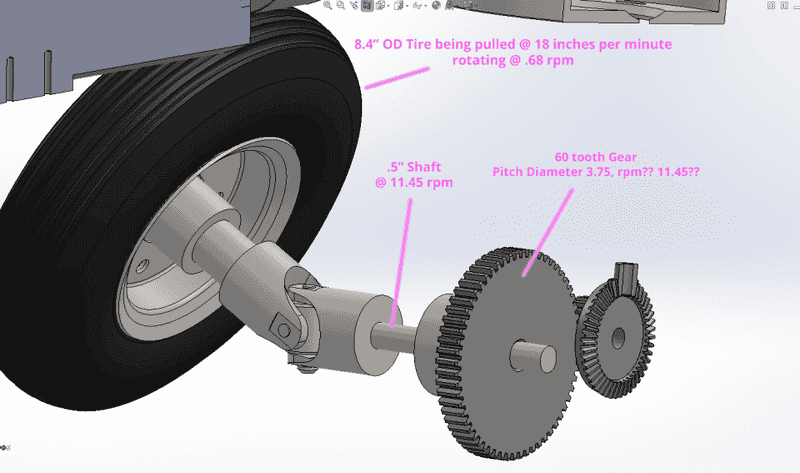
So in the attached image I'm trying to determine what the rpm of the 60 tooth gear will be given the 8.4" tire will be rotating at .68 rpm, everything else is just an assumption on my part.

I'm assuming the following which is probably wong:

The tire being rotated at .68 rpm will result in the .5" linked shaft rotating at 11.45 rpm. I'm dividing the circumference of the tire by the circumference of the shaft and multiplying by the rpm of the tire to arrive at 11.45 rpm.

If the .5" shaft is rotating at 11.45 rpm for the purpose of calculations will the 60 tooth gear also be rotating at 11.45 rpm? Sorry, I obviously suck @ life.
example_drive.png
 
Last edited:
Engineering news on Phys.org
Try this as a mental exercise.
1) Put a chalk mark on the tire so you can tell when it makes on complete revolution. (Say at the top.)
2) Put a mark on the shaft at the same place as the mark on the tire. (Again at the top.)
3) Now turn the tire a quarter revolution.

How many revolutions did the shaft make? Don't bother with any math, just think it thru.
 
  • Like
Likes   Reactions: billy_joule
Tom.G said:
Try this as a mental exercise.
1) Put a chalk mark on the tire so you can tell when it makes on complete revolution. (Say at the top.)
2) Put a mark on the shaft at the same place as the mark on the tire. (Again at the top.)
3) Now turn the tire a quarter revolution.

How many revolutions did the shaft make? Don't bother with any math, just think it thru.

well, they both made a 1/4 revolution. So would this mean the shaft & gear is at .68 rpm? lol
 
Yup, you got it!
 
Tom.G said:
Yup, you got it!
Thanks man!
 
Note that with a simple universal joint there will be some speed oscillation between the tire and the gear. Simple universal joints are not constant velocity. If that doesn't matter then the tire and the gear are turning at the same RPM. Everything, including the tire, the 60T gear, the intermediate shafts, the universal joint will be rotating at the same speed.
 

Similar threads

Replies
2
Views
3K
Replies
2
Views
4K
Replies
6
Views
2K
Replies
9
Views
5K
  • · Replies 5 ·
Replies
5
Views
5K
  • · Replies 24 ·
Replies
24
Views
9K
  • · Replies 19 ·
Replies
19
Views
4K
Replies
14
Views
25K
  • · Replies 1 ·
Replies
1
Views
6K
  • · Replies 6 ·
Replies
6
Views
3K