General question about math required to do david morins book

  • Context: Undergrad 
  • Thread starter Thread starter RubinLicht
  • Start date Start date
  • Tags Tags
    Book General
Click For Summary

Discussion Overview

The discussion revolves around the mathematical knowledge required to solve problems in David Morin's book, particularly focusing on the use of specific mathematical techniques and concepts such as differential equations and the fundamental theorem of calculus. Participants explore the challenges faced when encountering complex problems that involve advanced mathematical reasoning.

Discussion Character

  • Exploratory
  • Technical explanation
  • Debate/contested

Main Points Raised

  • One participant expresses difficulty with certain problems in Morin's book, particularly those requiring advanced mathematical tricks, and seeks guidance on where to learn these techniques.
  • Another participant clarifies that the solution in question is not a trick but rather a standard solution to a differential equation, specifically ##\rho'=-\rho##, and references the mathematical subject of Ordinary Differential Equations.
  • A later reply reiterates the clarification about the differential equation, suggesting that the original poster may have misunderstood the solution process.
  • One participant mentions the Newton-Leibniz formula and expresses a desire to improve their understanding of it, as well as the fundamental theorem of calculus, which they feel was inadequately covered in their class.

Areas of Agreement / Disagreement

Participants do not reach a consensus on the nature of the challenges faced; while some clarify the mathematical concepts involved, others maintain that the original poster's difficulties stem from a lack of familiarity with specific mathematical techniques.

Contextual Notes

There are indications of missing assumptions regarding the mathematical background of participants, as well as potential gaps in the coverage of certain topics in educational settings. The discussion reflects varying levels of understanding of differential equations and calculus concepts.

RubinLicht
Messages
131
Reaction score
8
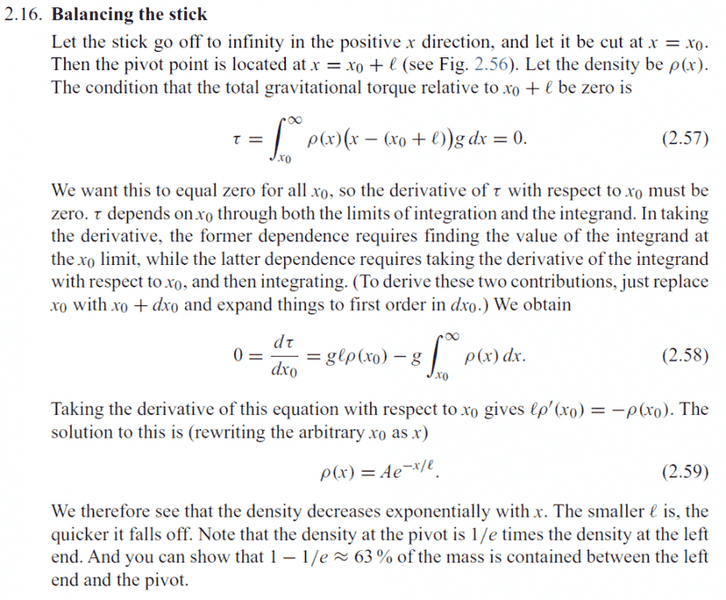
So i don't have issues with most of his problems, but once in a while a question that requires a ridiculous math trick that i had no way of knowing comes up and i just wonder if this is something you pick up from various places, or can attain through a focused study of mathematics. the question that prompted me to post this was this:

2.png

and solution:
1.png


I get completely lost once i get to "In taking the derivative, the former dependence requires finding the value of theintegrand at the x0 limit...". and then i can follow the solution again once you get to "the solution to this is -> exponential"

The problem i had with this is that i immediately knew that the solution would be an exponential with some dependence on l in the exponent, however, there was simply no way for me to reach the solution because i had to use what ever math tricks he used here.

background: i can comfortably do approximations with taylor series and binomial theorem, so I'm not completely new to the world of approximations.

tldr i would like to know where to gain the math knowledge for these kind of tricks
 
Physics news on Phys.org
this is not a trick this is a solution to the differential equation ##\rho'=-\rho##. There is a mathematical subject called "Ordinary Differential Equations"
 
wrobel said:
this is not a trick this is a solution to the differential equation ##\rho'=-\rho##. There is a mathematical subject called "Ordinary Differential Equations"
"I get completely lost once i get to "In taking the derivative, the former dependence requires finding the value of theintegrand at the x0 limit...". and then i can follow thesolution again once you get to "the solution to this is -> exponential" "

Tldr I knew how to do that part, and you would know this is if you read my post again
 
wrobel said:
O, now I see. By the way have you ever heard about the Newton-Leibniz formula :)

https://www.encyclopediaofmath.org/index.php/Newton-Leibniz_formula

Yes but my understanding of it is very poor because we seemed to just skip over it in class. My friend also said to read about the fundamental theorem of calculus, so I'll do that when i get time and come back to this problem. Thanks!
 

Similar threads

  • · Replies 3 ·
Replies
3
Views
7K
Replies
22
Views
3K
  • · Replies 17 ·
Replies
17
Views
2K
  • · Replies 10 ·
Replies
10
Views
6K
  • · Replies 8 ·
Replies
8
Views
2K
  • · Replies 16 ·
Replies
16
Views
3K
  • · Replies 11 ·
Replies
11
Views
2K
  • · Replies 16 ·
Replies
16
Views
8K
  • · Replies 12 ·
Replies
12
Views
3K
  • · Replies 26 ·
Replies
26
Views
5K