General Relativity as a Challenge for Physics Education

Click For Summary

Discussion Overview

The discussion centers around the challenges of teaching General Relativity (GR) in physics education, particularly focusing on the balance between qualitative understanding and mathematical rigor. Participants share personal experiences and opinions on teaching methods, course content, and the effectiveness of various textbooks and approaches in conveying the concepts of GR.

Discussion Character

  • Exploratory
  • Debate/contested
  • Conceptual clarification
  • Technical explanation

Main Points Raised

  • Some participants express a preference for Hartle's textbook for its "Physics-first" approach, contrasting it with more mathematically rigorous texts like Wald.
  • One participant recounts their experience of learning Special Relativity (SR), noting that while they could perform calculations, they struggled to connect the mathematics to physical concepts.
  • A participant critiques a symposium course on GR for being overly qualitative, arguing that it risks misleading students about the necessity of mathematical skills in understanding physics.
  • Concerns are raised about the lack of discussion on recent discoveries, such as gravitational waves, in introductory courses, suggesting missed opportunities for engaging students with contemporary physics.
  • Another participant reflects on the aesthetic appeal of teaching physics through symmetry principles but questions whether this approach accurately represents the process of scientific discovery.
  • There is a discussion about the impact of educational reforms, such as the Bologna system, on the learning experience and the depth of understanding in physics education.
  • Some participants propose that teaching methods should incorporate a more gradual introduction to complex concepts, linking them to students' existing knowledge and experiences in physics.

Areas of Agreement / Disagreement

Participants do not reach a consensus on the best methods for teaching GR or the balance between qualitative and quantitative approaches. Multiple competing views on effective teaching strategies and course content remain evident throughout the discussion.

Contextual Notes

Limitations include varying definitions of what constitutes a successful physics education, differing opinions on the role of mathematics in understanding physical concepts, and the impact of educational structures on student learning experiences.

robphy
Science Advisor
Homework Helper
Insights Author
Gold Member
Messages
7,397
Reaction score
2,924
This week I am at
"General Relativity as a Challenge for Physics Education"
690. WE-Heraeus-Seminar
https://www.we-heraeus-stiftung.de/...ativity-as-a-challenge-for-physics-education/
( https://twitter.com/hashtag/GenRelEdu19?f=tweets&vertical=default&src=hash )

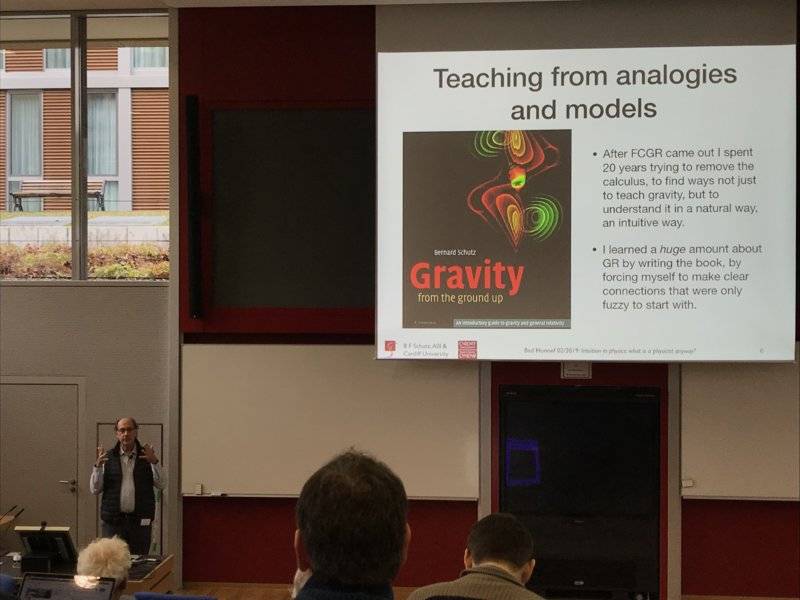
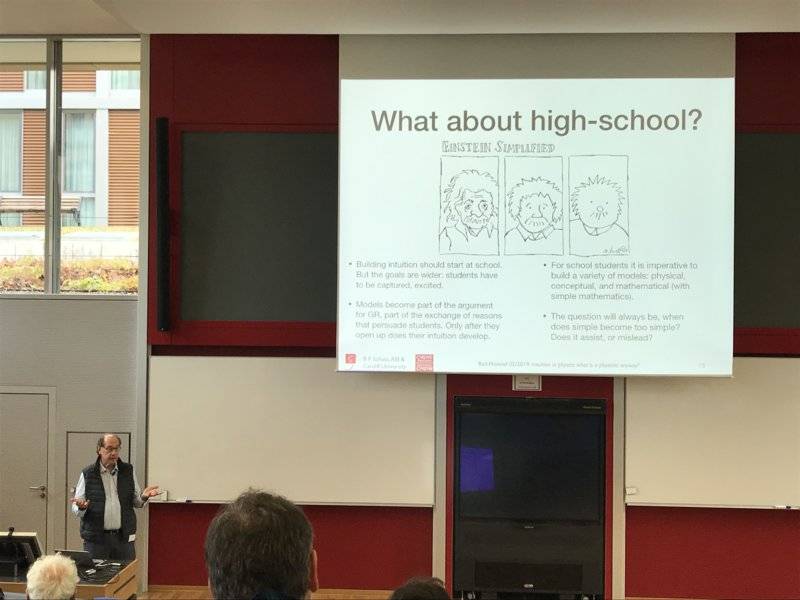
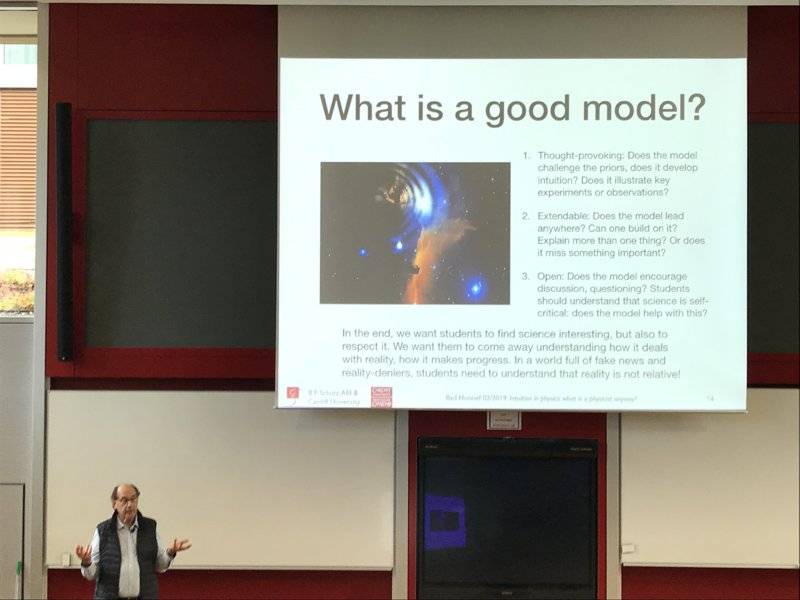
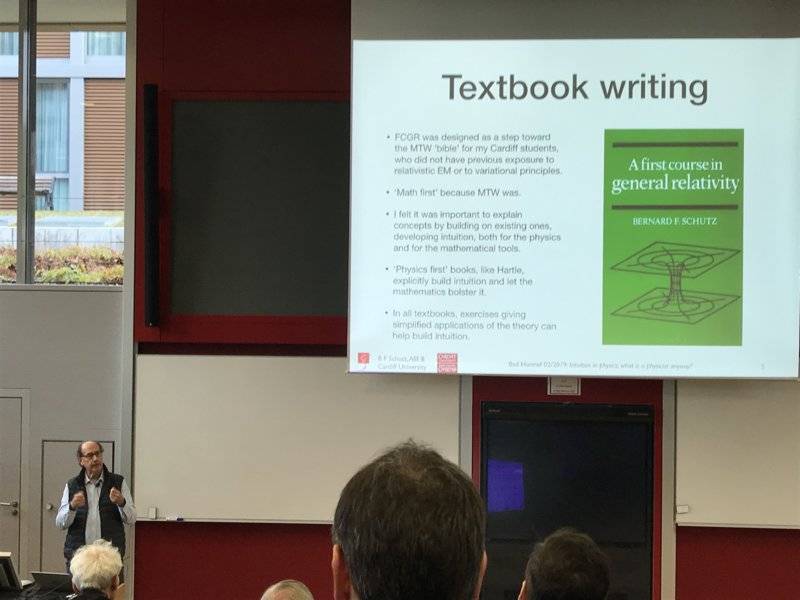
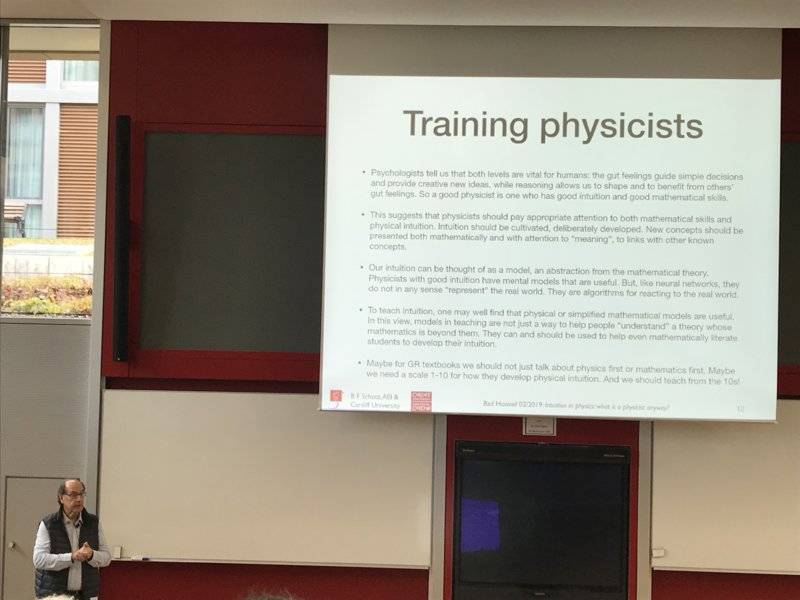
Here are a few slides from Bernard Schutz Monday morning talk
"Intuition in physics: What is a physicist anyway?"
upload_2019-2-12_7-21-27.jpeg


upload_2019-2-12_7-31-45.jpeg


Funny... he says that, recently, he has been using Hartle's textbook for his undergraduate class
because he felt his audience needed a "Physics-first" text rather than a "Math-first" text like his own.
upload_2019-2-12_7-33-57.jpeg
upload_2019-2-12_7-34-28.jpeg


upload_2019-2-12_7-25-35.jpeg
I brought a poster describing my Relativity on Rotated Graph Paper method ( Insight ) .
My poster session is on Tuesday.
 

Attachments

  • upload_2019-2-12_7-21-27.jpeg
    upload_2019-2-12_7-21-27.jpeg
    44.1 KB · Views: 1,157
  • upload_2019-2-12_7-25-35.jpeg
    upload_2019-2-12_7-25-35.jpeg
    42.1 KB · Views: 1,109
  • upload_2019-2-12_7-31-45.jpeg
    upload_2019-2-12_7-31-45.jpeg
    49.1 KB · Views: 1,132
  • upload_2019-2-12_7-33-57.jpeg
    upload_2019-2-12_7-33-57.jpeg
    45.2 KB · Views: 1,086
  • upload_2019-2-12_7-34-28.jpeg
    upload_2019-2-12_7-34-28.jpeg
    44.5 KB · Views: 1,129
Last edited:
  • Like
Likes   Reactions: dextercioby, Auto-Didact, vanhees71 and 4 others
Physics news on Phys.org
robphy said:
My poster session is on Tuesday.
Good luck! I hope you get lots of interest
 
  • Like
Likes   Reactions: robphy
Hartle's book is excellent for a first year exposure! I've never liked rigorous mathematical treatments like Wald, although I used it a lot to understand his papers.

Good luck! :)
 
  • Like
Likes   Reactions: dextercioby and vanhees71
I must say that my own experience of learning SR from undergraduate days was that the Lorentz transforms just came out of the left field. I could do them - as we are very much aware here the maths is pretty straightforward if you idealise acceleration - and I could resolve all the paradoxes. But I couldn't work out how it related to physics I knew.

Now I understand that they (and the Galilean transforms in Newtonian physics) are an underpinning of all of physics, but the idea that physics can follow from such an abstraction completely escaped me.
 
My son took a 1 hour symposium style course in General Relativity his first semester of college. Since he's a physics major, we talked a lot about it.

Weaknesses:
1. It was nearly completely qualitative with less than 10% of the course points requiring quantitative computations, and no math skills required above algebra 1. This carries the significant risk of imparting the misunderstanding that students can really understand physics without the necessary math skills. Students who end up in a real general physics class thinking they can succeed with weak math skills are in for a rude awakening.
2. Being qualitative, the course tended to spend a lot of time on the philosophical and historical side (as opposed to the scientific side). I define the scientific side as addressing questions like "What are the predictions of General Relativity?" "Which of these predictions have been experimentally tested?" "Which predictions are likely to be tested in the near future?" and "What are the competing theories, what different predictions do they make, and which experiments are expected to test them?"
3. The recent gravity wave observations were hardly discussed. Sure, a real explanation would have required some math. But a tremendous opportunity was missed here to spend some quality time discussing what was the most important discovery in physics so far this century (at least in my opinion).

Strengths:
1. It was a Gee Whiz physics course that got the interest of some students.
2. If fulfilled my son's symposium course requirement, and was the most appealing option for a physics major.
3. The instructor was willing to discuss some of the more interesting stuff outside of class with interested students.

I don't recall Feynman treating GR, but in the Feynman Lectures, he usually did a very good job getting the physics right with minimal mathematics (especially compared with other treatments). I especially like Feynman's treatment of Quantum Mechanics. Is there an intro GR treatment out there that does a good a job with the science as Feynman's treatment of QM?
 
  • Like
Likes   Reactions: Dale
Ibix said:
I must say that my own experience of learning SR from undergraduate days was that the Lorentz transforms just came out of the left field. I could do them - as we are very much aware here the maths is pretty straightforward if you idealise acceleration - and I could resolve all the paradoxes. But I couldn't work out how it related to physics I knew.

Now I understand that they (and the Galilean transforms in Newtonian physics) are an underpinning of all of physics, but the idea that physics can follow from such an abstraction completely escaped me.
The point of course is that this is the deductive way of representing the material. It's very elegant and when I was first exposed to this "symmetries-first approach" I was deeply impressed by the esthetics behind the fundamental laws of physics. Of course, this teaches you everything from the point of view of established theory. It doesn't give you any clue, how centuries of physics research, starting indeed with Galilei, and culminating in Minkowski's, Hilberts, and finally Noether's insights into what's behind special and general relativity from the point of view of symmetry principles.

I'm not sure, what's the right way to teach theoretical physics to newcomers though. On the one hand, of course, the aesthetical joy of representing everything in the deductive way from a point of view of symmetry principles may be a strong motivation for the fascination of physics. On the other hand, I've sometimes the feeling it's a bit like cheating, because that's not the way new physics is found, which always is a quite cumbersome endeavor of collaborative work between experimentalists and theorists with a lot of creative acts on both sides rather than just rational steps leading to "first principles" in a straight way.

That's why I think that the invention of the "Humboldt ideal" of a university is more important than ever, and at least in Germany we went a wrong turn in the early 2000ies when switching from the old diploma system to the Bologna system, where the empasis became from university studies as a free joice of the student to follow his/her individual interests in listening to lectures, taking tutorials and labs, etc. to finally prepare the final examanations (forcing the student to sit down and recapitulate all of physics at the very end of the studies) and in addition, and most importantly, a joice of a first research topic towards a diploma thesis work.

Nowadays everything is clearly ordered by "module plans" and collecting "credit points" with a lot of written exams after each semester. The students have to learn tons of single topics for these exams in a short time, just to write the tests and then to forget all the content again to make room for the next round of "bulimi learning".
 
  • Like
Likes   Reactions: dextercioby
vanhees71 said:
I'm not sure, what's the right way to teach theoretical physics to newcomers though.
I don't think there is a single right way. For me, I think the problem was that this way of thinking was so different to my internal model of physics that I didn't know how to fit it in. I think I needed to be shown something like how relativistic kinematics comes about (forces and energy conservation in (1+1)d, just like Newton but with more difficult maths), then show how that gets difficult as you go to (2+1)d or higher (force not parallel to acceleration, Newton's second law depending on the angle between force and velocity). And then show me Euler-Lagrange and start explaining that there's a mathematically complex but more general way to do physics.
vanhees71 said:
On the one hand, of course, the aesthetical joy of representing everything in the deductive way from a point of view of symmetry principles may be a strong motivation for the fascination of physics. On the other hand, I've sometimes the feeling it's a bit like cheating, because that's not the way new physics is found, which always is a quite cumbersome endeavor of collaborative work between experimentalists and theorists with a lot of creative acts on both sides rather than just rational steps leading to "first principles" in a straight way.
I do think the history of how these things come about is useful, at least to me. Not because it's a good way of learning the theory, but because it helps to ground the rather abstract modern theories in lab work and deductions and arguments. I remember my SR course showing me Einstein's train. I don't remember it telling me that you can describe a charge moving past a magnet or a magnet past a charge but you cannot relate the two by Galilean transforms. And there's this funny fact that Maxwell always gives us a wave equation with velocity ##c##. And everyone thought something was missing from Maxwell because that's obviously silly, but Einstein took that silly idea at face value. And hence the Lorentz transforms and hence EM works again (I realize I've just summarised Einstein's 1905 paper - interesting). But after that, by all means use a modern way to derive all the necessary maths.

It's possible, of course, that it did say all of that somewhere and I'm doing a horrible disservice to my lecturer. But if it did I don't remember it.
 
  • Like
Likes   Reactions: vanhees71
  • #10
I think, quoting the history of Einstein's "moving-body paper" of 1905, you give a perfect example for theory building as a "creative act", being grounded by (pretty detailed and precise!) empirical facts. Einstein in his younger years (i.e., until 1915 or so) was perfect in this and then got lost in losing the contact to empirical facts seeking for a unified classical field theory of gravitation and electromagnetism which was already then an outdated research project.
 
  • Like
Likes   Reactions: dextercioby and Ibix
  • #11
Here’s what the poster looked like...
upload_2019-2-20_14-55-7.jpeg


As my brother said...
“Is that the fabric of the space-time continuum?”
 

Attachments

  • upload_2019-2-20_14-55-7.jpeg
    upload_2019-2-20_14-55-7.jpeg
    76.2 KB · Views: 782
  • #12
@robphy Any way we could get an image or PDF of that poster?
 
  • #13
SiennaTheGr8 said:
@robphy Any way we could get an image or PDF of that poster?
I have attached an edited version of the poster.
upload_2019-2-22_2-59-29.png
 

Attachments

  • Like
Likes   Reactions: vanhees71 and SiennaTheGr8
  • #14
(shameless plug? I have a chapter in here)

This conference from 2019 has led to this recently published book
https://www.routledge.com/Teaching-...-Teachers/Kersting-Blair/p/book/9781760877712
Teaching Einsteinian Physics in Schools: An Essential Guide for Teachers in Training and Practice
Edited By Magdalena Kersting, David Blair
Copyright Year 2021
ISBN 9781760877712
Published August 31, 2021 by Routledge

preview: https://www.google.com/books/editio...0V89EAAAQBAJ?hl=en&gbpv=1&printsec=frontcover

The target audience are teachers of K-12.

Here is a draft of Schutz's chapter:
https://arxiv.org/abs/2106.01820
Intuition in Einsteinian Physics
Bernard F. SchutzHere is the website of the conference organizers
https://www.tempolimit-lichtgeschwindigkeit.de/
Ute Kraus and Corvin Zahn (Institut für Physik, Universität Hildesheim)
 
Last edited:
  • Like
Likes   Reactions: vanhees71, SiennaTheGr8, dextercioby and 1 other person
  • #15
Dr. Courtney said:
I don't recall Feynman treating GR, but in the Feynman Lectures, he usually did a very good job getting the physics right with minimal mathematics (especially compared with other treatments). I especially like Feynman's treatment of Quantum Mechanics. Is there an intro GR treatment out there that does a good a job with the science as Feynman's treatment of QM?
Here is Feynman on GR:

https://www.amazon.com/dp/0465025269/?tag=pfamazon01-20

Also, typical for Feynman, his posthumous notes show he had duplicated a good bit of Chandresekhar's gravitational collapse work earlier, but never chose to publish.
 
  • Like
Likes   Reactions: Dr. Courtney and vanhees71
  • #16
Even better:

https://www.amazon.de/dp/0813340381/

It's a gem, treating GR from the point of view of any other of the fundamental interactions. It's an ideal complement to standard textbooks emphasizing the geometrical point of view.
 
  • Like
Likes   Reactions: PeterDonis

Similar threads

  • · Replies 9 ·
Replies
9
Views
2K
  • · Replies 7 ·
Replies
7
Views
3K
  • · Replies 21 ·
Replies
21
Views
2K
  • · Replies 18 ·
Replies
18
Views
2K
  • · Replies 21 ·
Replies
21
Views
5K
  • · Replies 3 ·
Replies
3
Views
2K
  • · Replies 0 ·
Replies
0
Views
2K
  • · Replies 6 ·
Replies
6
Views
3K
  • · Replies 36 ·
2
Replies
36
Views
6K
  • · Replies 1 ·
Replies
1
Views
2K