Geometry Challenge: Find $\angle BCD$ in Convex Quadrilateral

  • Context: MHB 
  • Thread starter Thread starter anemone
  • Start date Start date
  • Tags Tags
    Challenge Geometry
Click For Summary
SUMMARY

The problem involves finding the angle $\angle BCD$ in a convex quadrilateral $ABCD$ where $AB=BC$, $AC=BD$, $\angle CBD=20^{\circ}$, and $\angle ABD=80^{\circ}$. The solution requires applying properties of isosceles triangles and the law of sines. The final calculated value of $\angle BCD$ is determined to be $40^{\circ}$ based on the given angles and side lengths.

PREREQUISITES
  • Understanding of basic geometric properties of quadrilaterals
  • Knowledge of isosceles triangles and their properties
  • Familiarity with the law of sines
  • Ability to perform angle calculations in geometric figures
NEXT STEPS
  • Study the properties of isosceles triangles in depth
  • Learn about the law of sines and its applications in triangle problems
  • Explore advanced geometric constructions and their implications
  • Practice solving problems involving angles in quadrilaterals
USEFUL FOR

Mathematics students, geometry enthusiasts, and educators looking to deepen their understanding of angle relationships in quadrilaterals.

anemone
Gold Member
MHB
POTW Director
Messages
3,851
Reaction score
115
Let $ABCD$ be a convex quadrilateral such that $AB=BC,\,AC=BD,\,\angle CBD=20^{\circ},\,\angle ABD=80^{\circ}$. Find $\angle BCD.$
 
Mathematics news on Phys.org
anemone said:
Let $ABCD$ be a convex quadrilateral such that $AB=BC,\,AC=BD,\,\angle CBD=20^{\circ},\,\angle ABD=80^{\circ}$. Find $\angle BCD.$

Hint:

Draw a line parallel to $BD$ from $C$ and see where that leads you...
 
anemone said:
Hint:

Draw a line parallel to $BD$ from $C$ and see where that leads you...

Follow up hint:

Construct an equilateral $\triangle ACE$ where $CE$ is the line parallel to $BD$.
 
anemone said:
Let $ABCD$ be a convex quadrilateral such that $AB=BC,\,AC=BD,\,\angle CBD=20^{\circ},\,\angle ABD=80^{\circ}$. Find $\angle BCD.$
$130^o$
 
Last edited:
Albert said:
$130^o$

Please provide how you obtained your solution. :)
 
MarkFL said:
Please provide how you obtained your solution. :)
step 1 :construct $\triangle ABC$ ,it is fixed , for $AB=BC$ , and $\angle ABC=20^o+80^o=100^o$
$\therefore \angle A=\angle C=40^o$
step 2: find point $D'$ on $AC$, and $\angle CBD'=20^o$
(step 1 and 2 can be done easily)
now point D must be on $BD'$ ray
step 3: construct circle $B$ with center $B$ and $BD=AC$
here point $D$ is the intersection of circle $B$ and $BD'$ ray
so $\angle BCD=\angle BCA+\angle ACD=40+90=130^o$
 
Last edited:
Albert said:
step 1 :construct $\triangle ABC$ ,it is fixed , for $AB=BC$ , and $\angle ABC=20^o+80^o=100^o$
$\therefore \angle A=\angle C=40^o$
step 2: find point $D'$ on $AC$, and $\angle CBD'=20^o$
(step 1 and 2 can be done easily)
now point D must be on $BD'$ ray
step 3: construct circle $B$ with center $B$ and $BD=AC$
here point $D$ is the intersection of circle $B$ and $BD'$ ray
so $\angle BCD=\angle BCA+\angle ACD=40+90=130^o$

Hi Albert!

When you mentioned of constructing a circle that centered at $B$, I am wondering if $r=BA\stackrel{\text{or}}{=}BD$?
 
anemone said:
Hi Albert!

When you mentioned of constructing a circle that centered at $B$, I am wondering if $r=BA\stackrel{\text{or}}{=}BD$?
$r=BD=AC$
 
Albert said:
$r=BD=AC$

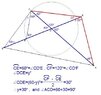
Okay, thanks for your reply...but Albert, I have constructed the diagram and drew everything up according to suggestion, but, I failed to see why $\angle ACD=90^\circ$.
 
  • #10
anemone said:
Okay, thanks for your reply...but Albert, I have constructed the diagram and drew everything up according to suggestion, but, I failed to see why $\angle ACD=90^\circ$.
View attachment 5532
$\angle ACD=90^o$
 

Attachments

  • Angle BCD=130.jpg
    Angle BCD=130.jpg
    20.8 KB · Views: 127
  • #11
Albert said:
$\angle ACD=90^o$

Oh okay...thanks for your diagram!

Btw, the solution below is from a smart mathematician:
View attachment 5537

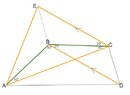
Draw a line parallel to $BD$ from $C$, and then construct an equilateral $\triangle ACE$ where $CE$ is the line that parallel to $BD.$

Note that $\triangle AEB \equiv \triangle CEB$ and since $BC=CB,\,\angle BCE=\angle CBD,\,CE=AC=BD$ (given), we have $\triangle BCE \equiv \triangle CBD$.

$\therefore \angle BCD=\angle CBE=180^\circ-20^\circ-\dfrac{60^\circ}{2}=130^\circ$
 

Attachments

  • geometry challenge.JPG
    geometry challenge.JPG
    14.3 KB · Views: 109

Similar threads

  • · Replies 5 ·
Replies
5
Views
2K
Replies
3
Views
1K
  • · Replies 1 ·
Replies
1
Views
1K
  • · Replies 3 ·
Replies
3
Views
3K
Replies
2
Views
2K
  • · Replies 1 ·
Replies
1
Views
1K
  • · Replies 2 ·
Replies
2
Views
2K
  • · Replies 1 ·
Replies
1
Views
2K
  • · Replies 2 ·
Replies
2
Views
2K
  • · Replies 4 ·
Replies
4
Views
2K