Get transfer function from block diagram

Click For Summary

Discussion Overview

The discussion revolves around deriving transfer functions from a block diagram related to a DC motor and gear system. Participants seek assistance in identifying the transfer functions at specific points in the system, particularly between the motor's power supply and the speed of rotation, as well as the displacement of a mass.

Discussion Character

  • Homework-related
  • Technical explanation
  • Exploratory
  • Debate/contested

Main Points Raised

  • One participant expresses difficulty in finding the transfer functions at points B and C from the block diagram.
  • Another participant requests clarification on the locations of certain variables (Vm and ΩM) and notes that the provided expression for F(s) seems incomplete.
  • Several participants discuss the interpretation of outputs in the context of the block diagram, with differing views on what constitutes an output.
  • There is mention of simplifying the block diagram to derive the necessary transfer functions, with some participants suggesting that feedback loops and algebraic manipulation may be useful.
  • One participant shares a list of parameters and a translation of the problem statement, reiterating the need to find transfer functions for various system elements.
  • Some participants express uncertainty about how to approach the problem when there is no clear output defined in the block diagram.

Areas of Agreement / Disagreement

Participants do not appear to reach a consensus on how to define outputs in the block diagram or the best approach to derive the transfer functions. Multiple competing views and uncertainties remain regarding the interpretation of the system and the necessary steps to solve the problem.

Contextual Notes

Participants mention various parameters and conditions that may affect the derivation of transfer functions, including initial conditions and the structure of the block diagram. There are unresolved questions about the completeness of the provided expressions and the definitions of inputs and outputs.

JPGraphX
Messages
11
Reaction score
0
Hello guys!

1 & 2:
I would like to get some help to take everything in A and find transfer function at B and C.

I can't find these answer...
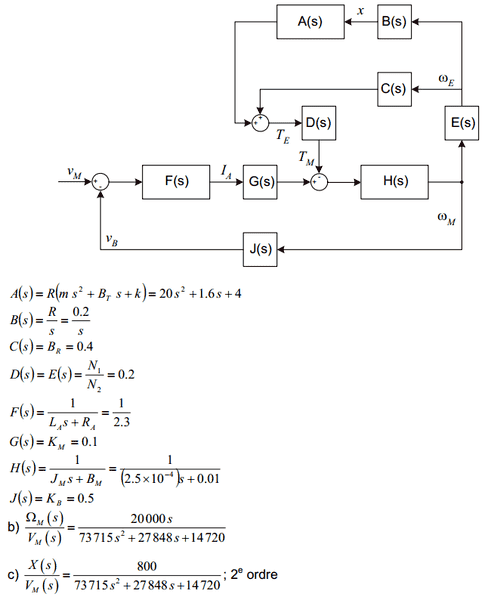
transferfunction.png


3.
I know how to go from b) to c) .. we only multiply by E(s) and B(s). But I can't find b) at first.

Thanks so much!
JPGraphX
 
Physics news on Phys.org
Is there any more detail you can assist with this? For example, where is Vm located? Where is ΩM?

Your F(s) expression seems incomplete.
 
I think omega m is wm.

Here is mechanical drawing from where my block diagram came. Sorry it is in french.

a) should link motor electric supply Vm to speed of shaft in rotation. (Wm)

Thanks!
JP

IMG_20141015_210540.jpg
 
If after couple of days you still have no help with this, I suggest that you attach a translation of the description associated with it.

You checked F(s) as I suggested?
 
F(s) is ok. Here is why (this is a list of all the parameter): La = 0.0H

parameter.png


  • Why this table, everything that can help find a solution is here.
 
Here is a translation:

We want to know position x(t) of mass m with the help of a DC moteur and a gear system. All system elements are shown on picture 2.

a) With the use of block diagram (first picture I posted) and parameters (in my last picture), find transfer function of every system elements. Consider initial condition to zero.

b) Simplify the block diagram found in (a) to obtain the transfer function between the power supply of the motor and the speed of rotation of its shaft.

c) From the transfer functions found in (b), find one that connects the motor electric supply to the displacement of the mass x (t). Determine the order of the system.
 
JPGraphX said:
Here is a translation:

We want to know position x(t) of mass m with the help of a DC moteur and a gear system. All system elements are shown on picture 2.

a) With the use of block diagram (first picture I posted) and parameters (in my last picture), find transfer function of every system elements. Consider initial condition to zero.

b) Simplify the block diagram found in (a) to obtain the transfer function between the power supply of the motor and the speed of rotation of its shaft.

c) From the transfer functions found in (b), find one that connects the motor electric supply to the displacement of the mass x (t). Determine the order of the system.
Where are you stuck? Show your work.
 
Well I know how to get transfer function when I got Input and Output. (I only simplify my diagram). But I don't know how to get my transfer function when it is not between input and output. (There's no output..)

Like this:
F31D56A06EE05E84BD365CFE626E2968_02_01.gif
 
I'll try to simplify my block diagram tonight. Right now, I'm at work.
 
  • #10
JPGraphX said:
Well I know how to get transfer function when I got Input and Output. (I only simplify my diagram). But I don't know how to get my transfer function when it is not between input and output. (There's no output..)

Like this:
F31D56A06EE05E84BD365CFE626E2968_02_01.gif
I'm not sure I understand what you mean. In (b), for instance, you're asked to find the transfer function ##\frac{\omega_M(s)}{v_M(s)}##, i.e. ##v_M(s)## is the input and ##\omega_M(s)## is the output.

In other words, you have to simplify the diagram so you have:
##v_M \rightarrow##some transfer function##\rightarrow \omega_M##
 
  • #11
I don't know where to split my diagram to get wm as an output. What are the transfer function useless, etc.
 
  • #12
JPGraphX said:
I don't know where to split my diagram to get wm as an output. What are the transfer function useless, etc.
What does it mean, in a diagram, for a signal to be an output? How can you tell that ##\omega_M## isn't an output in the first diagram you posted?
 
  • #13
In my idea an output is like my last picture y(Z), when there is nothing after it.
 
  • #14
JPGraphX said:
In my idea an output is like my last picture y(Z), when there is nothing after it.
That depends on your point of view. Would it help if you drew an arrow out from ##\omega_M## in your first diagram? There's nothing more to the right of that either.
 
  • #15
Yeah you're right.. I'll try tonight!
 
  • #16
If you take the view that ##\omega_M## is the output, then it's helpful to realize that there's then just a simple feedback loop around H(s), which you can simplify using the rules for blocks in series, parallel and negative feedback.
 
  • #17
JPGraphX said:
Hello guys!

1 & 2:
I would like to get some help to take everything in A and find transfer function at B and C.

I can't find these answer...

transferfunction.png


3.
I know how to go from b) to c) .. we only multiply by E(s) and B(s). But I can't find b) at first.

Thanks so much!
JPGraphX

Just use algrebra!
My guess, you are trying to use formulas, just derive the equation yourself.

Lets start by defining Wm.
Wm=H(s)*(Ia*G(s)-Tm)
Ia=(Vm-Vb)*F(s)
etc...
 

Similar threads

Replies
24
Views
5K
  • · Replies 5 ·
Replies
5
Views
652
  • · Replies 4 ·
Replies
4
Views
2K
  • · Replies 1 ·
Replies
1
Views
2K
  • · Replies 5 ·
Replies
5
Views
3K
  • · Replies 3 ·
Replies
3
Views
3K
Replies
3
Views
3K
  • · Replies 13 ·
Replies
13
Views
3K
  • · Replies 1 ·
Replies
1
Views
2K
  • · Replies 16 ·
Replies
16
Views
2K