SUMMARY
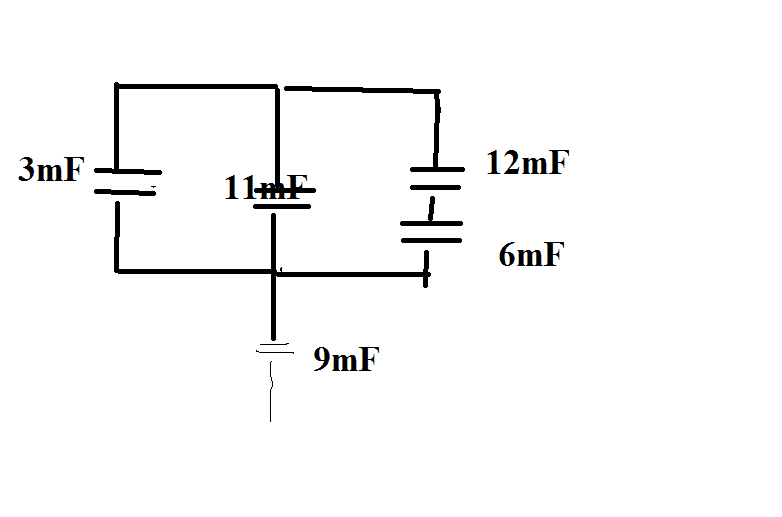
The discussion centers on calculating the total capacitance of a circuit involving both parallel and series connections. The circuit includes a 3mF capacitor in parallel with a series combination of 11mF and 9mF, as well as another series combination of 12mF and 6mF. The correct approach involves first calculating the equivalent capacitance of the series capacitors using the reciprocal sum formula, followed by adding the resulting capacitances in parallel. The final capacitance must be less than 9mF, confirming the calculations are accurate.
PREREQUISITES
- Understanding of capacitance and its units (mF, μF)
- Knowledge of series and parallel capacitor combinations
- Familiarity with the reciprocal sum formula for series capacitors
- Basic circuit analysis skills
NEXT STEPS
- Study the reciprocal sum formula for calculating series capacitance
- Learn about the principles of combining capacitors in parallel
- Explore practical examples of capacitance calculations in circuits
- Review the differences between microfarads (μF) and millifarads (mF)
USEFUL FOR
Electronics students, circuit designers, and anyone involved in capacitor calculations and circuit analysis will benefit from this discussion.