Double pendulum equations of motion using Newton's laws

Click For Summary

Homework Help Overview

The discussion revolves around deriving the equations of motion for a double pendulum using Newton's laws, as presented in a textbook on Mechanical Vibrations. The original poster expresses confusion regarding the approach taken in the problem, particularly concerning the moments of equilibrium and the forces acting on the system.

Discussion Character

  • Conceptual clarification, Assumption checking, Mathematical reasoning

Approaches and Questions Raised

  • The original poster questions the rationale behind considering only the forces acting on the first mass in the moments equilibrium about point O and seeks clarification on a specific term in the equations. Participants discuss the application of torque equations and the effects of fictitious forces in non-inertial frames.

Discussion Status

Participants are actively engaging with the original poster's questions, providing insights into the derivation process and the implications of using non-inertial reference frames. There is an exchange of ideas regarding the complexities of fictitious forces, with some participants suggesting that certain forces can be neglected in specific contexts.

Contextual Notes

The original poster indicates a lack of resources on classical mechanics and seeks recommendations for textbooks that cover the necessary concepts for understanding the equations of motion for systems like the double pendulum.

BayMax
Messages
4
Reaction score
3
Homework Statement
equations of motion
Relevant Equations
angular momentum equation
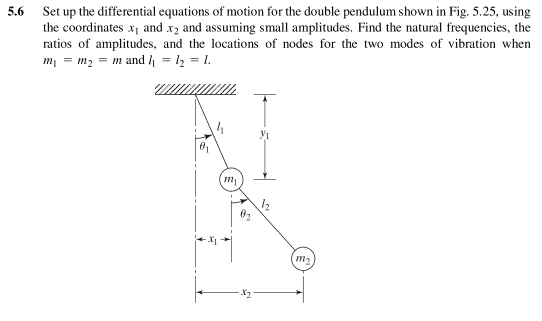
I need help to understand this problem taken from Mechanical Vibrations by S. Rao
testo.png
soluzione.PNG

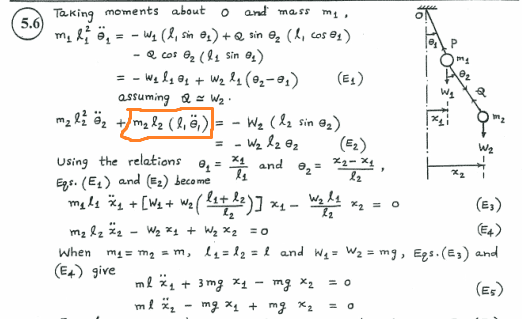
I know that the equations of motion could be obtained in various ways, for example using the Lagrangian, but, at the moment, I am interested in understanding the method he used. In particular, if I'm not mistaken, he used moments equilibrium about point O and point ##m_1##. Here's my questions:

1- Why in the moments equilibrium about the point O (equation E1) he considered only the forces acting on ##m_1## as if ##m_2## were not there and also just the moment of inertia of ##m_1##?

2- But above all, in the equation E2, where does the highlighted term ##m_2⋅l_2(l_1⋅\ddot\theta_1)## come from and what does it represent?

3- I have a lot of problems when I'm asked to find equations of motion of a system of particles (like in this case) or of a rigid body, so I need some good resources (textbooks preferably) where I can find all the tools I need to understand and solve this kind of problems.

Thanks !
 
Physics news on Phys.org
Welcome to PF!

BayMax said:
1- Why in the moments equilibrium about the point O (equation E1) he considered only the forces acting on ##m_1## as if ##m_2## were not there and also just the moment of inertia of ##m_1##?
Equation E1 comes from ##\sum \tau = I \alpha## applied to just ##m_1##. So, ##I## is the moment of inertia of just ##m_1##.

The effect of ##m_2## on ##m_1## is via the tension force ##Q## in the lower rod.

2- But above all, in the equation E2, where does the highlighted term ##m_2⋅l_2(l_1⋅\ddot\theta_1)## come from and what does it represent?
Equation E2 can be derived from ##\sum \tau = I \alpha## applied to ##m_2## and taking the origin for moments to be the instantaneous location of ##m_1##. But, the frame attached to ##m_1## is an accelerating frame. So, there will be a fictitious force acting on ##m_2## that contributes to the moments acting on ##m_2##.
 
Last edited:
  • Like
Likes   Reactions: BayMax and etotheipi
In the lab frame, the acceleration of ##m_1## can be decomposed into a tangential and a radial component:

1594764238303.png


In the frame of ##m_1##, we must add a body force of ##-m_2\vec{a}_1## to the particle ##m_2##, whose components look like negated multiples of the components of the acceleration,

1594764279058.png


Note that the blue components are parallel and perpendicular to ##\vec{l}_1##, not ##\vec{l}_2##. So the total force on ##m_2## in the non-inertial rest frame of ##m_1## is the weight, plus the tension, plus this inertial force.

In the small amplitude regime, the we approximate for the purposes of computing the torque of the inertial force that ##\vec{l}_1 \parallel \vec{l}_2##, and as such the component of torque due to this inertial force out of the paper is ##m_2 l_2 (l_1 \ddot{\theta_1})##.
 
  • Like
Likes   Reactions: BayMax
Thank you so much !
I was going crazy in trying to understand this solution. Just a last thing about it: among the fictitious forces we can find Coriolis force too, am I right ? In this case we can neglect it because it's directed along ##l_2## so that its moment about ##m_1## is ##0## ?
 
BayMax said:
Thank you so much !
I was going crazy in trying to understand this solution. Just a last thing about it: among the fictitious forces we can find Coriolis force too, am I right ? In this case we can neglect it because it's directed along ##l_2## so that its moment about ##m_1## is ##0## ?

You don't need to here. We can choose our non-inertial reference frame so that its origin tracks the position of ##m_1## but its axes are always still aligned with that of the lab frame, so it is an accelerating frame but not a rotating frame. So we only require the one fictitious force.

Coriolis forces only arise in rotating frames, i.e. then the coordinate axes are themselves rotating w.r.t. some inertial frame. Rotating frames are much more complex, and when you employ them you must make sure to account for centrifugal, Coriolis and Euler forces.
 
Note that you could, if you really wanted to, define a new reference frame that is both translating and rotating, with the origin still at ##m_1## however the axes aligned parallel and perpendicular to ##\vec{l}_1## always.

Then you would need to account for the whole ensemble of fictitious forces. Note that you would also need to redefine your coordinates, since the angle to the vertical axis in your rotating and translating frame will not be ##\theta_2##!
 
etotheipi said:
You don't need to here. We can choose our non-inertial reference frame so that its origin tracks the position of ##m_1## but its axes are always still aligned with that of the lab frame, so it is an accelerating frame but not a rotating frame. So we only require the one fictitious force.
Got it, thanks a lot !
This choice of our non-inertial reference frame is the smartest one !
And thanks for having answered instantly !
I take this opportunity to ask you if you can suggest me some good resources (preferibly, but not necessarily, textbooks) where i can find all this stuff
 
  • Like
Likes   Reactions: etotheipi
No problem :smile:, @TSny's the expert and can probably give you some much better recommendations, but I really like Morin's classical mechanics textbook. It does have quite a good section on accelerating frames, and also quite a lot on rigid body motion.

MIT OpenCourseWare also has some really good mechanics stuff, maybe have a look into that too!
 
Thanks again !
I'll take it. Unfortunately in my university there's no a specific course about classical/Newtonian mechanics but it's only a part of physics course, even if in higher courses I need it, so I'm trying to delve into the topic.
 
  • Like
Likes   Reactions: etotheipi

Similar threads

Replies
25
Views
3K
  • · Replies 4 ·
Replies
4
Views
1K
Replies
44
Views
4K
Replies
1
Views
1K
  • · Replies 22 ·
Replies
22
Views
2K
  • · Replies 29 ·
Replies
29
Views
4K
  • · Replies 14 ·
Replies
14
Views
2K
Replies
37
Views
4K
  • · Replies 9 ·
Replies
9
Views
3K
  • · Replies 6 ·
Replies
6
Views
2K