Getting the sign right with the work-energy theorem

  • Context: Undergrad 
  • Thread starter Thread starter Rick16
  • Start date Start date
Join the discussion
Ask a follow-up here, or get your own question answered by working scientists, mathematicians and engineers — people, not an autocomplete.
Real named experts · corrections over time · the nuance an AI answer skips
2 replies · 1K views
Rick16
Messages
194
Reaction score
60
TL;DR
getting the sign right with the work-energy theorem
This is problem 3 in section 2.3.4 from Conquering the Physics GRE by Kahn and Anderson:
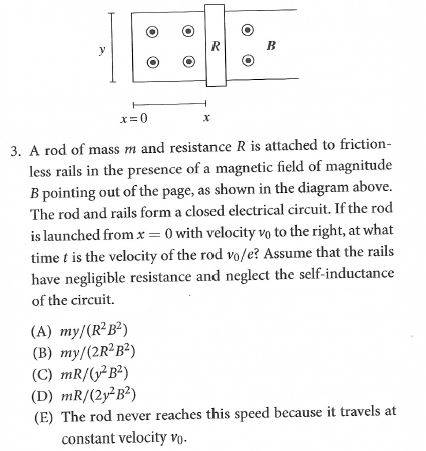
problem.JPG

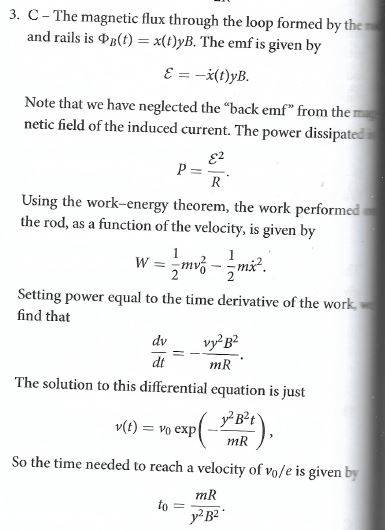
And here is the solution from the book:
solution.JPG

The point of confusion for me is that they use the work-energy theorem in the form W = Tinitial - Tfinal, instead of the other way around. If I were to do this problem, I would write W = Tfinal - Tinitial, but then I end up with a negative time, which does not make sense. What am I missing?
 
Physics news on Phys.org
You are right that the work performed on the rod should be ##W = \dfrac 1 2 m \dot x^2 - \dfrac 1 2 m \dot x_0^2##. So, the text has a sign error here.

But ##P = \mathcal{E}^2/R## gives the rate at which KE of the rod is transformed into Joule heat in ##R##. So, ##P## equals the rate of loss of KE of the rod. Thus, ##P = -\dfrac {d}{dt} (KE)_{\rm rod}= - \dfrac {dW} {dt}##. So, the text has an additional sign error here that compensates for the first error.

The print in the margin of the image is blurred, so I'm assuming ##W## is the work done on the rod.
 
Last edited:
Thanks a lot! I constantly run into problems with minus signs. I think they make up 98% of all the mistakes that I make. It's very frustrating. And yes, the text says "the work performed on the rod". Sorry about the bad quality of the scan. I scanned the page several times and this is the best that I could do.
 
Reply
  • Like
Likes   Reactions: TSny