Given circle, find the line of bearing of tan lines thru 0,0

Click For Summary
SUMMARY

The discussion focuses on finding the angle of tangent lines (T1 and T2) from the origin (0,0) to a circle defined by center P(x,y) and radius R, where R is less than the distance D from the origin to the circle's center. The solution involves using trigonometric relationships to derive the angles of the tangent lines in relation to the x-axis. The user references a potential theorem related to tangent lines and intersecting circles, suggesting a deeper mathematical principle may be at play.

PREREQUISITES
  • Understanding of coordinate geometry
  • Knowledge of trigonometric functions and their applications
  • Familiarity with the concept of tangent lines to circles
  • Basic understanding of the properties of circles in a plane
NEXT STEPS
  • Research the properties of tangent lines to circles in coordinate geometry
  • Study the relationship between angles and distances in trigonometry
  • Explore the theorem regarding tangent lines from one circle to another
  • Examine the mathematical proofs related to intersecting circles and their tangent lines
USEFUL FOR

Mathematicians, geometry enthusiasts, students studying coordinate geometry, and anyone interested in the properties of circles and tangent lines.

srcs
Messages
4
Reaction score
1
This question occurred to me a few days ago and it's been bugging me ever since.

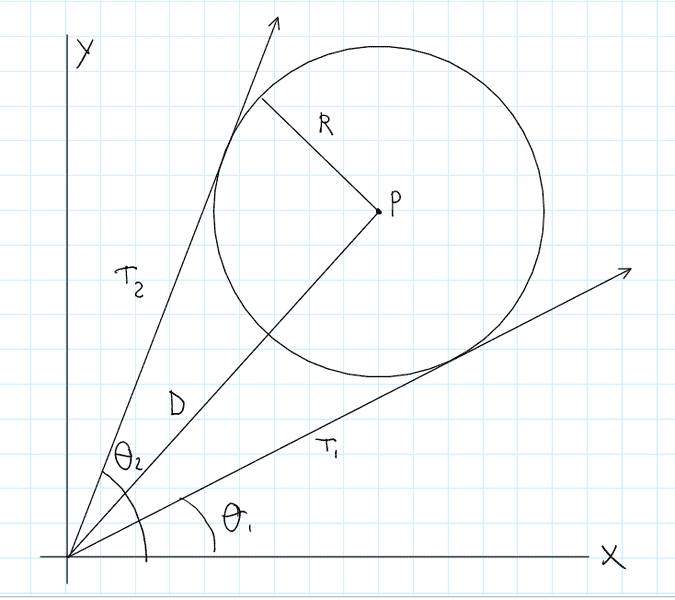
Consider a circle in the coordinate plane with center P(x,y) and radius R, where R < D, D being the distance from the origin to the circle's center.

There are two lines tangent to the circle (T1 and T2) that pass through the origin.

The circle's location can also be considered as a line segment of radius D and some angle Θ with the x axis.

How can I find a general equation in terms of x, y, R, and Θ to determine the angle each tangent line makes with the x axis?
073G7O0.png


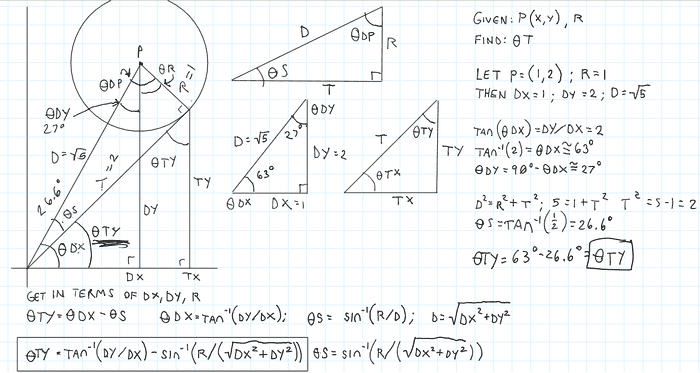
Solution found:

C9qMSEA.png


Adding Θs to Θdx should yield the bearing for the other tangent line.
 
Last edited:
Physics news on Phys.org
You might consider that where the line hits the circle it will be perpendicular to some radius so you have some D length and some angle that D makes with the X axis and some trig to mix into get your answer.
 
jedishrfu said:
You might consider that where the line hits the circle it will be perpendicular to some radius so you have some D length and some angle that D makes with the X axis and some trig to mix into get your answer.

Solved. The help is appreciated.
 
Last edited:
I can't tell if this is just a coincidence of the values I chose, but the distance from the x-axis to the circle's center (Dy) worked out to be equal to the distance from the origin to the tangent line's intersection (T). Weird.
 
srcs said:
I can't tell if this is just a coincidence of the values I chose, but the distance from the x-axis to the circle's center (Dy) worked out to be equal to the distance from the origin to the tangent line's intersection (T). Weird.

This may be a theorem and might be proven if you think about it more abstractly. You are actually saying that drawing a circle with center at the origin that passes through the original circle's center will intersect at the tangent line points.

Perhaps @Mark44 could verify your observation and point to the theorem if it exists as I don't know for sure.

Edit: okay I think this is it on Wikipedia

https://en.m.wikipedia.org/wiki/Tangent_lines_to_circles

Look down a bit in the article to see two intersecting circles and how tangent lines from one circle go through the center of another.
 
jedishrfu said:
This may be a theorem and might be proven if you think about it more abstractly. You are actually saying that drawing a circle with center at the origin that passes through the original circle's center will intersect at the tangent line points.

Perhaps @Mark44 could verify your observation and point to the theorem if it exists as I don't know for sure.

Edit: okay I think this is it on Wikipedia

https://en.m.wikipedia.org/wiki/Tangent_lines_to_circles

Look down a bit in the article to see two intersecting circles and how tangent lines from one circle go through the center of another.
Thanks, this is interesting. Also I just noticed an error in my second diagram when I renamed my variables: Θty should beΘtx everywhere except in the cutout triangle, where it's correctly labeled. I'm pretty sure the calculations themselves are still correct. I'll update the image.

Never mind, the OP no longer has an edit option. I'll just post it here.

WIw8iv5.png
 
  • Like
Likes   Reactions: jedishrfu

Similar threads

Replies
5
Views
2K
  • · Replies 2 ·
Replies
2
Views
4K
  • · Replies 4 ·
Replies
4
Views
2K
  • · Replies 14 ·
Replies
14
Views
908
  • · Replies 2 ·
Replies
2
Views
2K
  • · Replies 2 ·
Replies
2
Views
2K
Replies
8
Views
3K
  • · Replies 8 ·
Replies
8
Views
3K
Replies
17
Views
3K
  • · Replies 4 ·
Replies
4
Views
4K