Length of a line between origin and edge of a circle

Click For Summary

Discussion Overview

The discussion revolves around determining the length of a line drawn from the origin to the edge of a circle, which is centered at a point along the X-axis. The participants explore the relationship between this length and the angle formed with the X-axis, using trigonometric principles. The context includes geometric reasoning and trigonometric relationships rather than being a homework problem.

Discussion Character

  • Exploratory
  • Mathematical reasoning

Main Points Raised

  • One participant poses a question about calculating the length of a line (L) in terms of the angle (α) and radius (R) of a circle centered at R along the X-axis.
  • Another participant suggests that there are two possible triangles to consider for computing L, referencing Thales' Theorem as one approach.
  • A later reply indicates that the length can be derived using trigonometric relationships, specifically stating that L = 2R cos(α) based on the geometry of the situation.

Areas of Agreement / Disagreement

Participants have not reached a consensus on the best method to compute the length L, as different approaches and interpretations of the problem are presented.

Contextual Notes

The discussion includes references to specific geometric configurations and trigonometric identities, but some assumptions and dependencies on the definitions of terms like diameter and angle are not fully explored.

Who May Find This Useful

Individuals interested in geometric properties of circles, trigonometry, and mathematical reasoning related to angles and lengths may find this discussion relevant.

jack476
Messages
327
Reaction score
124
For a circle with radius R centered at R along the X-axis so that the edge of the circle touches the origin, what is the length of a line drawn between the origin and an edge of the circle in terms of the angle between that line and the X-axis? This isn't a homework problem, just something I'm trying to figure out.

IE in this picture (sorry about the MS Paint, I'm on a fairly old computer right now), what is the length of the line L in terms of the angle a and radius R? Any help is much appreciated, thank you.
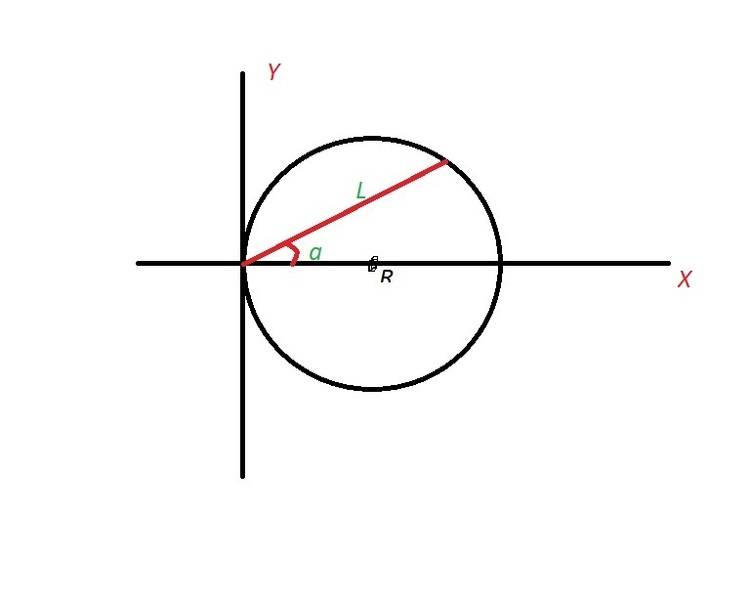
fxIEn7b.jpg
 
Physics news on Phys.org
Are you firm in computing sides of triangles?
 
fresh_42 said:
Are you firm in computing sides of triangles?
Yes, I'm pretty comfortable with that. What are you suggesting?
 
There are 2 possible triangles you can use to compute L depending on a. One involves Thales' Theorem. But it also can be done without. Just look for triangles and right angles you can find in your graphic.
 
jack476 said:
For a circle with radius R centered at R along the X-axis so that the edge of the circle touches the origin, what is the length of a line drawn between the origin and an edge of the circle in terms of the angle between that line and the X-axis? This isn't a homework problem, just something I'm trying to figure out.

IE in this picture (sorry about the MS Paint, I'm on a fairly old computer right now), what is the length of the line L in terms of the angle a and radius R? Any help is much appreciated, thank you.

fxIEn7b.jpg

This article shows the trigonometry of working out L based on a circle with unit radius:

http://geowords.com/e_/06_wind&compass/pi/protractor.htm

Scroll down to 2) at the link. The diagram there:

chord.gif

Matches what you drew in the OP.

Taking the diameter of an arbitrary circle as D, which is the length of EB in the picture above, then cos α = AE / EB, or using your diagram, cos α = L / D.

Therefore, L = D cos α

or L = 2R cos α
 

Similar threads

  • · Replies 2 ·
Replies
2
Views
2K
  • · Replies 5 ·
Replies
5
Views
3K
  • · Replies 5 ·
Replies
5
Views
4K
  • · Replies 2 ·
Replies
2
Views
6K
  • · Replies 7 ·
Replies
7
Views
11K
  • · Replies 1 ·
Replies
1
Views
2K
  • · Replies 22 ·
Replies
22
Views
4K
  • · Replies 2 ·
Replies
2
Views
4K
  • · Replies 3 ·
Replies
3
Views
1K
  • · Replies 2 ·
Replies
2
Views
2K