guyburns
- 44
- 12
Paper has a grain direction – the direction of the long fibres. For several reasons, publishers always print hardcover books with the grain of the paper in the same direction as the fold.
I'm working on a book that will be 2:1 wire bound (two holes to the inch). I was wondering what the grain direction for the paper should be for maximum resistance against tearing at the punched holes. Assume the book is open and one of the pages is being torn out by pulling perpendicular to the binding.
Should the grain run up and down the page, or across the page?
Originally I thought the fibres should run across the page because I'd be trying to stretch the fibres; but then I thought; "No, it would be easier to start a tear that way (the paper starting to rip between the fibres), so the fibres should run top to bottom."
Now I'm unsure.
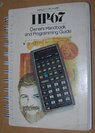
Of the various methods of binding using holes, wire binding seems to me to be the strongest and longest lasting. Attached is a photo of the manual that came with my HP67 in 1976, in the days when scientific calculators came with 300-page manuals. It's 2:1 wire bound, and apart from the plastic coating on the wire cracking here and there, the manual is still in very good condition, even though it saw a lot of use in its heyday. I don't use the manual anymore, but I still use the calculator daily, and it's now 46 years old.
I'll probably be using this paper. Under "Technical Data" on that page it states that the longitudinal tensile strength is 7.2kN/m; transverse 3.2kN/m.
So, for a wire-bound book, grain up and down, or across?
I'm working on a book that will be 2:1 wire bound (two holes to the inch). I was wondering what the grain direction for the paper should be for maximum resistance against tearing at the punched holes. Assume the book is open and one of the pages is being torn out by pulling perpendicular to the binding.
Should the grain run up and down the page, or across the page?
Originally I thought the fibres should run across the page because I'd be trying to stretch the fibres; but then I thought; "No, it would be easier to start a tear that way (the paper starting to rip between the fibres), so the fibres should run top to bottom."
Now I'm unsure.
Of the various methods of binding using holes, wire binding seems to me to be the strongest and longest lasting. Attached is a photo of the manual that came with my HP67 in 1976, in the days when scientific calculators came with 300-page manuals. It's 2:1 wire bound, and apart from the plastic coating on the wire cracking here and there, the manual is still in very good condition, even though it saw a lot of use in its heyday. I don't use the manual anymore, but I still use the calculator daily, and it's now 46 years old.
I'll probably be using this paper. Under "Technical Data" on that page it states that the longitudinal tensile strength is 7.2kN/m; transverse 3.2kN/m.
So, for a wire-bound book, grain up and down, or across?
Attachments