[Griffiths Electrodynamics] Finding the electric flux through this quarter cylinder

  • Thread starter Thread starter physics_student01
  • Start date Start date
  • Tags Tags
    Direction Flux
Click For Summary
SUMMARY

This discussion focuses on calculating the electric flux through the Left and Back faces of a quarter cylinder in cylindrical coordinates. The confusion arises from the direction of the φ cap, where the Left face is considered negative and the Back face positive due to the clockwise and anti-clockwise movement of the angle φ, respectively. The area vectors (da) must point outward from the enclosed region, and the relationship between da and the φ cap is crucial for accurate flux calculations. The participants clarify that the orientation of area vectors and the vector field must be aligned correctly to compute the flux accurately.

PREREQUISITES
  • Understanding of electric flux in vector fields
  • Familiarity with cylindrical coordinates and their conventions
  • Knowledge of vector calculus, specifically dot products
  • Experience with flux calculations through closed surfaces
NEXT STEPS
  • Study the concept of electric flux in vector fields
  • Learn about cylindrical coordinate systems and their applications
  • Review vector calculus, focusing on dot products and area vectors
  • Examine examples of flux calculations through various closed surfaces
USEFUL FOR

Students and professionals in physics, particularly those studying electromagnetism, as well as anyone involved in vector calculus and surface integrals.

physics_student01
Messages
3
Reaction score
5
Thread moved from the technical forums to the schoolwork forums
TL;DR Summary: Confusion in φ cap direction for Left & Back face

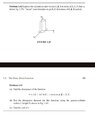
The image of the question is shared at this Imgur link - The only issue I'm facing in this particular problem is in calculating the flux through the "Left" & "Back" faces of this quarter cylinder.

More specifically the issue is in the direction of φ cap, because I'm unable to understand or figure out how or why we considered it to be negative for Left face & positive for the Back face. This is something I'm unable to visualise. Further adding fuel to the fire is the knowledge that unlike Cartesian system, these coordinates don't have a "fixed" spatial direction as such. So how can & how are we assigning positive-negative directions here?

Additionally, it still didn't make sense for the negative angle direction except when I consider this- φ is the angle made wrt the x axis. For the left face, the direction is negative because the angle makes a clockwise movement. In case of the back face however, the direction is positive because the angle traced while reaching that particular face is anti-clockwise. Does it make sense to you too/is my interpretation correct?

Please guide.
Imagur01.jpeg
 
Last edited by a moderator:
Physics news on Phys.org
Which problem are you asking about, 1.42 or 1.43? By convention, ##\mathbf{\hat {\phi}}## points in the direction of increasing ##\phi## which is anti-clockwise looking down the ##z-##axis.
 
  • Like
Likes   Reactions: physics_student01
physics_student01 said:
More specifically the issue is in the direction of φ cap, because I'm unable to understand or figure out how or why we considered it to be negative for Left face & positive for the Back face.
When finding the flux ##\oint \mathbf v \cdot \mathbf{da}## of a vector field ##\mathbf v## through a closed surface, the area vectors ##\mathbf{da}## point outward from the enclosed region. So, you need to consider the relation between ##\mathbf{da}## and ##\hat{\boldsymbol{\phi}}## for the left and back sides of the quarter-cylinder.
 
  • Like
Likes   Reactions: physics_student01
Care must be taken calculating flux from a closed surface. The efflux (from inside to outside) is defined as positive (this also coincides with the definition of the unit surface normal vector). So you need to be cognizant and adjust the calculation appropriately.
 
  • Like
Likes   Reactions: physics_student01
kuruman said:
Which problem are you asking about, 1.42 or 1.43? By convention, ##\mathbf{\hat {\phi}}## points in the direction of increasing ##\phi## which is anti-clockwise looking down the ##z-##axis.
Thank you for responding! My issue is with 1.42, one of its parts where Flux needs to be calculated.

I believe as per your insight, my interpretation mentioned in #1 seems correct. Do you also think so?
 
TSny said:
When finding the flux ##\oint \mathbf v \cdot \mathbf{da}## of a vector field ##\mathbf v## through a closed surface, the area vectors ##\mathbf{da}## point outward from the enclosed region. So, you need to consider the relation between ##\mathbf{da}## and ##\hat{\boldsymbol{\phi}}## for the left and back sides of the quarter-cylinder.
Yes indeed. But for the Left & Back side, somehow it is not clear why one is positive & the other negative. I was suspecting it has to do with clockwise/anticlockwise sweep of the angle as mentioned in #1. Is that a correct way of thinking about it?
 
physics_student01 said:
Is that a correct way of thinking about it?
The issue is the sign of ##\vec v \cdot d\vec a## as explained above
TSny said:
When finding the flux ∮v⋅da of a vector field v through a closed surface, the area vectors da point outward from the enclosed region. So, you need to consider the relation between da and ϕ^ for the left and back sides of the quarter-cylinder.
I don't see how it can be said more clearly
 
To find the flux ∮v⋅da of a vector field v through a closed surface, such as a quarter-cylinder, it's crucial to consider the orientation of the area vectors da with respect to the direction of the vector field v.
Let's consider the quarter-cylinder with its curved surface and two flat surfaces (front and bottom) forming the closed surface. When we talk about the orientation of the area vectors da, we mean their direction relative to the outward normal of the surface.
For the curved surface of the quarter-cylinder, the outward normal points radially outward from the cylinder. Therefore, the orientation of the area vector da on this surface would also be radially outward, perpendicular to the surface.
For the flat surfaces (front and bottom), the outward normal is straightforward, perpendicular to the surface and pointing away from the enclosed region. Therefore, the orientation of the area vectors da on these surfaces would be aligned with the outward normal.
In terms of the relation between da and the unit vector ϕ^ϕ^ (which typically denotes the azimuthal direction in cylindrical coordinates), we can say the following:
  • For the curved surface of the quarter-cylinder, since the orientation of da is radial, and in cylindrical coordinates, ϕ^ϕ^ represents the azimuthal direction which is tangent to the circular cross-sections of the cylinder, there's no direct relation between da and ϕ^ϕ^ on this surface.
  • For the flat surfaces (front and bottom), since da is oriented perpendicular to the surface and ϕ^ϕ^ points tangentially to the circular cross-sections, there's no direct relation between da and ϕ^ϕ^ on these surfaces either.
However, while integrating over the entire surface to find the flux, you will need to consider the dot product v⋅dav⋅da at each point on the surface, taking into account the orientation of both the vector field v and the area vector da at that point. This involves aligning the direction of v and da appropriately to calculate the dot product correctly, ensuring that the flux is calculated accurately.
 
The finite length quarter cylindar has 5 surfaces: four of them are flat. Have you forgotten the surfaces in the x-z plane and in the y-z plane???? What about them?
 
  • #10
Thread locked temporarily -- @physics_student01 check your messages and please reply to my latest message with the question about the other account. Thanks.
 

Similar threads

  • · Replies 10 ·
Replies
10
Views
792
  • · Replies 1 ·
Replies
1
Views
3K
  • · Replies 9 ·
Replies
9
Views
8K
  • · Replies 3 ·
Replies
3
Views
3K
  • · Replies 21 ·
Replies
21
Views
3K
  • · Replies 8 ·
Replies
8
Views
2K
  • · Replies 14 ·
Replies
14
Views
4K
  • · Replies 2 ·
Replies
2
Views
2K
  • · Replies 8 ·
Replies
8
Views
7K
  • · Replies 6 ·
Replies
6
Views
2K