Hair-brained venturi idea, will it work?

  • Context: Undergrad 
  • Thread starter Thread starter seijirou
  • Start date Start date
  • Tags Tags
    Idea Venturi Work
Click For Summary

Discussion Overview

The discussion revolves around a proposed method for managing crankcase pressure in a race car engine, specifically exploring the use of a venturi effect created by a smog pump and exhaust system. Participants examine the feasibility of this idea and alternative approaches to address the issue of oily mist venting.

Discussion Character

  • Exploratory
  • Technical explanation
  • Debate/contested

Main Points Raised

  • One participant suggests using a smog pump to create a venturi effect to draw pressure from the crankcase, terminating the tubing into the exhaust system.
  • Another participant questions the necessity of the smog pump, suggesting that the headers might already provide a sufficient venturi effect without modification.
  • A different viewpoint mentions the historical use of scavenger pipes to vent crankcase pressure directly to the headers, implying this could be a simpler solution.
  • Concerns are raised about the pressures involved in the system, including those from the crankcase, exhaust headers, and smog pump, with one participant expressing uncertainty about measuring these pressures accurately.
  • Another participant proposes an alternative method using the exhaust pipe to create a vacuum, suggesting that a larger pipe could enhance the vacuum effect at high speeds.

Areas of Agreement / Disagreement

Participants express differing opinions on the effectiveness and necessity of the smog pump in the proposed design. While some support the venturi concept, others question its practicality and suggest alternative methods. The discussion remains unresolved regarding the best approach to manage crankcase pressure.

Contextual Notes

Participants acknowledge limitations in their understanding of the pressures involved and the specific requirements of the racing class, which may restrict modifications to the exhaust system.

seijirou
Messages
4
Reaction score
0
Hi,

I know a little about a little and nothing about a lot, but I've got an idea and I thought this community may be able to lend a hand. Perhaps even find it interesting, who knows.

I'm working on a race car, and I need to deal with pressure that can build in the crankcase because piston rings don't seal perfectly.

Typically the crankcase pressure is vented through a tube back into the intake behind the throttle plate and thereby recirculated. That is not an option on this car as the vented pressure contains an oily mist which reduces the effective octane rating in the combustion chamber, and this is very unhealthy for race car engines.

A common alternative is to simply vent the crankcase to atmosphere. In time however this smothers that oily mist all over everything under the hood, and generally makes a mess.

A more enterprising idea is to use a vacuum pump to draw pressure from the crankcase. Unfortunately it's also a rather expensive idea to purchase a pump for this purpose. Some have tried to re-purpose smog pumps (exhaust air injection pumps) but they are designed to run dry. So when their innards are exposed to that oily mist, they shortly fail.

Now here's my hair-brained idea. Rather than using a smog pump directly as a vacuum pump, use it to blow through tubing. Step down the diameter of the tubing after the smog pump to create a venturi effect, and provide a tap at the choke point where from a line can be run to the crankcase. Finally terminate the run of tubing into the exhaust system.

Here's a picture that I whipped up.
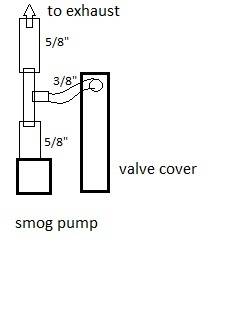
SmogPumpVenturiScavenge.jpg


Would it work?

Thanks
 
Physics news on Phys.org
Welcome to PF.
It seems to me that the introduction of a "smog pump" (whatever the hell that is) would be a wasted effort in an otherwise good system. Back in the 70's, we just vented from the valve covers to the headers. We called them "scavenger pipes" or "pan evacuation systems".
 
Danger said:
Welcome to PF.
It seems to me that the introduction of a "smog pump" (whatever the hell that is) would be a wasted effort in an otherwise good system. Back in the 70's, we just vented from the valve covers to the headers. We called them "scavenger pipes" or "pan evacuation systems".

You're absolutely right. But I'm told the class that this car will compete in requires all the factory accessories to be present, which means the smog pump stays.

I'm assuming the rules don't allow for one of those exhaust evac systems or we'd just use that. I'll double check.

Meanwhile are you saying that the venturi design would not work?

Thanks
 
seijirou said:
Meanwhile are you saying that the venturi design would not work?
What are the pressures from the crankcase, at the exhaust headers, and from the smog pump (when connected to the headers as shown in your diagram)? As mentioned, is the smog pump really needed?
 
seijirou said:
I'm told the class that this car will compete in requires all the factory accessories to be present, which means the smog pump stays.
Does it say that they have to be hooked up? :devil:
By the bye, I looked up "smog pump". It's just what I knew of as "air injection". While I have some very vague knowledge of it, I've never owned a vehicle new enough to have one and thus am totally lacking in experience with it.

seijirou said:
Meanwhile are you saying that the venturi design would not work?
Not at all. Sorry if I gave that impression. It's just that the headers themselves provide the venturi effect without modification. I don't know whether or not that would apply to a supercharged engine, though. As Rcgldr mentioned, it's a matter of relative pressure. He has demonstrated, in other threads, that he is more knowledgeable than I in automotive matters, so I'm going to turn the answering over to him at this point. Pay attention also if RangerMike or Stingray chirps up; they're both serious gearheads.
Happy Hunting on the track. Keep us informed of your activities.
 
rcgldr said:
What are the pressures from the crankcase, at the exhaust headers, and from the smog pump (when connected to the headers as shown in your diagram)? As mentioned, is the smog pump really needed?

I'm afraid I have no idea precisely what the pressures are. The smog pump by design blows into the factory exhaust, so I can know it will produce more than what's in the exhaust. Factory exhaust is not particularly free-flowing either. I expect the exhaust is slightly above atmospheric, the smog pump is producing a little more than that, and the crank case is slightly above atmospheric as well.
None of these I can readily measure directly except perhaps crank case pressure. I could run a line to a pressure gauge in the car and see where it's at under load. At that point though I may as well build everything and see how it changes.

So about the smog pump, it does need to be installed. It does not need to be hooked up to anything. So, just connecting the valve covers to the header collectors would be an option, BUT, the shop owner doesn't want to do that because the clearance to install them is so tight, he doesn't believe the headers could be installed and removed with the extra tube installed, without lifting up the whole motor.
 
Danger said:
Does it say that they have to be hooked up? :devil:
By the bye, I looked up "smog pump". It's just what I knew of as "air injection". While I have some very vague knowledge of it, I've never owned a vehicle new enough to have one and thus am totally lacking in experience with it.


Not at all. Sorry if I gave that impression. It's just that the headers themselves provide the venturi effect without modification. I don't know whether or not that would apply to a supercharged engine, though. As Rcgldr mentioned, it's a matter of relative pressure. He has demonstrated, in other threads, that he is more knowledgeable than I in automotive matters, so I'm going to turn the answering over to him at this point. Pay attention also if RangerMike or Stingray chirps up; they're both serious gearheads.
Happy Hunting on the track. Keep us informed of your activities.

No worries! Thanks for taking the time :)
 
My pleasure.
 
I bet your not old enough to know how the old steam locomotive used steam released from each cylinder to suck a vacuum on the fire box and blow the smoke out of the chemney.

Use your car engine exhaust to suck the vacuum you need. Let's assume your car exhaust pipe is 2" diameter. Slide a 3" diameter pipe over the tip end of your exhause pipe at high speed with the engine running several 1000 RPMs all the exhaust moving through the 3" pipe will suck a vacuum on one end. The exhaust comes out one end of the 3" pipe and you have a vacuum on the other end of the pipe. If you run a piece of tubing from your engine vent to the vacuum end of the 3" pipe it will do what you want at high speed but not at idle speed.
 

Similar threads

  • · Replies 17 ·
Replies
17
Views
5K
  • · Replies 11 ·
Replies
11
Views
3K
  • · Replies 19 ·
Replies
19
Views
9K
  • · Replies 3 ·
Replies
3
Views
3K
  • · Replies 2 ·
Replies
2
Views
8K
Replies
3
Views
4K