Bqback
- 3
- 0
- Homework Statement
- A glass piece with dimensions LxLxH mm is sitting on a cooled table (with constant temp T0) and receiving a stream of protons with given stream density φ (protons/(cm^2*s)) and energy per proton Ep from above.
Density ρ , specific heat capacity c_p, heat conductivity κ, emissivity ε are all given.
Using the finite difference method, find heat distribution for varying stream densities and estimate heat eradiated from the glass piece's surface.
- Relevant Equations
- dT/dt = a^2 * d^2T/dx^2 + f(x) is the standard heat equation.
f(x), the source function is replaced by an array of data points that show the distribution of absorbed energy (in keV/(proton*μm)) throughout the H dimension within a very narrow band (from 0.006 μm to 0.51 μm).
First of all, I didn't know whether to pick this subforum or the engineering/compsci one, I understand this might need to be moved to a more appropriate subforum.
The general approach is fairly obvious, use implicit method to construct the tridiagonal matrix for Thomas method and solve. However, I'm having problems bringing heat transfer on the "outer side" facing the stream into the mix. I assumed the initial condition is the same temperature all throughout the piece, and the face touching the table will obviously have the same temperature regardless of time.
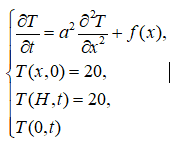
My first (and only) idea so far was comparing energy received from protons and radiated away:


For heat capacity C I used a small slice along H (from 0 to the first point in distribution data)
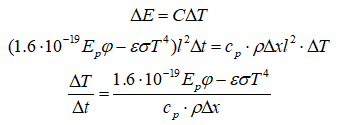
However, implementing this as a finite difference
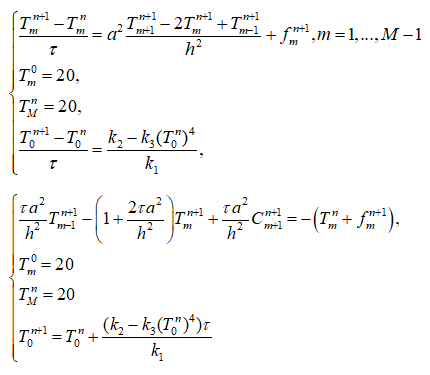
always leads to not only huge endless divergencies (on the orders of magnitude far beyond humanly achievable), but even negative temperatures for sufficiently small (10^`11 or less) φ. I've spent a lot of time tinkering with coefficients and trying different things with my code but it never worked out. Closest I got to something resembling normal behavior is T^n_0 aproaching a value, but the value and the "approach speed" is the same regardless of φ, which doesn't make much sense physically.
My second idea so far has been to flat out assign a value to temperature on the outer face (e. g. the temperature at the nearest point), but then I still have no idea how to bring in heat radiation.
The general approach is fairly obvious, use implicit method to construct the tridiagonal matrix for Thomas method and solve. However, I'm having problems bringing heat transfer on the "outer side" facing the stream into the mix. I assumed the initial condition is the same temperature all throughout the piece, and the face touching the table will obviously have the same temperature regardless of time.
My first (and only) idea so far was comparing energy received from protons and radiated away:
For heat capacity C I used a small slice along H (from 0 to the first point in distribution data)
However, implementing this as a finite difference
always leads to not only huge endless divergencies (on the orders of magnitude far beyond humanly achievable), but even negative temperatures for sufficiently small (10^`11 or less) φ. I've spent a lot of time tinkering with coefficients and trying different things with my code but it never worked out. Closest I got to something resembling normal behavior is T^n_0 aproaching a value, but the value and the "approach speed" is the same regardless of φ, which doesn't make much sense physically.
My second idea so far has been to flat out assign a value to temperature on the outer face (e. g. the temperature at the nearest point), but then I still have no idea how to bring in heat radiation.