Bootleg5353
Hello,
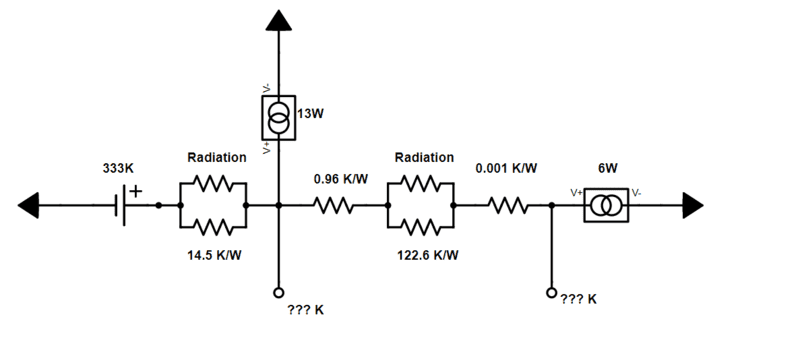
So I am assembling some testing equipment. I have an active circuit, microcontroller, and two battery packs inside a black polypropylene case (which is around 1 ft x 1 ft x 0.5 ft). I was performing a thermal analysis because I want to make sure the electronics do not heat up past around 80C (the temperature node near the 6W supply). I am assuming the ambient temperature can get up to about 60C, the wind speeds around and inside the case are very low (0.01m/s or h=.15 W/m^2K). The thermal shown below has values placed in for the various thermal resistances I am looking at. Currently, I have the outside thermal radiation resistance to be 0.82 K/W and the inside to be 1.82 K/W. The outside has an area of 0.138 m^2 and the inside has an area of 0.054 m^2. The radiation coefficient was initially estimated then the solution was iterated until convergence.
A further note, this is for one direction of heat xfer, for the full picture each chain of resistances should be put into 3x parallel - keeping the power and ambient temp the same.I am quite confident on the values besides the radiation resistances. They seem very very low, which signifies that the heat transfer due to radiation is pretty substantial. During my academic career we essentially avoided radiation - probably because it is so temperature dependent. I do not really have a good grasp on temperatures/resistances/coefficients as I only took one class that was years ago on this.
The first temperature near the 13W supply is sitting at 65C and the second temperature is sitting around 75C - do these make sense?
Thank you!
So I am assembling some testing equipment. I have an active circuit, microcontroller, and two battery packs inside a black polypropylene case (which is around 1 ft x 1 ft x 0.5 ft). I was performing a thermal analysis because I want to make sure the electronics do not heat up past around 80C (the temperature node near the 6W supply). I am assuming the ambient temperature can get up to about 60C, the wind speeds around and inside the case are very low (0.01m/s or h=.15 W/m^2K). The thermal shown below has values placed in for the various thermal resistances I am looking at. Currently, I have the outside thermal radiation resistance to be 0.82 K/W and the inside to be 1.82 K/W. The outside has an area of 0.138 m^2 and the inside has an area of 0.054 m^2. The radiation coefficient was initially estimated then the solution was iterated until convergence.
A further note, this is for one direction of heat xfer, for the full picture each chain of resistances should be put into 3x parallel - keeping the power and ambient temp the same.I am quite confident on the values besides the radiation resistances. They seem very very low, which signifies that the heat transfer due to radiation is pretty substantial. During my academic career we essentially avoided radiation - probably because it is so temperature dependent. I do not really have a good grasp on temperatures/resistances/coefficients as I only took one class that was years ago on this.
The first temperature near the 13W supply is sitting at 65C and the second temperature is sitting around 75C - do these make sense?
Thank you!