Help about the unit vectors for polar coordinates in terms of i and j

Click For Summary
SUMMARY

The discussion centers on the derivation of the unit vector U(θ) in polar coordinates, specifically expressed as U(θ) = -sin(θ)i + cos(θ)j. The negative sign before sin(θ) indicates the direction of the unit vector i, which points in the negative x-direction when θ = π/2, resulting in U(θ) = -i. Participants clarify that the expression reflects basic trigonometric principles, particularly the relationship between the angles and the unit vectors in polar coordinates.

PREREQUISITES
  • Understanding of polar coordinates and their unit vectors
  • Familiarity with trigonometric identities and their applications
  • Knowledge of vector decomposition in two dimensions
  • Basic proficiency in mathematical notation and inner products
NEXT STEPS
  • Study the derivation of unit vectors in polar coordinates
  • Explore trigonometric identities, particularly sin and cos relationships
  • Learn about vector projections and their significance in physics
  • Investigate the geometric interpretation of angles in polar systems
USEFUL FOR

Students and educators in mathematics and physics, particularly those focusing on vector calculus and polar coordinate systems.

srnixo
Messages
51
Reaction score
10
Homework Statement
What is the significance of the negative sign [-] before [sin] in the final expression for Uθ? or was it just my mistake in the projections that prevented me from finding it?
Relevant Equations
Angular Unit Vector.
"Firstly, I represented []on the two-dimensional polar coordinate system to facilitate the steps and projections."
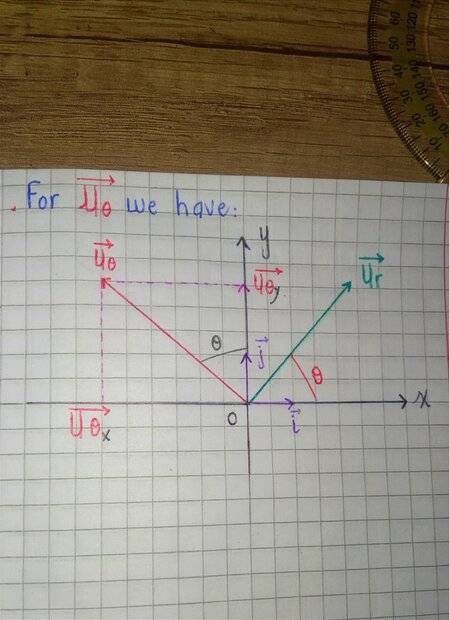
1000004597.jpg


Then, I have written the steps, step by step, to ultimately derive the expression U(θ) in terms of i and j which is:
[ Uθ=−sin(θ)i+cos(θ)j ]

NOTE:
The professor provided us with this expression directly, without proof, for that reason, I am aware of it. And I just wanted to substantiate it myself as an attempt."

Here are the steps:
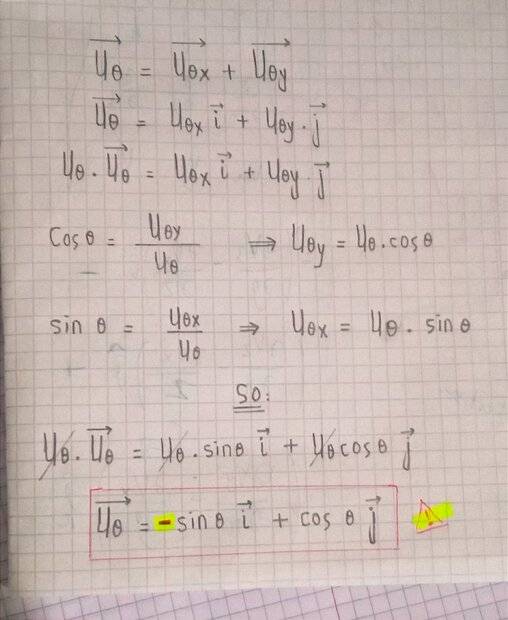
1000004593.jpg

``However, as I mentioned earlier, I did not ascertain the origin of the negative sign before sin [Uθ=−sin(θ)i] in the end . Does it merely indicate the opposite direction for the unit vector i ? (meaning it is only written as an indication in the end)? Or have I made an error in the projection concerning the angles or something like that??

I HAVE ANOTHER QUESTION: (additional)​

when i write Uθ=−sin(θ)i . Is it the same as writing Uθ=sin(θ)−i ????

Thanks for your consideration.
 
Physics news on Phys.org
If ##\theta=\pi/2##, what is the value of ##\sin{\theta}## and what direction is ##U_{\theta}## pointing?
 
Hi,

You write
1704296967482.png

First line: to decompose the vector ##\vec U_{\theta}## in two vectors ##\vec U_{\theta x}## and ##\vec U_{\theta y}##.
Second line: coefficients ##U_{\theta x}## and ##U_{\theta y}## are real numbers.

Third line I don't understand. You add ##U_\theta## (a real number ? positive definite ?) and a dot on the left side, but the right side remains the same.

Usually a dot signifies an inner product of two vectors,.

What do you mean to express here ?

[ah, Chet is faster...]

##\ ##
 
Your diagram seems to define ##\theta## in 2 different ways, one with respect to the x-axis and the other with respect to the y-axis. You can't do that!

Maybe this diagram makes it clearer:
polar.png

(diagram taken from here: http://www.physicsbootcamp.org/Motion-in-Polar-Coordinates.html )

On the diagram, the angular unit-vector, ##\hat u_{\theta}## is directed at angle ##\frac {\pi}2 + \theta## (angle measured counter-clockwise from the +x-axis). So that's the angle you must use when finding ##\hat u_{\theta}##'s components.

srnixo said:
when i write Uθ=−sin(θ)i . Is it the same as writing Uθ=sin(θ)−i ????
You probably meant to type: Is Uθ=−sin(θ)i the same as Uθ=sin(θ)(−i)?
The answer is yes - though it's not relevant here.

Aha. Everyone is faster than me.
 
Interesting :smile: ....

@srnixo , could you describe in a bit more detail what you are trying to do and precisely what alll your variables mean ? @Steve4Physics hat means he is talking about unit vectors. Are your ##\vec U## unit vectors ? From the figure I didn't conclude that ...

##\ ##
 
Chestermiller said:
If ##\theta=\pi/2##, what is the value of ##\sin{\theta}## and what direction is ##U_{\theta}## pointing?
When θ=π/2 the value of sin(θ)=1 because sin(2/π)=1
And after substituting that in our final expression we will get [-1]. Which means Uθ is pointing in the negative x-direction (-i).

In addition, I know that Uθ=Ur( θ=θ+2/π) which means that we obtain it by rotating Ur by an angle of π/2 in the direction of the angular rotation θ. but i'm not pretty sure if that means that: if for example is pointing in the positive x and y direction then the final expression is gonna be Uθ=sin(θ)i+cos(θ)j . In other words, that negative sign signifies only the direction of the and it is not to be directly memorized as it was!!
 
@Steve4Physics :
In the illustration, the direction of Uθ doesn't matter; what's important is that it is perpendicular to Ur. which means that i can draw it like the diagram you provided or simply just like I did.
For that reason i was asking about the minus sign in the expression Uθ=−sin(θ)i if it is an indication about the direction only or a part of a general law.
 
BvU said:
Interesting :smile: ....

@srnixo , could you describe in a bit more detail what you are trying to do and precisely what alll your variables mean ? @Steve4Physics hat means he is talking about unit vectors. Are your ##\vec U## unit vectors ? From the figure I didn't conclude that ...

##\ ##
Hello there!

Yes, i'm talking about the unit vector [polar coordinate system] and its relationship with the unit vectors i and j.
i was trying to prove the final expression from the beginning.
 
srnixo said:
When θ=π/2 the value of sin(θ)=1 because sin(2/π)=1
And after substituting that in our final expression we will get [-1]. Which means Uθ is pointing in the negative x-direction (-i).

In addition, I know that Uθ=Ur( θ=θ+2/π) which means that we obtain it by rotating Ur by an angle of π/2 in the direction of the angular rotation θ.but i'm not pretty sure if that means that: if for example is pointing in the positive x and y direction then the final expression is gonna be Uθ=sin(θ)i+cos(θ)j . In other words, that negative sign signifies only the direction of the and it is not to be directly memorized as it was!!
I have no idea what you are saying.
 
  • #10
srnixo said:
@Steve4Physics :
In the illustration, the direction of Uθ doesn't matter; what's important is that it is perpendicular to Ur. which means that i can draw it like the diagram you provided or simply just like I did.
For that reason i was asking about the minus sign in the expression Uθ=−sin(θ)i if it is an indication about the direction only or a part of a general law.
It is part of the general law.
 
  • #11
Chestermiller said:
I have no idea what you are saying.
That's what i meant it Mr.
IMG_20240103_181026.jpg


When drawing both polar unit vectors in the x and y positive direction. The final expression of the relationship between (Ur , Uθ, i and j) is it gonna be Uθ=sin(θ)i+cos(θ)j ! Or still Uθ=-sin(θ)i+cos(θ)j (with minus sign)
 
  • #12
srnixo said:
@Steve4Physics :
In the illustration, the direction of Uθ doesn't matter; what's important is that it is perpendicular to Ur. which means that i can draw it like the diagram you provided or simply just like I did.
Agreed. But I provided a different drawing because (as stated) I thought your drawing made ##\theta## ambiguous. Maybe I was being too fussy.

srnixo said:
For that reason i was asking about the minus sign in the expression Uθ=−sin(θ)i if it is an indication about the direction only or a part of a general law.
The minus sign follows from basic trig’. It’s worth understanding where it comes from and being able to derive it for yourself. Here’s one way.

If ##\hat u_r## points in direction ##\theta## then ##\hat u_{\theta}## points in direction ##\alpha = \frac {\pi}2 + \theta##.

The projection of ##\hat u_{\theta}## (length =1) onto the x-axis is
## 1*\cos \alpha = \cos (\frac {\pi}2 + \theta)##

We use the identity ##\cos (\frac {\pi}2 + \theta) \equiv -\sin \theta##. That's where the minus sign creeps in.

So the projection of ##\hat u_{\theta}## onto to the x-axis is ##-\sin(\theta)##. I.e the x-part of ##\hat u_{\theta}## is ##-\sin(\theta) \hat i##
 
  • #13
srnixo said:
Hello there!

Yes, i'm talking about the unit vector [polar coordinate system] and its relationship with the unit vectors i and j.
i was trying to prove the final expression from the beginning.
In that case: the decomposition of ##\vec{\hat U_\theta}## in ##x## and ##y## components can be written as$$
\vec{\hat U_\theta} =
\left (\vec{\hat U_\theta}\cdot \hat\imath \right ) {\bf \hat \imath} +
\left (\vec{\hat U_\theta}\cdot \hat\jmath \right ) {\bf \hat \jmath}
$$ and the coefficients follow from the inner procucts$$
\begin{align*}
\vec{\hat U_\theta}\cdot \hat\imath & = \left | \vec{\hat U_\theta} \right | \left | \hat \imath \right | \cos\theta_1 \\
\vec{\hat U_\theta}\cdot \hat\jmath & = \left | \vec{\hat U_\theta} \right | \left | \hat \jmath \right | \cos\theta_2
\end{align*}
$$All the | ##\ ## | are 1 and with ##\ \theta_1 \ =\ \theta_2 +\pi/2 \ =\ \theta +\pi/2\ ## you have ##\cos\theta_1 = -\sin\theta##

1704306038199.png

So that's where the minus sign comes from :smile:

[ah, duplicates Steve's post. Well, better twice than not at all]

##\ ##
 
  • #14
  • Like
Likes berkeman, Steve4Physics and BvU

Similar threads

  • · Replies 3 ·
Replies
3
Views
4K
  • · Replies 1 ·
Replies
1
Views
2K
  • · Replies 9 ·
Replies
9
Views
2K
  • · Replies 3 ·
Replies
3
Views
2K
Replies
5
Views
2K
  • · Replies 3 ·
Replies
3
Views
9K
  • · Replies 1 ·
Replies
1
Views
5K
  • · Replies 25 ·
Replies
25
Views
4K
  • · Replies 7 ·
Replies
7
Views
3K
  • · Replies 3 ·
Replies
3
Views
2K