[help] finding the total electric flux

Click For Summary
SUMMARY

The discussion centers on calculating total electric flux using Gauss's theorem, specifically in relation to electric flux density (D) and electric field (E). The user initially attempted to integrate over the volume of a sphere but was advised to integrate over surface area instead. The correct approach involves applying Gauss's theorem, which simplifies the calculation of electric flux without the need for integration.

PREREQUISITES
  • Understanding of electric flux and its relationship to electric field and charge.
  • Familiarity with Gauss's theorem and its application in electrostatics.
  • Basic knowledge of spherical coordinates and surface area integration.
  • Concept of electric flux density (D) and its significance in electromagnetism.
NEXT STEPS
  • Study Gauss's theorem in detail, focusing on its applications in calculating electric flux.
  • Learn about electric flux density (D) and its relationship to electric field (E) in various materials.
  • Explore surface area integration techniques in spherical coordinates for electrostatic problems.
  • Review examples of electric flux calculations in different geometries using Gauss's law.
USEFUL FOR

Students and professionals in physics, particularly those studying electromagnetism, as well as educators looking for practical examples of electric flux calculations.

bibo_dvd
Messages
37
Reaction score
0
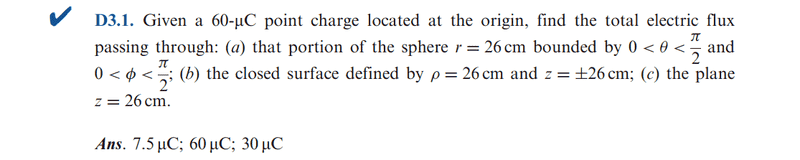
Hello Guys !

iam studing the electric flux and how the relationship between D ( electric flux density ) and E ( elecric field)


but i found this problem and i don't know which formula should i use to solve it to find the electric flux

i know that Q=(Psi)=the electric flux but i don't know how to use this to solve this problem

i tried to use the integration of the volume of the sphere which is r^2 sin(ceta)*dr*d(ceta)*d(phi)

but i didn't reach to the number in the solution ...I need your help !
MhjsfpZ.png
 
Physics news on Phys.org
You don't integrate over volume, you integrate over surface area.
 
hmmm , this means that i will integrate r^2 sin(ceta) *d(ceta)*d(phi) ??
 
You don't actually perform any integration. You use Gauss's theorem thruout.
 
The book claims the answer is that all the magnitudes are the same because "the gravitational force on the penguin is the same". I'm having trouble understanding this. I thought the buoyant force was equal to the weight of the fluid displaced. Weight depends on mass which depends on density. Therefore, due to the differing densities the buoyant force will be different in each case? Is this incorrect?

Similar threads

  • · Replies 9 ·
Replies
9
Views
1K
  • · Replies 2 ·
Replies
2
Views
2K
  • · Replies 2 ·
Replies
2
Views
1K
  • · Replies 8 ·
Replies
8
Views
3K
  • · Replies 4 ·
Replies
4
Views
2K
  • · Replies 2 ·
Replies
2
Views
4K
  • · Replies 1 ·
Replies
1
Views
2K
  • · Replies 6 ·
Replies
6
Views
3K
Replies
6
Views
3K
  • · Replies 14 ·
Replies
14
Views
2K