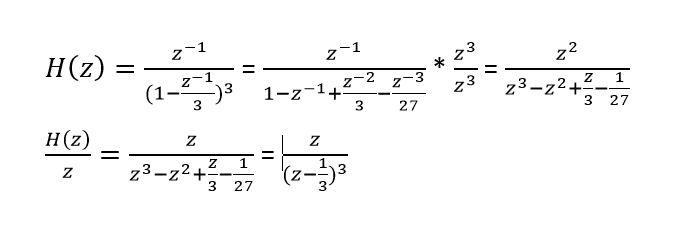
SUMMARY
The discussion centers on finding the inverse Z transform of a given signal. Participants suggest starting with the original function F(z) and applying the transformation z → z/3. Additionally, they recommend examining the Z transform for the sequence f[n] = [n^2] and recognizing the relationship z-1F(z) ↔ f[n-1]u[n-1]. These steps provide a clear pathway to solving the inverse Z transform problem.
PREREQUISITES
- Understanding of Z transforms and their properties
- Familiarity with the concept of sequences in signal processing
- Knowledge of the unit step function u[n]
- Basic skills in manipulating mathematical functions and transformations
NEXT STEPS
- Study the properties of the Z transform in detail
- Learn about the relationship between Z transforms and discrete-time signals
- Explore examples of inverse Z transforms for various sequences
- Investigate the application of the unit step function in signal processing
USEFUL FOR
Students and professionals in signal processing, electrical engineering, and applied mathematics who are looking to deepen their understanding of Z transforms and their applications in analyzing discrete-time systems.