Help me understand cheap boost module?

Click For Summary

Discussion Overview

The discussion revolves around the understanding and analysis of cheap boost modules used in plasma experiments. Participants explore the components of these modules, their functionality, and their differences compared to traditional neon sign transformers. The conversation includes inquiries about circuit design, safety considerations, and the nature of the electrical arcs produced by these devices.

Discussion Character

  • Exploratory
  • Technical explanation
  • Debate/contested
  • Conceptual clarification

Main Points Raised

  • One participant describes their attempt to reverse engineer a boost module, noting the presence of a resistor, diode, and transformer, but expressing uncertainty about other components.
  • Another participant questions the necessity of 400kV for the plasma experiments and asks about the original poster's experience with high voltages.
  • There is a mention of a Jacob's ladder setup using the boost module, with a participant noting a magnetic attraction effect between the chains that differs from their experience with neon sign transformers.
  • Some participants discuss the characteristics of the pulsed arc from the boost modules and its suitability for a Jacob's ladder, noting that the climbing effect is not as smooth as with other transformers.
  • Concerns are raised about the safety of handling high voltage devices, with one participant cautioning against relying on YouTube for safety practices.
  • There is a debate about the actual voltage output of the modules, with skepticism expressed regarding the advertised 400kV, suggesting it may be exaggerated.
  • Participants discuss the complexity of switch mode power supplies, with one asserting that the modules are likely self-oscillating boost circuits without regulation or filtering.

Areas of Agreement / Disagreement

Participants express varying opinions on the nature and specifications of the boost modules, particularly regarding their voltage output and design. There is no consensus on the exact characteristics of the circuits or the safety implications of using these devices.

Contextual Notes

Some participants express limitations in their understanding of the circuit components and safety practices, indicating a reliance on personal experience and informal sources for knowledge. There are unresolved questions about the actual voltage output and the design specifics of the modules.

Who May Find This Useful

This discussion may be of interest to individuals involved in plasma experiments, educators seeking to explain high voltage concepts, and hobbyists exploring the functionality of boost modules and their applications.
mishima
Messages
576
Reaction score
43
TL;DR
It's a transformer. I'd like more detail, or help reverse engineering a circuit diagram.
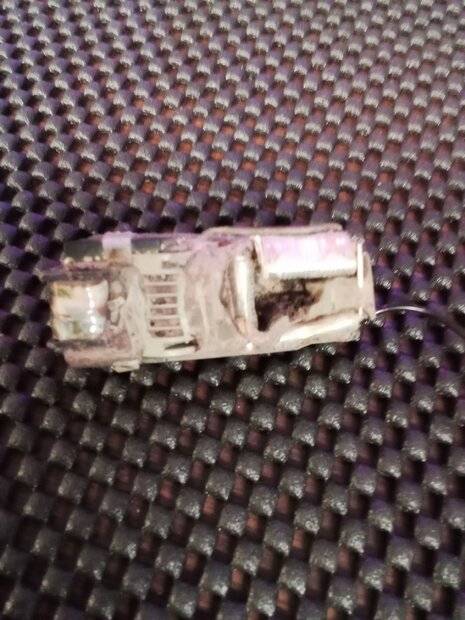
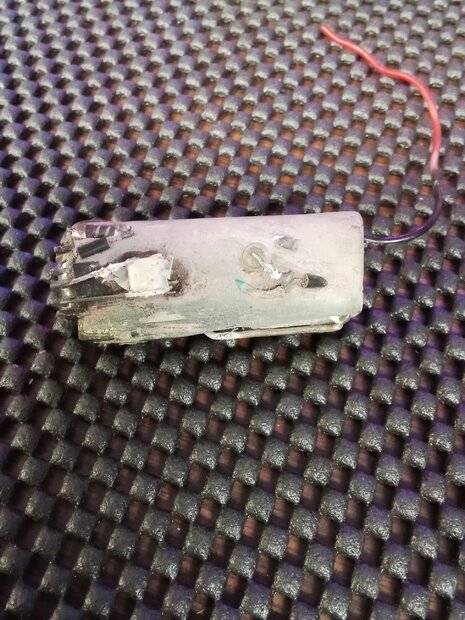
Hi, I recently acquired some of these cheap modules for plasma experiments. I tried dissolving the epoxy off of one of them in an attempt to reverse engineer the circuit. I can see a resistor, diode, and transformer but am unsure about some of the other components. I was wondering if anyone here could just look at some of these parts and help identify them, or give some insight into what is going on with the circuit.

IMG_2024-05-09-10-21-15-868.jpg
IMG_2024-05-09-10-20-53-633.jpg


Also a question, with these boost modules I notice a magnetic attraction in the chains that I don't experience with the neon sign transformer. Why?
 
Engineering news on Phys.org
Thread is paused for Moderation...
 
Thread is reopened provisionally...

mishima said:
Hi, I recently acquired some of these cheap modules for plasma experiments.
What kind of "plasma experiments" are you planning on doing? Why do you need 400kV? What experience do you have working with high voltages?

From the info in your link at Amazon:
★High pressure type: the type of pulse current.Output voltage: 400000 v (Please pay attention to safety).
★High pressure discharge distance between: 10 mm - 20 mm.
 
It is a Jacob's ladder that uses 2 hanging chains as the conductors, and also this. For the latter I have not had much luck getting my 3d prints to become conductive enough. But it makes a great Jacob's ladder with a 6V lantern battery and some hanging chains.

I have used neon sign transformers in the past for similar Jacob's ladders, and I never noticed the magnetic attraction between the chains the way these smaller modules create. I assume the pulse current design in these things is causing the effect. I was hoping to get some rough idea of a circuit diagram from taking one apart.

edit: I don't believe they are actually that high of a voltage, but I also don't have a great way to measure it. That is another reason why I'd like to work out a schematic. As for my experience, not a lot. I have a physics degree and have been teaching physics for a decade and some change. I believe I am taking all the precautions necessary to mitigate the risk. I am not an electronics engineer however.
 
Last edited:


As I understand it, a handheld taser has two ‘stabbing’ prongs for delivering the shock, branching off from which are two smaller prongs closer together.

When the unit is activated, but not applied to a baddie, the arc is allowed to jump across the smaller prongs. This snapping arc acts as a deterrent, but also prevents the unit from operating open circuit, which quickly destroys the windings by internal arcing.

Also, would the pulsed arc from these suit a Jacob’s ladder? The arc normally takes a second or two to climb up, but the pulsed arc from these units would keep breaking.
 
  • Like
Likes   Reactions: mishima
Yes, it works similar to a Jacob's ladder but the climbing effect is not as smooth, as you say. It does clearly rise in height. Also as mentioned, there is a magnetic attraction effect I never noticed with other transformers.

It's interesting because the magnetic effect actually pulls the chains together before any arc, so it kind of auto-adjusts the gap spacing (which otherwise takes some tinkering with the traditional neon sign transformer).
 
mishima said:
It is a Jacob's ladder that uses 2 hanging chains as the conductors, and also this. For the latter I have not had much luck getting my 3d prints to become conductive enough. But it makes a great Jacob's ladder with a 6V lantern battery and some hanging chains.

I have used neon sign transformers in the past for similar Jacob's ladders, and I never noticed the magnetic attraction between the chains the way these smaller modules create. I assume the pulse current design in these things is causing the effect. I was hoping to get some rough idea of a circuit diagram from taking one apart.

edit: I don't believe they are actually that high of a voltage, but I also don't have a great way to measure it. That is another reason why I'd like to work out a schematic. As for my experience, not a lot. I have a physics degree and have been teaching physics for a decade and some change. I believe I am taking all the precautions necessary to mitigate the risk. I am not an electronics engineer however.
You'll need to be a d#$@ sight more careful around HV than that guy in the video. YouTube is an awful place to learn about potentially dangerous activities.

Switch mode power supplies are relatively complex things for someone that hasn't studied EE. It won't actually help you much to see what's in that circuit, you won't know what your looking at. You probably don't have the equipment necessary to build one that works. They typically just don't work if you put together a bunch of parts without really understanding the theoretical basis. This is good news because it limits how much danger you'll be exposed to, unlike neon sign transformers, for example.

BTW 400kV is ridiculous. That is not a trustworthy source, they are lying to you, and assuming you know nothing about HV power supplies. Maybe the engineering is good, IDK. But the marketing is disingenuous.
 
  • Like
Likes   Reactions: davenn and mishima
Oh, I am not trying to build my own power supply. I was just trying to get a circuit diagram of this one to study, mostly in an effort to explain it better to curious students and differentiate it from the neon sign transformer. As I said, my current explanation amounts to 'its a transformer, a transformer is...(normal textbook explanation with algebra based math)' which I feel is lacking.

I don't base my safety practices on YouTube videos. I've had some university circuit labs and worked with some high voltage circuits as a service observer at a USGS telescope. And no, indeed I don't have a degree in EE (I wish) but I can usually make sense of schematics after a little study and simulation...and coffee and help from physics forums. ;)
 
  • Like
Likes   Reactions: DaveE
So, these are possibly switch mode power supplies? Is anything identifiable from the pictures? I can try to remove more epoxy, but its a little fragile.

backAnnotate.png
topAnnotate.png
 
  • #10
mishima said:
So, these are possibly switch mode power supplies?
I would not call them that. Just some kind of self-oscillating boost circuit without any regulation or filtering.

If you terminate the current on a coil fast enough you can make some really high voltages without any need to have serious HV circuitry.
Example.


BTW the same black tube-like thing is advertised everywhere with outputs from 50kV to 1MV.
Dangerous, stupid joke.
 
Last edited:
  • Like
Likes   Reactions: mishima

Similar threads

  • · Replies 1 ·
Replies
1
Views
2K
Replies
12
Views
2K
  • · Replies 10 ·
Replies
10
Views
2K
Replies
13
Views
3K
Replies
2
Views
3K
  • · Replies 8 ·
Replies
8
Views
2K
Replies
2
Views
4K
  • · Replies 3 ·
Replies
3
Views
3K
Replies
3
Views
3K
Replies
6
Views
5K