Help Needed: Last Physics Lab Assignment Rod Problem

Click For Summary

Homework Help Overview

The discussion revolves around a physics lab assignment involving a system of rods and masses, focusing on calculating the center of mass and forces acting on the rods. Participants are attempting to solve specific parts of the problem related to the setup of the rods and the forces exerted by attached masses.

Discussion Character

  • Mixed

Approaches and Questions Raised

  • Participants explore calculations for the center of mass of multiple rods with attached masses, questioning the placement of masses and the resulting calculations. There are discussions about the forces exerted by the strings and how they relate to torque.

Discussion Status

The conversation includes various attempts to clarify the calculations for different parts of the assignment. Some participants express confusion over the correct answers and the reasoning behind them, while others provide guidance on how to approach the calculations. There is an ongoing exploration of the relationships between the masses and their positions.

Contextual Notes

Participants mention constraints related to submission limits and the impact of incorrect answers on their overall scores. There is also a reference to the importance of understanding the distribution of mass in the system.

riseofphoenix
Messages
294
Reaction score
2
I need to get a 100 on this last Physics lab assignment, but I can't get this "rod"

...problem :(
Help would be appreciated
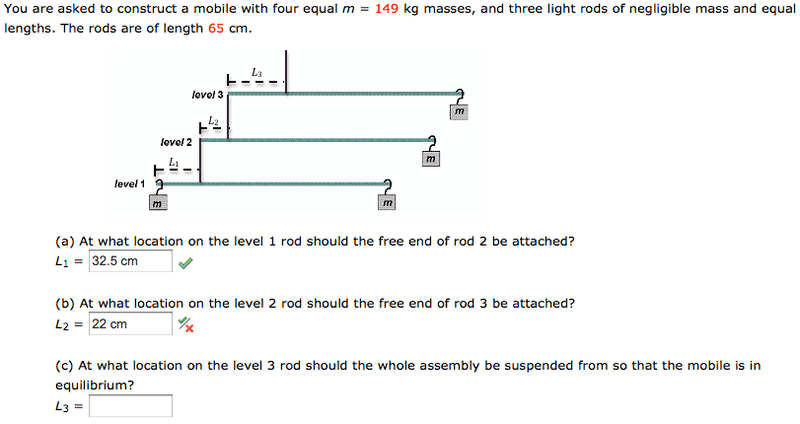
Number2Physics.png


(a) L1 = (65 cm)/2 = 32.5 cm

"CORRECT"

(b) [(149 kg)(1) + (149 kg)(65 cm) + (149 kg)(65 cm + 32.5 cm)] / (3)(149 kg)
= (149 + 9685 + 14527.5) / (447)
= 54.5

Then,

54.5 - 32.5 = 22 cm

"INCORRECT"

-.- Help?

(c) ?

L3 _________
 
Physics news on Phys.org


What's the force the string from 1 exerts on 2, and where is that force applied?


superdave said:
What's the force the string from 1 exerts on 2, and where is that force applied?

(149)(65)? in the vertical direction.


riseofphoenix said:
(149)(65)? in the vertical direction.

Well, that's torque. I just want to know if you held the string with rod 1 and its masses attached, instead of attaching it to the rod, how much force would be pulling down on your hand (ignoring the weight of your own hand)?


superdave said:
well, that's torque. I just want to know if you held the string with rod 1 and its masses attached, instead of attaching it to the rod, how much force would be pulling down on your hand (ignoring the weight of your own hand)?

149(9.81)?


riseofphoenix said:
149(9.81)?

aren't there 2 masses on rod 1?


superdave said:
aren't there 2 masses on rod 1?

Oh...
(149+149)(9.81)


riseofphoenix said:
Oh...
(149+149)(9.81)

Okay, now we can ignore 9.81 because it will be in every term.

But my point is, you can model rod 2 as having 1m (149 kg) at one end and 2m (298 kg) at the other.

So find the center of mass of that system for Rod 2.
Rod 3 can be modeled in a similar way, but you now have 3m on one end.


superdave said:
Okay, now we can ignore 9.81 because it will be in every term.

But my point is, you can model rod 2 as having 1m (149 kg) at one end and 2m (298 kg) at the other.

So find the center of mass of that system for Rod 2.
Rod 3 can be modeled in a similar way, but you now have 3m on one end.

[(149 kg)(1 m) + (298 kg)(2 m) + (447 kg)(3 m)] / (3 m)(447 kg)

Like that?
 
  • #10


Eep, no. m as in m=mass=149 kg.

Rod 3 has 3*149 kg at one end, and 149 kg at the other. Because all of rod 2 and rod 1's mass (a total of 3*149 kg) is supported by one string at the end of rod 3.
 
  • #11


superdave said:
Eep, no. m as in m=mass=149 kg.

Rod 3 has 3*149 kg at one end, and 149 kg at the other. Because all of rod 2 and rod 1's mass (a total of 3*149 kg) is supported by one string at the end of rod 3.

Ok so the equation should be...

[(149 kg)(1) + (149 kg)(65 cm)(2) + (149 kg)(65 cm + 32.5 cm)(3)] / (3)(149 kg)??

Like that?
 
  • #12


No, it should be the mass*distance at the one end + mass times distance at the other end, divided by total mass.

Or [149 kg * (3) + 149 kg *(1) * 65 cm] / 4 * 149kg

the diagram shows that L3 is the distance from the end of that rod to the balance point, so you don't need to add anything.

If you do the algebra, you should find that because the masses are equal, if you have 3 on one side and 1 on the other, the balance point is just 1/4 L. for rod two, it's 1/3 L. So you kind of stumbled into the answer the wrong way.
 
  • #13


[149 kg * (3) + 149 kg *(1) * 65 cm] / 4 * 149kg


^

That still doesn't give me the right answer though :(
I just submitted 17 cm and it still marked it as incorrect!

I did:

447.0000 + 9685.0000 / 596.0000

10132.0000 / 596.0000

17.0000

?
 
  • #14


You are right, my bad. The first term is at 0 cm. So

[149 kg * (3) * 0 cm + 149 kg *(1) * 65 cm] / 4 * 149kg
 
  • #15


superdave said:
You are right, my bad. The first term is at 0 cm. So

[149 kg * (3) * 0 cm + 149 kg *(1) * 65 cm] / 4 * 149kg

I did

0 + 9685.0000 / 596.0000

= 16.2500

I put 16.25 cm in the answer box and I still got it wrong :(
I've already used 3 submissions...anything beyond 4 with be .33 points off :(
 
  • #16


this is part c, right?

If 16.25 cm isn't the answer to part c, then I have no idea what's going on.
 
  • #17


This is part c yeah...
 
  • #18


wait no this is part b!
 
  • #19


ohh you were doing part c?
 
  • #20


oh 16.25 for part c is CORRECT nvm...

I was asking for part b
 
  • #21


Oooh. Put that answer in part C to make sure my reasoning is correct. If it is, then part b should be:

(0cm * 2 * 149 kg + 65 cm * 149 kg * 1) / 3 * 149 kg.
 
  • #22


superdave said:
this is part c, right?

If 16.25 cm isn't the answer to part c, then I have no idea what's going on.

16.25 cm IS the answer to part c, sorry...
I thought we were doing part b because that's what I was having trouble on.
 
  • #23


superdave said:
You are right, my bad. The first term is at 0 cm. So

[149 kg * (3) * 0 cm + 149 kg *(1) * 65 cm] / 4 * 149kg

Ok, so part b should be 21.67 right?
 
  • #24


riseofphoenix said:
Ok, so part b should be 21.67 right?

It should be.
 
  • #25


superdave said:
It should be.

Awesome! They're all right.
Thanks a bunch!
 
  • #26


To be sure understand it:

The locations of the masses on the rod below don't matter. All the total mass in all of the rods below (really all the weight) is in the string at the end of the current rod.

For rod b, you have 149*2 kg at x=0 cm. And 149 kg at x=65 cm. Divide by total mass (149 kg * 3).

For rod c, you have 149 kg * 3 at x=0 cm. And 149 kg* 1 at x = 65 cm. Divide by total mass (149 kg * 4).
 

Similar threads

  • · Replies 1 ·
Replies
1
Views
4K
  • · Replies 6 ·
Replies
6
Views
2K
  • · Replies 7 ·
Replies
7
Views
2K
Replies
7
Views
2K
  • · Replies 2 ·
Replies
2
Views
2K
  • · Replies 1 ·
Replies
1
Views
6K
  • · Replies 1 ·
Replies
1
Views
3K
  • · Replies 10 ·
Replies
10
Views
3K
  • · Replies 7 ·
Replies
7
Views
2K
  • · Replies 3 ·
Replies
3
Views
10K